Meet the Committee – Isla Gladstone

What is your role on the NatSCA Committee?

I help promote information sharing and collaboration between NatSCA and closely allied subject specialist network the Geological Curators’ Group. These groups share core aims and, increasingly with loss of specialist curatorial posts, a membership. It’s exciting to explore how we can capitalise their individual strengths for the benefit of natural sciences collections and the people who work with them. 

Job title and institution

Senior Curator (Natural Sciences), Bristol Museum & Art Gallery, Bristol Culture

Twitter username

@isla_gladstone

Tell us about your day job

I work with a small team (Biology Curator Rhian Rowson and Geology Curator Deborah Hutchinson) to curate over one million natural sciences specimens of all shapes and sizes. As many a curator will recognise, this varies from high level strategic work to lifting, shifting, labelling and cleaning – a medley of activities to enable diverse access to and preserve these astonishing collections.
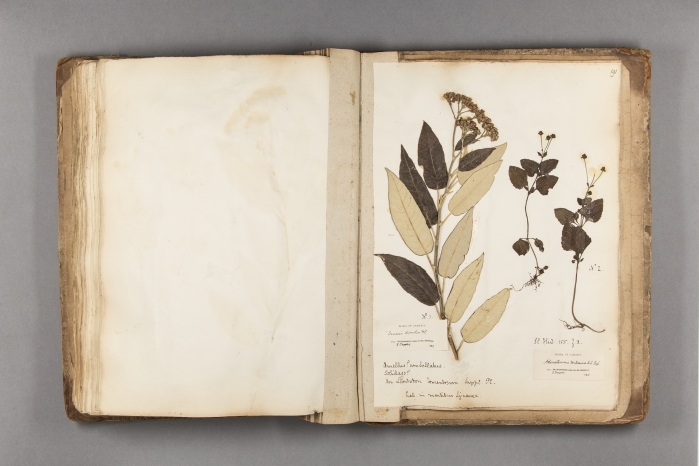
Medicinal plant on a page from Bristol’s earliest natural sciences collection – the Broughton herbarium, Bristol & Jamaica, 1779-90. (C) Bristol Culture.

Continue reading

NatSCA Digital Digest – January

Happy New Year, and welcome to the first Digital Digest of 2018. We have lots of news, conferences, and jobs to keep you entertained for the rest of the ‘working week’. Read on…

What Should I Read?

Palaeontologists have made public the discovery of a new giant bat found in New Zealand, and the media has gone mad for it. Its scientific name (Vulcanops jennyworthyae) was chosen to commemorate the Roman god of fire (specifically including that of volcanoes, making him rather relevant to New Zealand), as well as the hotel in the village in which it was found (also named after Vulcan – that is the Roman god, not Spock’s home planet), and the scientist who found the first fossils; Jenny Worthy.

If you’d like to know all about the Chair of the Geological Curators’ Group, Matthew Parkes, then a perusal of the new blog Six questions for a geological curator would be a good place to start.

The third blog article I’d like to recommend actually came out mid December but it has a lot of interesting points that are important for those working with natural history collections to consider, and so is worth another mention; Four ways natural history museums skew reality.

Continue reading

The Stag and Jackdaw are Clearly Talking to Each Other

I see urban red foxes quite regularly in London

Although I have lived in England all of my life, I have travelled a great deal and been exceptionally lucky to see some absolutely incredible wildlife, right across the world. With the memories of these exotic beauties in my mind, I think it’s probably natural to feel that Britain is left wanting when it comes to enigmatic fauna.

But then again, every so often I come across something that re-minds and re-amazes me just how much diversity we actually have, and how harsh my aforementioned critical analysis probably is. To win the most prestigious accolades for wildlife photography (on my bucket list), I may need a camera slightly better than the frankly awful smartphone I possess (currently sporting a smashed screen, which can’t help), but I don’t necessarily need to leave this little island. The current British Wildlife Photographer Awards prove I wouldn’t even need to leave my garden (if I didn’t live in London and could afford a property that had one). Squirrels are one of my favourite animals in Britain and luckily for me I get to see big fat fluffy grey ones nearly every day (yes yes, they’re not endemic… Doesn’t mean they’re not cute). Check out these epic photography skills, taken THROUGH a window no less:

Probably not going to win an award with this one.

Continue reading

The Legacy of Entomologist Harold Edward Hammond

A Fellow of the Royal Entomological Society, Harold Edward Hammond, (1902 – 1963), was a keen Lepidopterist. Coupled with this affinity for butterflies and moths he was also interested in entomology generally and would take up a new order every couple of seasons, afterwards giving the carefully mounted specimens to some young aspiring student of the subject. Before his health failed a few years before his death, it was not unusual to find Hammond out in the snow on Boxing Day, splitting logs with an axe to find beetle larvae. Generous, almost to a fault, he was content with gaining new knowledge and found reward in encouraging a new generation of enthusiasts.

Hammond’s main focus was on the larvae of Lepidoptera and, as can be seen by the associated article, he became an expert in their preservation. Raising many larvae into a suitable size for mounting could be somewhat problematic, so his Birmingham garden became a cross between a sanctuary and a fattening pen for many caterpillars. This miniature farm was orderly and well maintained, where trees were pruned to the size of bushes for easy access and micro habitats were constructed to help manage conditions for more demanding food plants.

The skills that Hammond developed in preserving caterpillars were much in demand by fellow entomologists, and he would sometimes receive dozens of boxes of live larvae a week, all dutifully delivered by a postman oblivious to their wriggling contents. His fee for this service was a request that he could have a larva or two for his own collection. During his preparations he encountered many parasitic hymenopteran and dipteran larvae, so he became quite the expert on those also, co-authoring several papers in the Entomologist’s Gazette.

Continue reading

How a Hundred and Fifty-Year-Old Botany Collection Can Help Modern Science

This article has been re-posted from the Horniman Museum and Gardens blog.

Katie Ott, a museum studies student on placement with the Horniman, tells us about her fascinating work with our botany collection.

I’m Katie, and I’m three weeks into an eight-week work placement at the Horniman, helping the Natural History team to research and document the botany collection.

The botany collection at the Horniman is made up of around 3000 individual specimens either mounted onto herbarium sheets or bound in volumes. The flowering plant collection dates mainly from 1830-1850.

Two herbarium sheets from Flora Britannica no. 4., Katie Ott

Two herbarium sheets from Flora Britannica no. 4., Katie Ott

The main task is to transcribe the (beautiful, but squiggly) Victorian handwriting on the herbarium sheets such as the plant’s scientific name, and where it was found etc onto MimsyXG, our collections management database.

Continue reading