Scott Wilson’s Iʻiwi: Colouring the Past

Written by Dan Gordon, Keeper of Biology, The Great North Museum: Hancock.

Sometimes you come across something in the stores that catches your eye. Something a little puzzling, maybe something hiding in plain sight, or in a drawer you’d never had cause to open before. For me, the specimen in question was a bright red bird. Clearly historic by its beady glass eyes, but seemingly lacking any other provenance, and identity unknown. The appearance was striking, with bright scarlet feathers and a long, curved bill like a scimitar. This made identifying it the easiest step – an I’iwi (ee-EE-wi) one of the Hawaiian Honeycreepers, and a little surprising, given its rarity. It sat alone, without context, among a flock of other small birds, drawing your eye as a patch of scarlet amongst the browns and greys. A mystery, then.
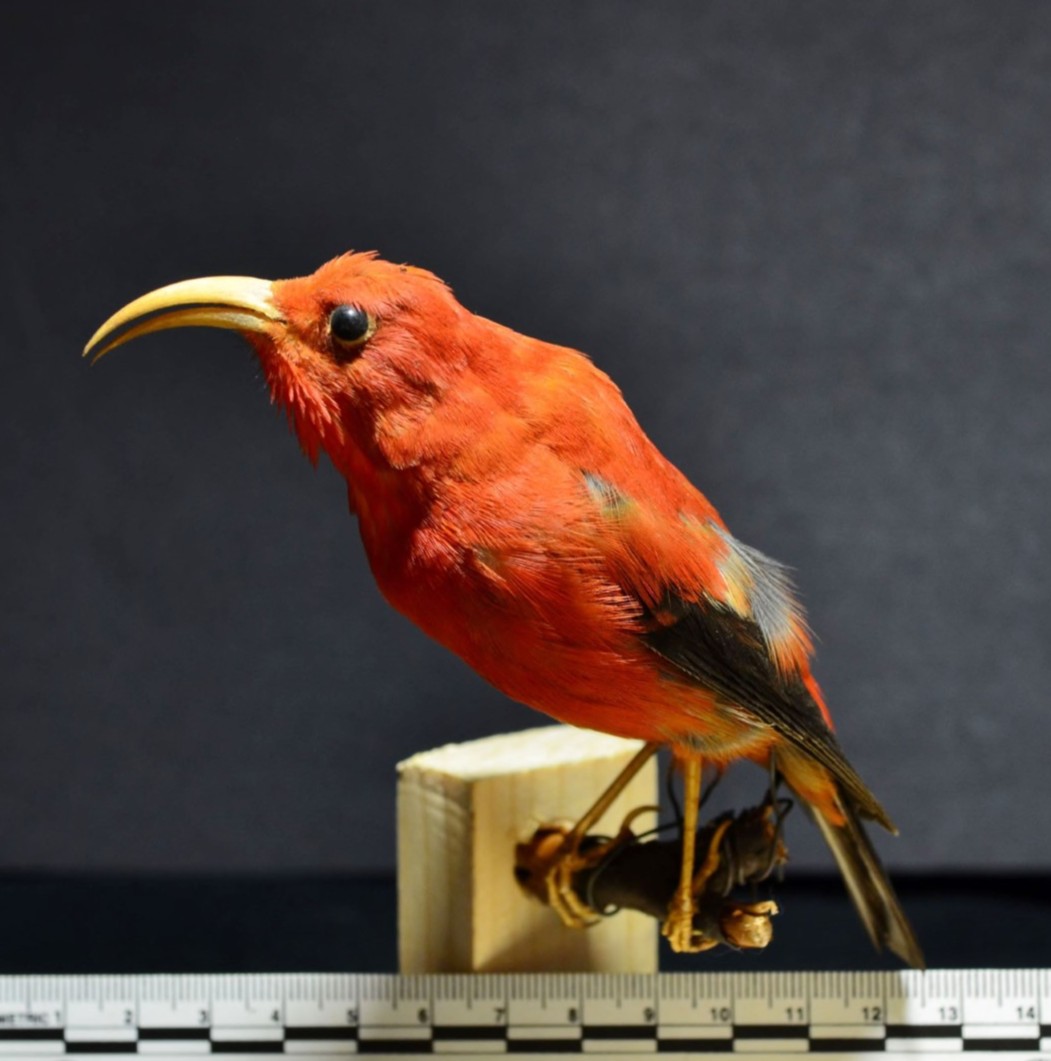
NEWHM : 2016.H5 – I’iwi (Drepanis coccinea) collected by Scott B. Wilson 1888. All images credited to The Natural History Society of Northumbria.

A bit of digging in the archives began to shed some light. Two of a Honey-Eater from Keauhou, Kona – Presented per J. Hancock by Scott Wilson Esq. looked like a likely candidate. One of a pair, collected from the Big Island, Hawaii, reached us here in 1889. The Natural History Society of Northumbria were keen collectors of specimens from all over the world at that time, but this one seemed unusual. Who was Scott Wilson, and why might he have sent them here?

Continue reading

A Hundred Feet Through the Door – A Chance Encounter with some Centipedes set me on a Curatorial Path…

Written by Dan Gordon, Keeper of Biology, The Great North Museum: Hancock.

So, how did I get started in museums? Like perhaps many people, it began with a stroke of luck.

I’d decided to study Biology at university—I suppose I’d vaguely pictured myself at some point in the future, white-coated in the lab, pouring over spectrophotometer readings or agar plates. But by the end of the first year, I found myself staring out of the window during practicals. Nineteen-year-old me was slowly becoming disillusioned: Botany was biochemistry; Zoology was elegant mathematics; even Ecology was really an intricate forest of statistics, not trees. There was beauty in the numbers, but it was all a long way from my childhood passion for birdwatching, rock pooling and reading travel books. One day, peering at smudges on a petri dish and trying to work out if I’d just induced gene expression, I realised I might not be cut out for that imagined future. I was fascinated by the soul of the subject, but the finer points of its language were losing their magic.

Continue reading

Rediscovering the Hancock Coelacanth

Written by Dan Gordon, Keeper of Biology, The Great North Museum: Hancock.

For as long as I’d worked at the museum, there’d always been a Coelacanth. People referred to it in passing, pointing out the large tub of orange tinted spirit where it lurked. I’d always rather taken it for granted; an interesting but rather mundane specimen, and I’d never been curious enough to fish it out of the murky liquid and examine it.

That is, until 2018, when staff at the National Maritime Museum Cornwall got in touch about an exhibition they were putting together called Monsters of the Deep. They’d asked us about Coelacanth fossils and I mentioned the Coelacanth in the fish collection, which was greeted with some surprise. A real one…Would we consider a loan? And as I thought about this, I came to realise that I knew very little about the Coelacanth at all.

There was next to nothing in the catalogue about it, so I decided, firstly, to get a better look. This was easier said than done. The Coelacanth is over a metre long and weighed over 20kg, sitting in a container of tea coloured alcohol bigger than a bathtub. Reaching in, I ran my gloved fingers over its flanks, which had the texture of coarse sandpaper. Lifting it out was like wrestling an alligator, but eventually it emerged, a gaping mouth with small sharp teeth, a ragged tear through the flesh of its head, and the huge eyes of a deep-water dweller.

Continue reading

Ostracod Odessey – Broadcasting the Brady Collection

Written by Dan Gordon, Keeper of Biology, The Great North Museum: Hancock.

The Great North Museum : Hancock is home to many remarkable collections, but one of the most important is perhaps one of the most unfamiliar to our visitors. The Brady collection of Ostracods.

Ostracods, sometimes called Seed Shrimp, are distinctive Class of crustaceans. A shell of two intricately textured valves almost entirely envelopes their shrimp-like bodies, with just a small opening for a cluster of rapidly moving legs to poke out. As their common name suggests, most species are very small, mostly invisible to human eye, but they’re ubiquitous, busily going about their lives wherever there is permanent or temporary water, from the poles to the tropics. Some swarm the world’s oceans in vast planktonic shoals, while others live in the still, dark pools of caves, in garden ponds or even puddles.

They’re poorly known outside of academic communities, which is a real shame, because despite being fascinating creatures in their own right, they have important roles in many aquatic ecosystems, and significantly, they’re commonly encountered in the fossil record, which means that they are particularly important indicator fossils. In addition, the chemical make-up of their distinctive shells tells us about ocean acidity and temperature, which can tell us about ocean warming and climate change.

The collection was the work of George Stewardson Brady, a local man, born in Gateshead in 1832, and one of the people who pioneered the study of these animals at a time when they were relatively poorly understood.  Housed in a row of cabinets, the Brady collection is made up of nearly 3000 microscope slides with up to 100 Ostracods on each. These specimens were collected all over the world, many of them by well-known expeditions such as the HMS Challenger expeditions in the 1870s. It contains many Types, and provides a valuable resource for the study of these animals today.

Continue reading

Behind The Heads: Natural History, Empire and The Abel Chapman Collection. Part 2.

Written by Dan Gordon, Keeper of Biology, The Great North Museum: Hancock.

Abel Chapman’s time in southern Africa was only the first of many visits to the continent. His next trip, in 1904, was to a very different place – British East Africa. This was a colonial protectorate roughly equivalent to today’s Republic of Kenya. It had grown out of land leased by the British East Africa Company but was now firmly under British imperial control.

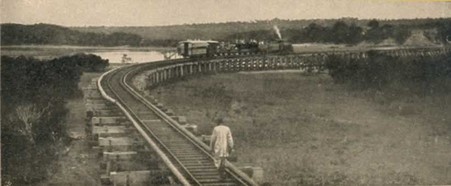
The Uganda railway, a huge feat of engineering, had been completed just three years before Chapman’s visit. This now allowed trains to travel the 800km (500 miles) between Mombasa on the east coast and the African Great Lakes. The British now had the means to extend their influence right across East Africa, disrupting the slave routes and simultaneously opening up the land to the missionaries, settlers, tourists and game hunters that were now pouring in. It was in this rapidly changing environment that Chapman strove to find the longed for wilderness that had eluded him in Transvaal, and test his skills as a sportsman, before that land too vanished under the settler’s plough.

Figure 1. An undated photo of the Uganda Railway near Mombasa (http:/www.jaduland.de, Public domain via Wikimedia Commons)
Continue reading