Written by Hannah Jenkins, Assistant Curator, Natural Sciences, Amgueddfa Cymru – Museum Wales.
The botany collection at National Museum Cardiff, Amgueddfa Cymru – Museum Wales, contains approximately 726,000 botanical specimens from across the world, including around 310,000 bryophytes (mosses, liverworts and hornworts).
Most of our moss specimens (approximately 225,000) are stored in conservation grade packets, however unlike some herbaria, these packets are not mounted on to herbarium sheets but instead are filed directly into drawers within our herbarium.
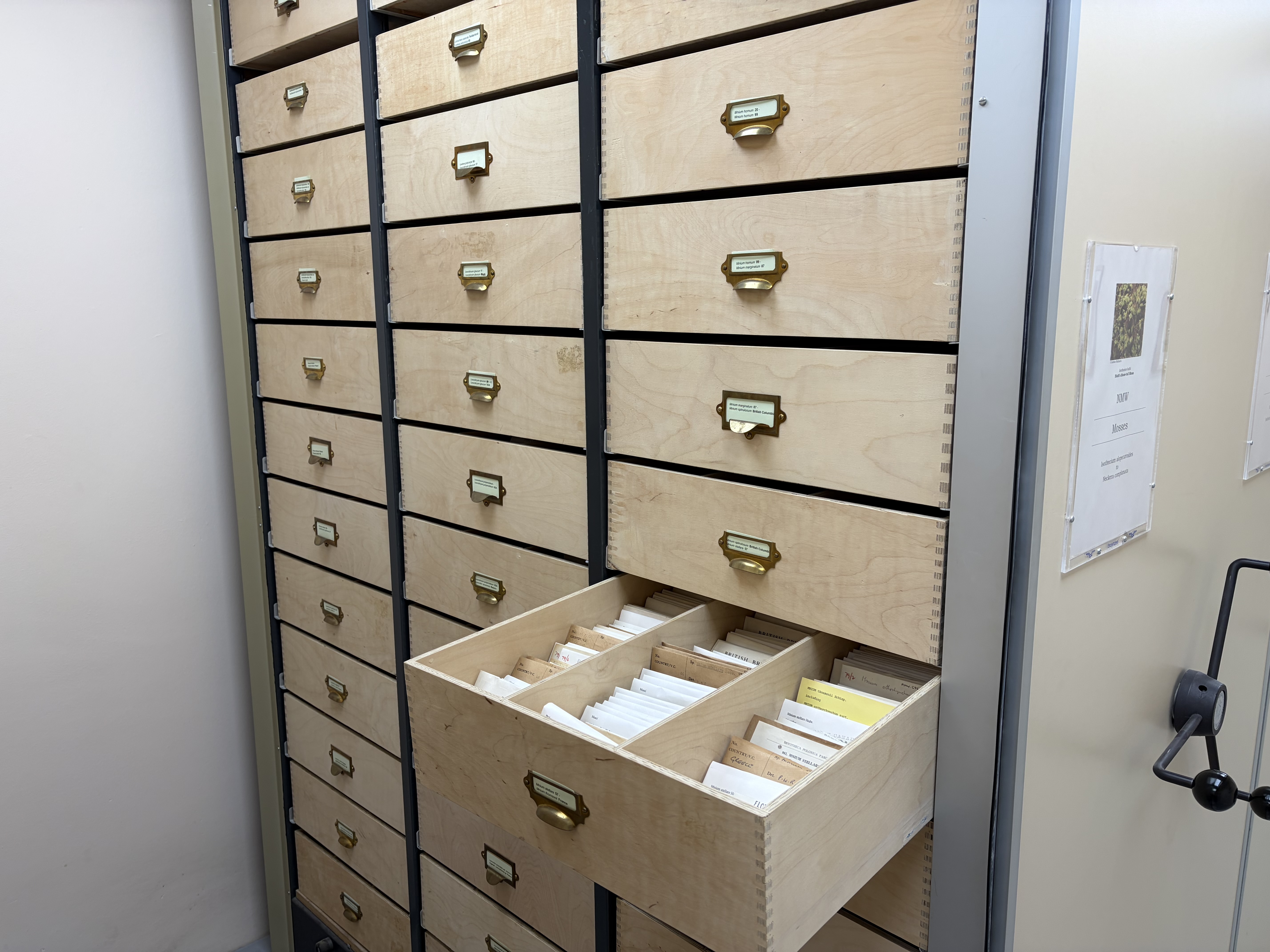
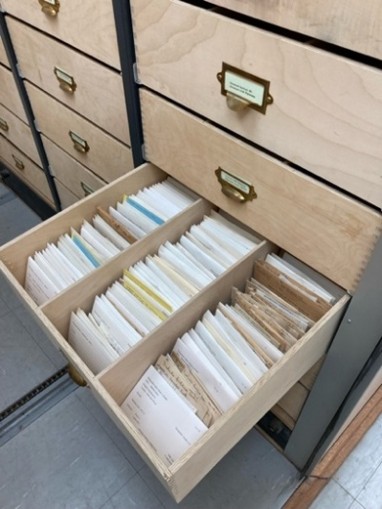
Large divided wooden drawers housing individual specimen packets © Amgueddfa Cymru
However, tucked away, we also have a small number of outsized bryophyte specimens, the majority of which are mosses, mounted directly on herbarium sheets. This is in a similar vein to some of the historical exsiccatae they are stored with but is a technique more commonly associated with vascular plant herbaria.
Outsized Moss Specimens?
You may think of moss as being small but … not according to these specimens!
Some of the larger outsized specimens include Common Haircap Moss, Polytrichum commune, described by the British and Irish Bryological Society as “one of our [Britain and Ireland’s] largest mosses, with individual stems reaching up to 40 cms long”.
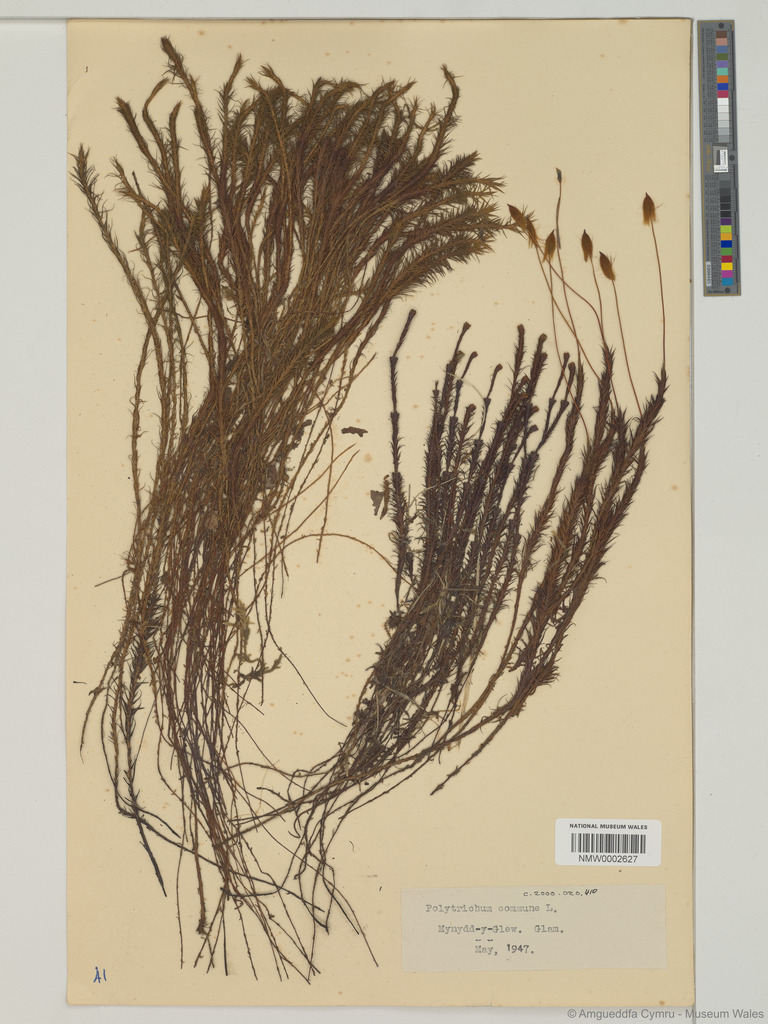
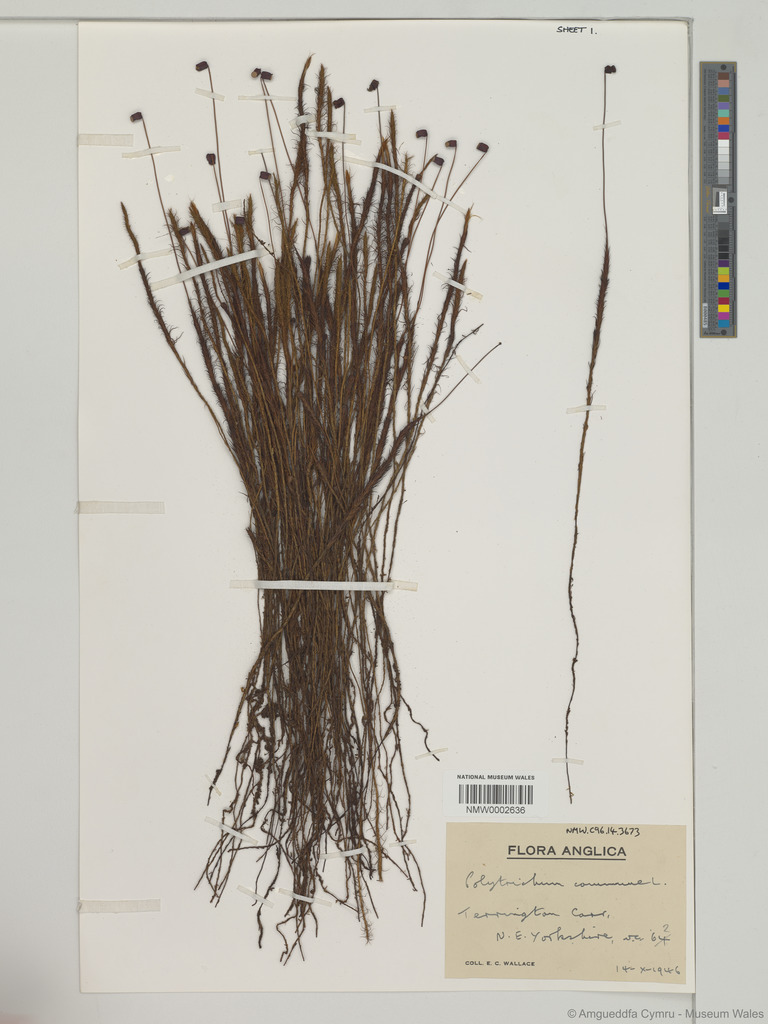
Polytrichum commune (Common Haircap Moss) specimens. A standard herbarium sheet is approximately 42cm high © Amgueddfa Cymru
Our outsized bryophytes arrived at the museum at varying times, from different collections and so illustrate a number of methods historically used to mount botanical specimens, including sewing with thread and strapping.
Although these techniques are still practiced as standard today, some of the historical materials used had begun to deteriorate and I was set the task of re-mounting any specimens that had become loose, replacing strapping that had deteriorated and also removing any non-archival materials.
Some Repair Required
Many of the outsized specimens were in good condition and didn’t need repair. For those that needed a bit more work, once original strapping materials had been carefully removed, specimens were laid out on new herbarium sheets and, trying to follow the original placement as much as possible, remounted using adhesive cotton tape strapping. All original collection labels were also transferred to the new sheet.
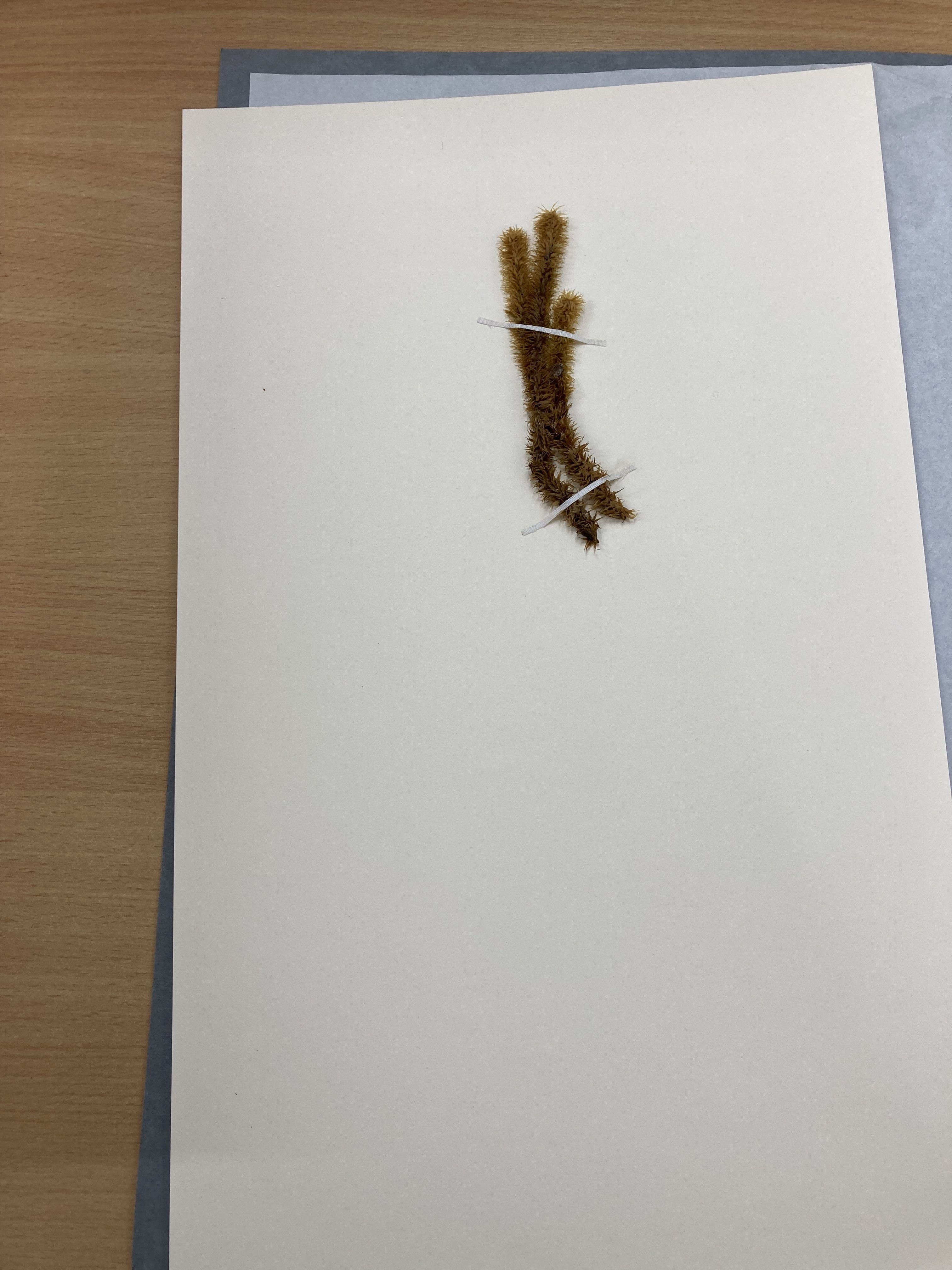
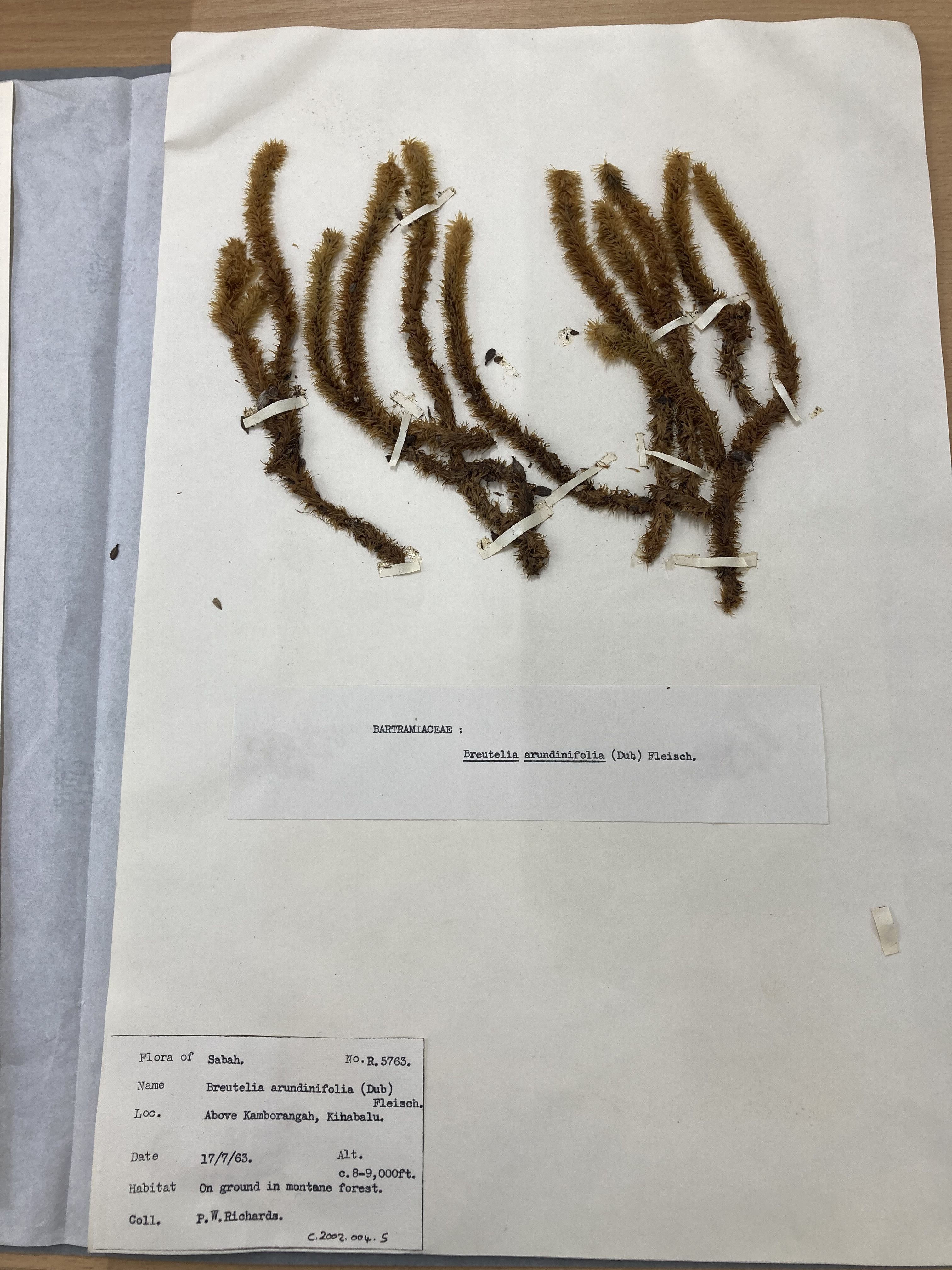
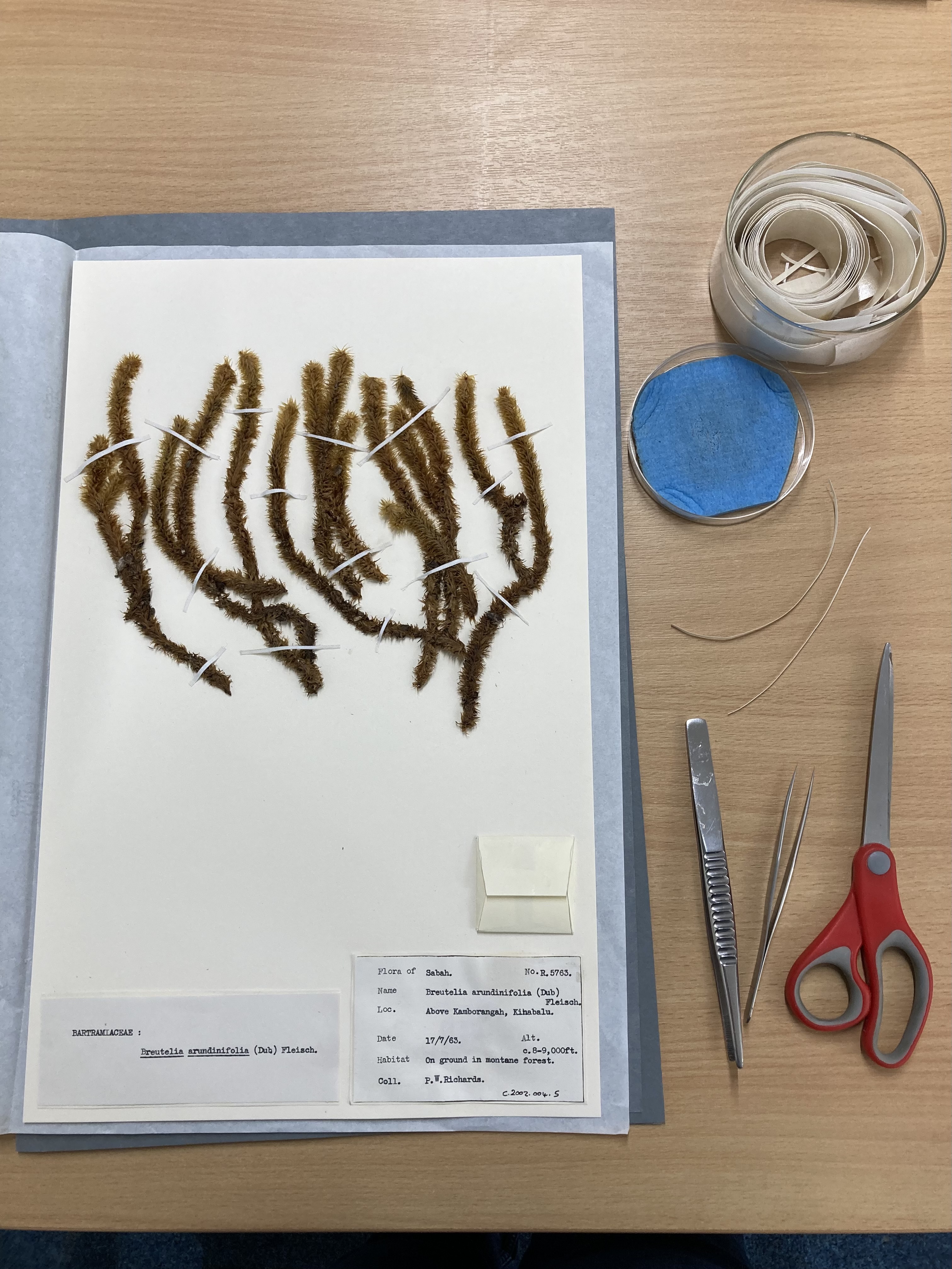
Re-mounting of a Breutelia arundinifolia moss specimen. The small paper capsule (above specimen label, bottom right) contains loose material found with the specimen on the original sheet © Amgueddfa Cymru
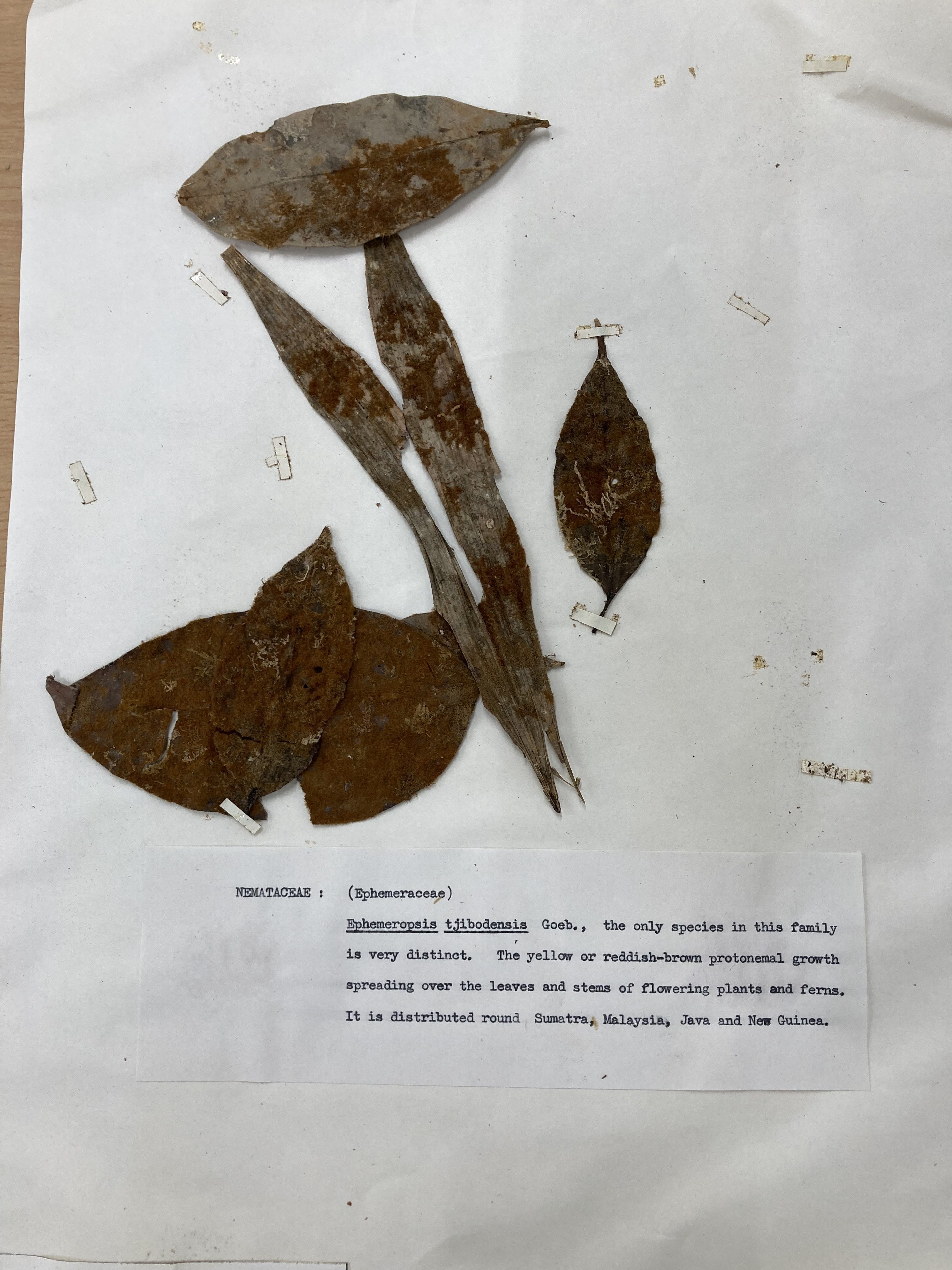
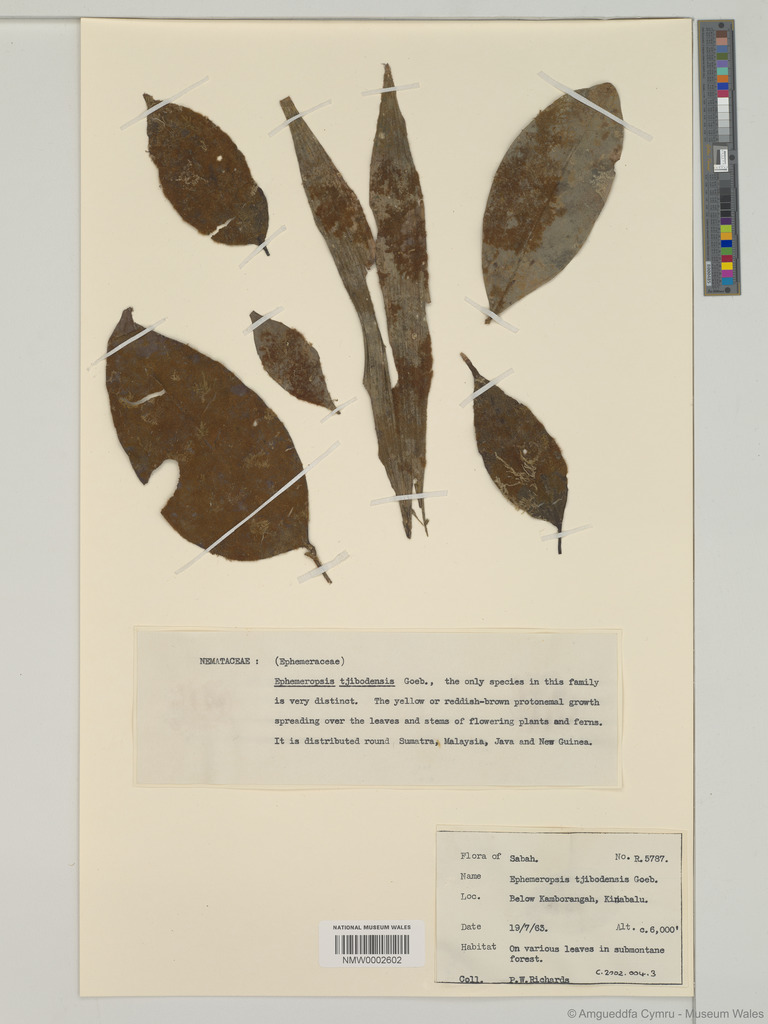
Before and after photos of epiphyllous moss Ephemeropsis tjibodensis, still attached to the leaves on which it was growing. ©Amgueddfa Cymru
A number of the specimens had been wrapped in a cellophane-type material, attached at the back with sticky tape! These wraps had tightly moulded around the sheets and proved quite awkward to remove while keeping the specimen as flat as possible. Removal of this cellophane enables researchers to access the specimen more easily and better images of the specimen to be taken, as illustrated below.
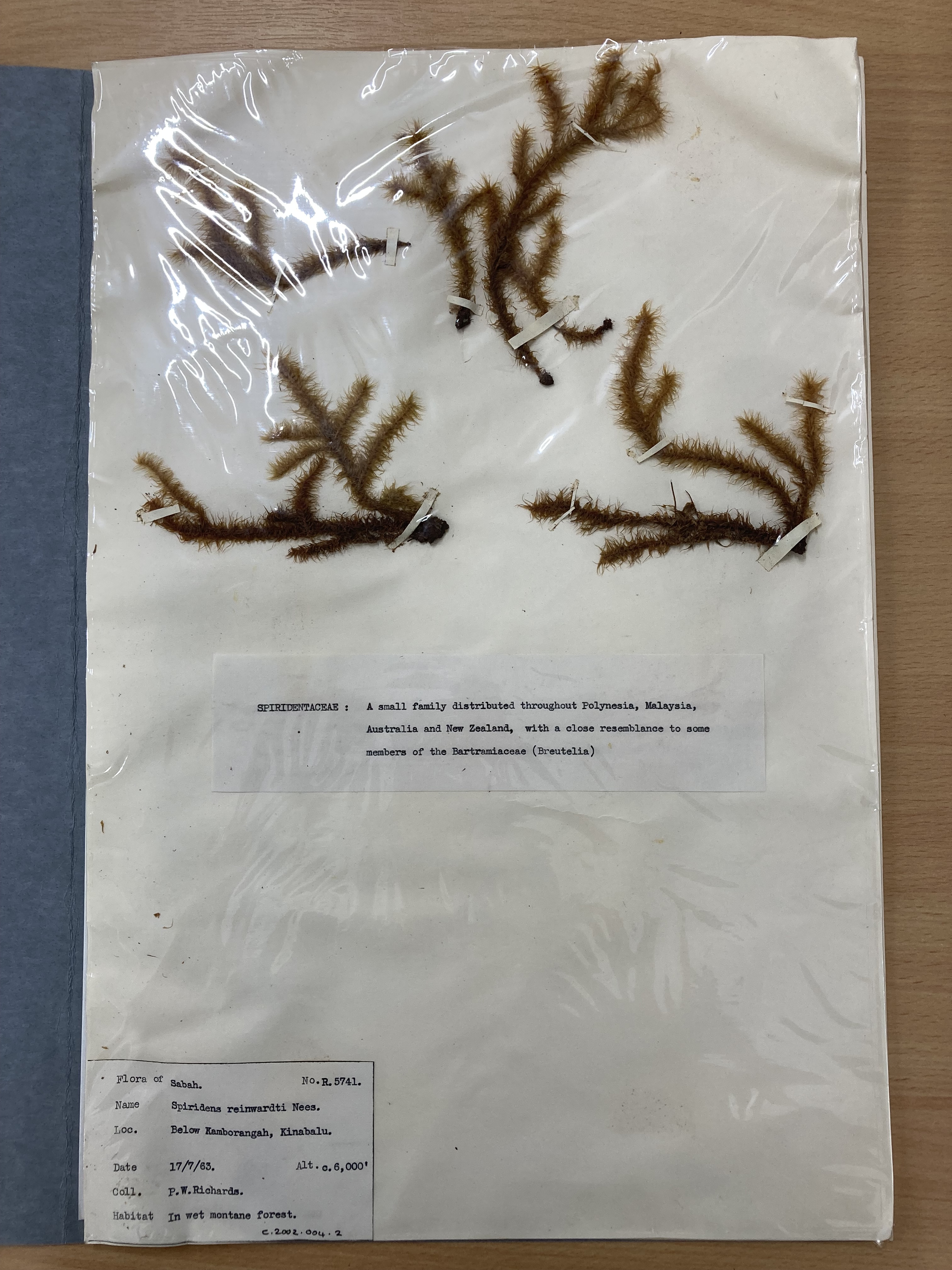
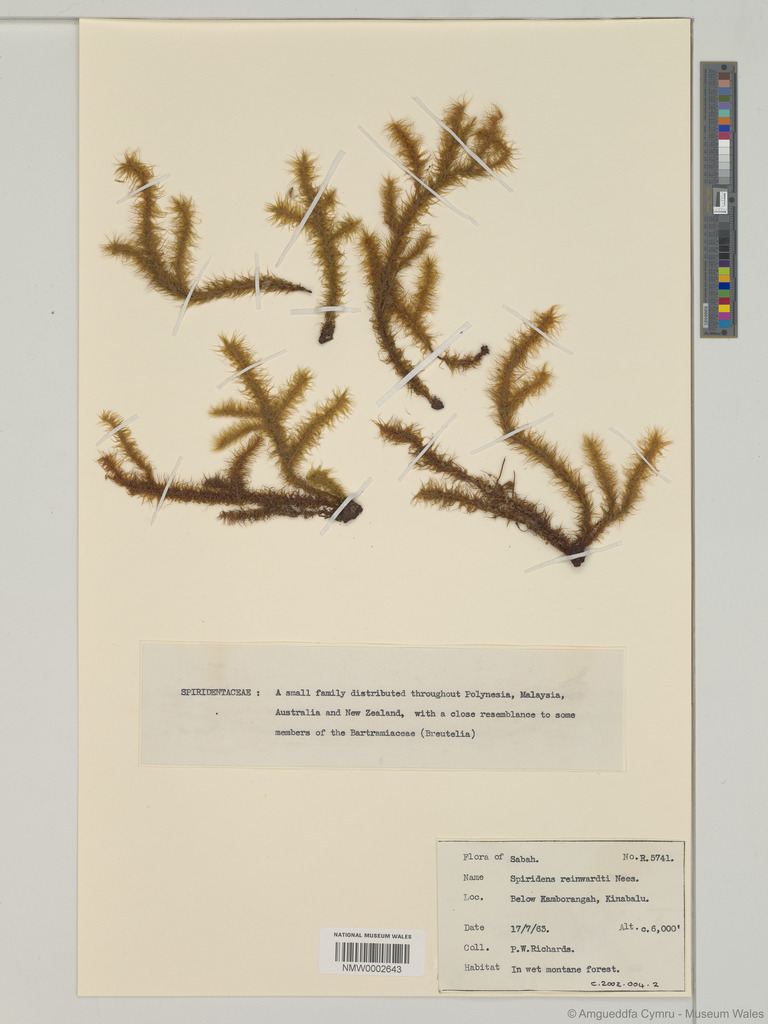
The placement of this moss, Spiridens reinwardtii, was adjusted slightly to avoid the top of the herbarium sheet where it could be more prone to damage © Amgueddfa Cymru
Richards’ Bryophytes
Many of our outsized bryophyte specimens were collected by Professor Paul W Richards (1908-1995), a prominent botanist and ecologist well known for both his work on the ecology of tropical rainforests and the study of bryophytes.
Richards had a long association with the museum, donating his first specimens in 1920 at the age of 12 and he continued to donate around 11,000 specimens throughout his life. Amgueddfa Cymru also holds a large amount of archive material relating to Professor Richards’ work.
An unnamed epiphyllous liverwort in the outsized collection (in good condition and needing no repair), was collected by Professor Richards in Grenada, August 1929, almost certainly during a stop on the voyage to the Oxford Exploration Club’s expedition to Guyana.
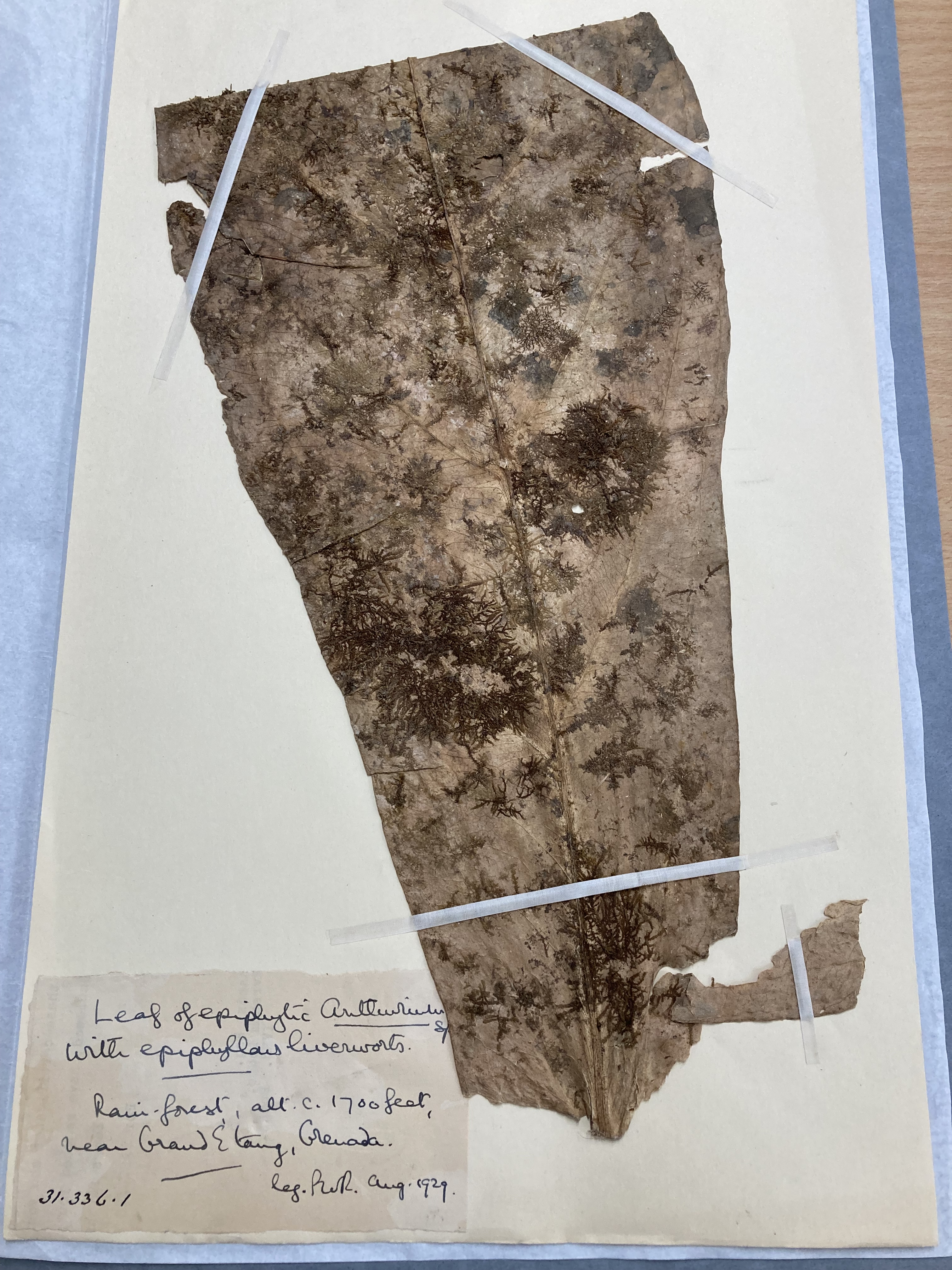
An epiphytic leaf (one that grows on the surface of another plant) and an epiphyllous liverwort (one that grows on the surface of a living leaf) collected by P.W. Richards, Grenada, August 1929. © Amgueddfa Cymru
Richards was still an undergraduate at the time of the expedition and at the British Bryological Society’s Paper Reading Meeting of 1990, talked about his “first steps in tropical bryology” being as he “set foot on Barbados, 1 August 1929, on my way to British Guiana (now Guyana) as a member of the Oxford Exploration Club’s expedition”. He described seeing some epiphyllous liverworts but that “it was not as good a place for bryophytes as Grenada where the ship called the next day”.
Camera Ready
Once the conservation work had been carried out, all outsized specimens were digitised using a specialised imaging set up developed for herbarium sheets. During this process a unique barcode is added to each specimen, the sheet is then placed into a lightbox imaging station with a colour chart and scale bar, and a high-resolution image is taken with a digital camera mounted at the top of the lightbox.
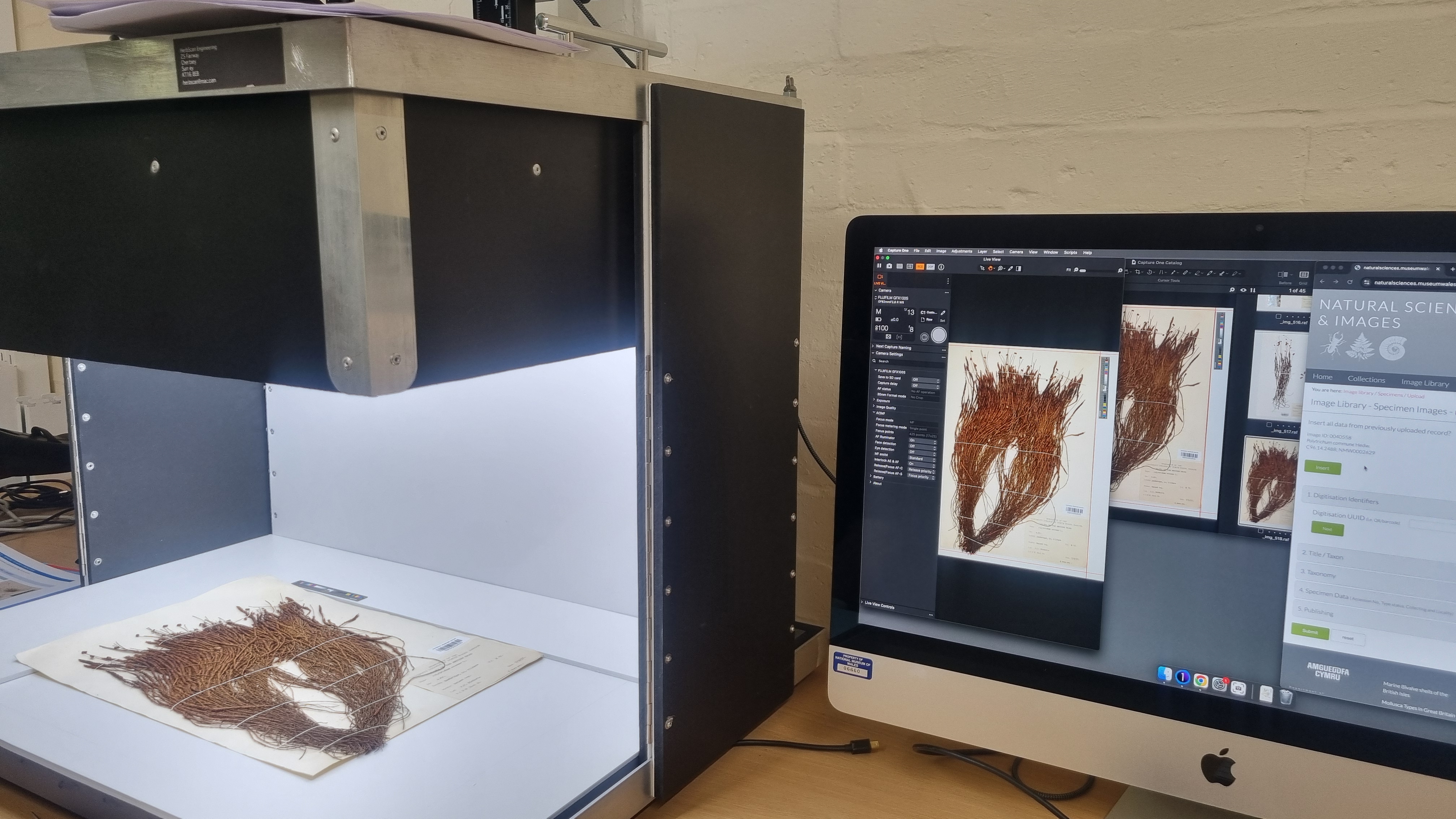
An outsized moss being imaged using a specialised set up for herbarium sheets at National Museum Cardiff @ Amgueddfa Cymru
The specimen images and associated collection data will become available to researchers across the world.
Closing Thoughts
Working on this project provided a lovely opportunity to get to know a different part of our collection and some of the collectors represented within it.
References
British Bryological Society Bulletin (1991), The Paper Reading Meeting, 1990, Cambridge, Summary of P.W. Richards autobiographical talk, British Bryological Society Bulletin 57, March 1991 11-12
British and Irish Bryological Society website, Species Finder, Polytrichum commune. Web access 12 October 2026 Polytrichum commune – British and Irish Bryological Society
Davies, N.M.J., Drinkwell, C and Utteridge, T.M.A., (eds) (2023) The Herbarium Handbook, Royal Botanic Gardens, Kew.
Harrison, S.G., (1982) The Collections in the Welsh National Herbarium – National Museum of Wales, Nature In Wales Journal NS Vol 1 Part 2.
Richards, P.W., (1991) A bryologist in British Guiana and the West Indies, Journal of Bryology 16(3) 437 – 441.
Slade, K. (in press), The British and Irish Bryological Society Herbarium in 2026. Field Bryology 136.