NatSCA Digital Digest – April

Dear Digital Digest-digesters, it has been an extremely busy month but there are just enough hours in the month to put out the April edition. Continue reading for a round up of all the things you need to know…

What Should I Read?

After much to-ing and fro-ing and panicking from various factions, it has been announced that “accredited museums and galleries will be granted an exemption in legislation… that bans the trade of elephant ivory in almost all circumstances”. This is great news for museums. Read the full story on the Museums Association website here.

There has been a lot of coverage of the dinosaur tracks found in Scotland, but if you missed it all, here’s what the BBC had to report. Both sauropod and theropod tracks are present and they’ve gotten everyone all excited.

Wildlife Photographer of the Year is in the news for another year as another photographer falls foul of either not reading, or else ignoring, the rules. The anteater in one of the winning images has been investigated and concluded to be a taxidermy specimen. The image was therefore disqualified and the photographer told to er… get stuffed.

Continue reading

Paradise, Problems, Perpetrators, and Positives

Written by Dr Emma Nicholls, Deputy Keeper of Natural History at the Horniman Museums and Gardens, and NatSCA Committee Member

The Paradise

Far away in a tropical land, where few of us will ever visit, there lives a plethora of exotic and enigmatic animals that would be at home in a book on Victorian expeditions and grand discoveries. Scaly pangolins, pygmy elephants, and a species of small rhinoceros that is covered in brown fur represent a drop in the ocean of the immense biodiversity living in the beautiful natural habitats of Indonesia and Malaysia. I hope you are conjuring a heart-warming image in your mind of lush green rainforests; perhaps a huge orange cat with black stripes disappearing into the undergrowth as birds and monkeys join forces to belt out a warning chorus, letting everything nearby know of the tiger’s presence.

Now raze the trees, set fire to everything, destroy the animals, and in the ensuing barren wasteland grow acres and acres of plantations. All for an ingredient called palm oil.

The Problems

What is this magical substance that is worth wiping out entire species of plants and animals for? It’s an edible vegetable oil that is in everything from soap and toothpaste, to cookies and chocolate bars. Pick up a consumable in any supermarket and you’ll probably be holding palm oil. The substance is this omnipresent in the western world and yet 85% of the entire world’s supply of palm oil comes from plantations in Indonesia and Malaysia alone. That should give you an idea of how much of these two Southeast Asian countries has been, and continues to be, burnt to the ground in order to produce palm oil. That biodiversity we spoke of before is hanging on by its finger tips in smaller and smaller… and smaller… pockets of forest.
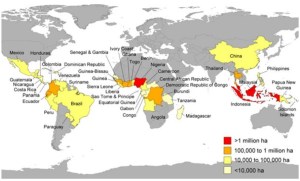
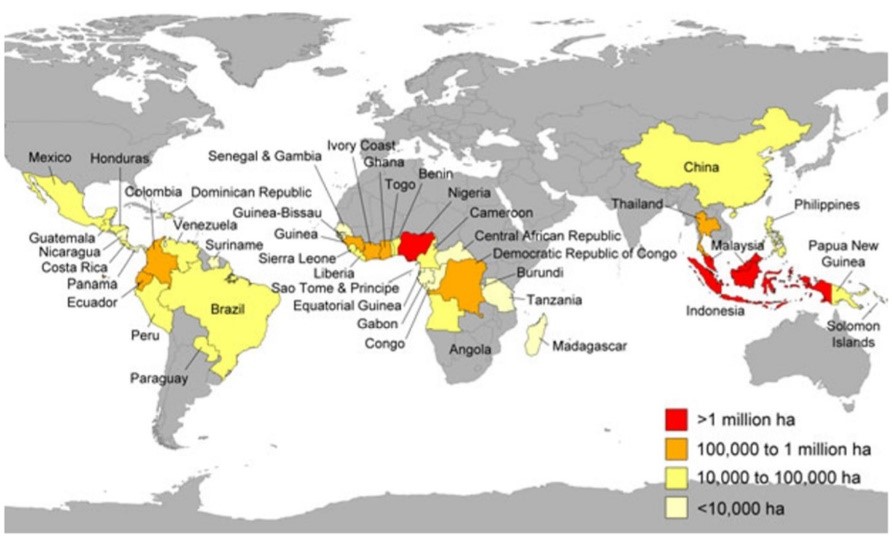
World map showing countries affected by large-scale clearance of natural habitat for producing palm oil as of 2006 (FAO 20076, via Koh and Wilcove, 20087).

Further to the suffering of the natural world, in many areas, indigenous peoples are forced to abandon their forest homes and their traditional ways of life, in order for the land to be purposefully destroyed. Indonesia has one of the highest deforestation rates in the world. What happens to these displaced people? Many of them are forced into working on the plantations as slaves. This includes child slavery. I am sure you have heard of Conflict Diamonds? Conflict Palm Oil is just as inhumane.

If you need further persuasion that palm oil is bad news, the carbon pollution produced by palm oil plantations is a MAJOR player in the line-up of human induced villains that are hurtling our climate out of control. Climate change is a normal, natural phenomenon. What isn’t normal is the speed at which it is occurring due to human activity. It is changing so fast that animals and plants can’t keep up, they can’t evolve or adapt fast enough. So they’re choosing option B and going extinct instead.
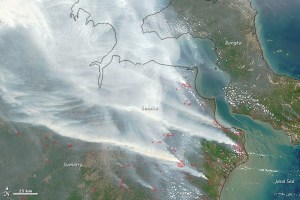
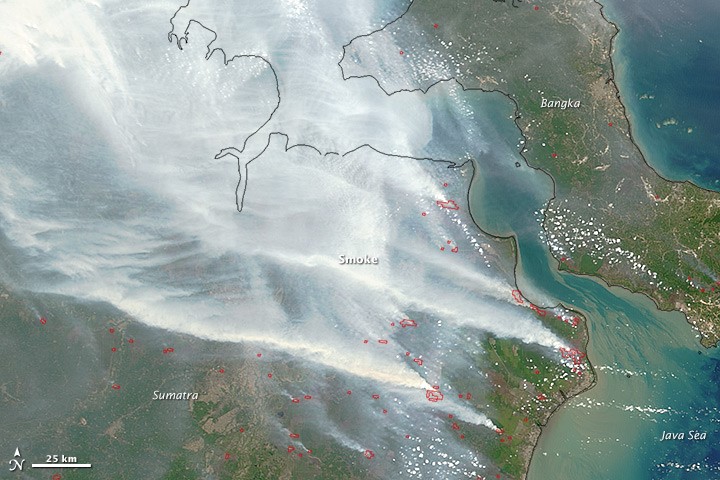
In 2015, smog produced as a direct result of fires used in palm oil production was so thick in Sumatra, Indonesia, that it caused air pollution levels to spike in neighbouring Malaysia and Singapore. (NASA, 2015).

Continue reading

When Museums Get it Wrong – Did We Accidentally Accession Someone’s Holiday Booze?

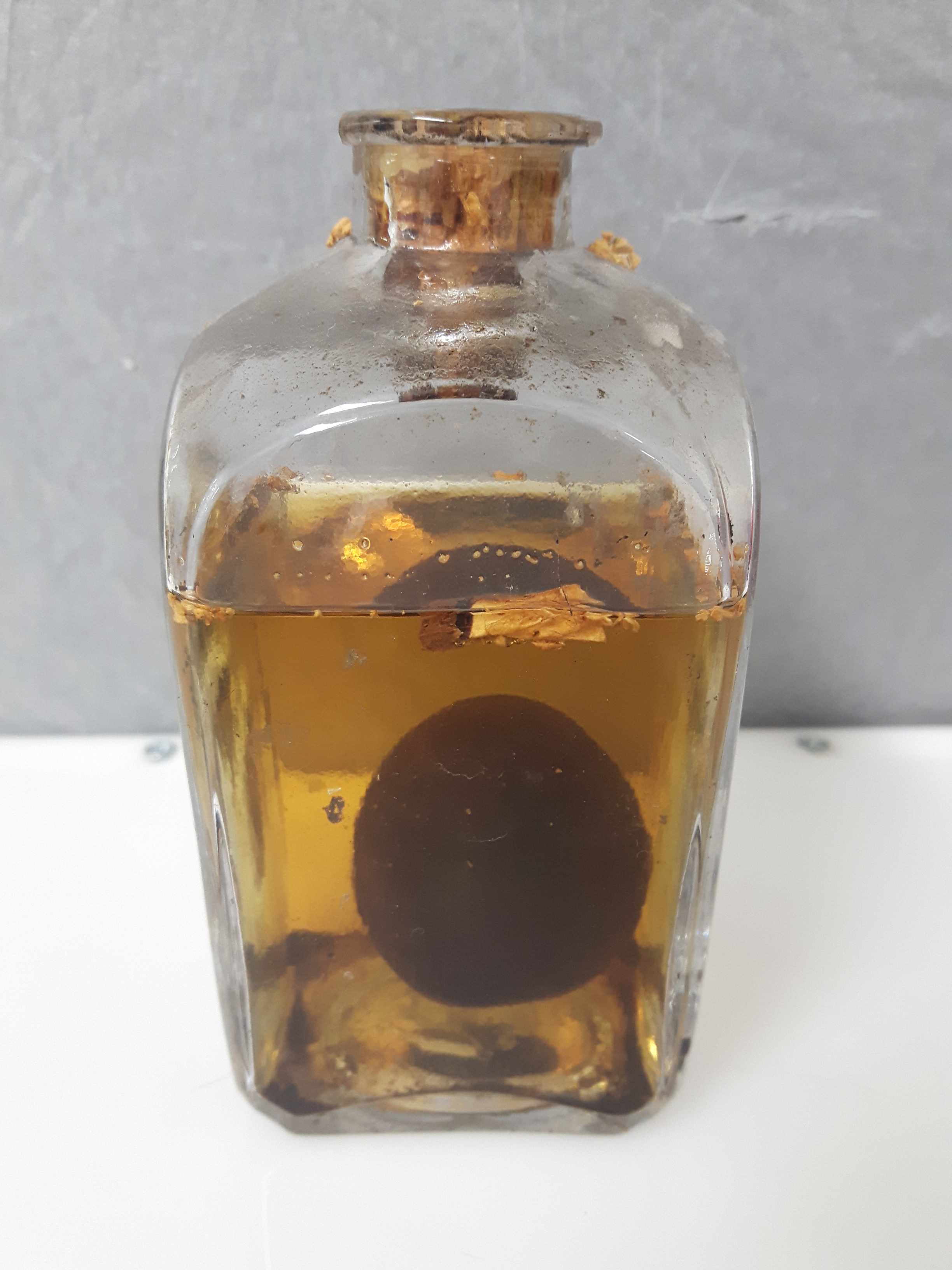
I have a strong suspicion that an object that is now in our collection at the Grant Museum was in fact a souvenir bottle of plum brandy. How could such a thing happen?

The mystery specimen in its original fluid before conservation. Is it in fact a bottle of plum brandy that a researcher bought as a souvenir? (C) UCL Grant Museum of Zoology.

My former colleagues Mark Carnall and Emma-Louise Nicholls first brought this “specimen” to my attention in 2011, when they found it in our wet specimen store: an unmarked bottle of clear brown liquid containing a near-spherical object with a cork stopper in its narrow neck. Mark wrote a blog at the time working through the process of elimination of all the spherical objects that might belong in a zoological collection such as ours. While others had assumed it was a testis, Mark and Emma decided that it was in fact a plum – not zoological at all. Aside from its identity, the other question was: how did a 25mm sphere get in a bottle with a 10mm neck?

Continue reading

NatSCA Digital Digest – March

What Should I Read?

As part of the International Year of the Reef (that’s this year, in case you hadn’t crossed paths with it yet) the Horniman Museum and Gardens is releasing a series of blogs that showcase and celebrate research taking place around the globe on coral reef conservation. There have been three installments so far, with the latest one here.  FYI- the images in this blog series are STUNNING! The hashtag for Internal Year of the Reef is #IYOR2018.

It’s that wonderful day of the year again when men all over the world realise it’s International Women’s Day and subsequently Google ‘When is International Men’s Day?’. To celebrate the day, the Natural History Museum has published an article- The women watching over London’s natural history collections, to demonstrate the diversity of roles of their wonderful staff, covering 11 fabulous women in conservation, curation, and research.

A new website has been launched in support of museum professionals called Museum Wellness Network; ‘A network for museum professionals to connect over mental health and well being’. As every human on the planet has a state of mental health, anything that aims to improve its quality in others definitely gets my vote. They are also on Twitter should you wish to give them a follow and see what they’re up to.

Continue reading

Willows in the Wind: Digitisation of the Tullie House Herbarium

Excited (botanical) chatter, the inexorable flashing of camera equipment, intrigued visitors gathering around our new gallery space; this was our Virtual Flora of Tullie Herbarium Project, funded by the Bill Pettit Memorial Award at the start of 2017.

The scope of the project, between 30th of May to 26th of September 2017, was to use a team of volunteers to begin photographing and cataloguing our (“ex”) University of Lancaster herbarium. This significant acquisition of 35,000 vascular plant sheets is a highly data rich and well-provenanced collection with invaluable information on the historical and contemporary distribution of species across the UK and beyond. Almost a third of the specimens were collected from Cumbria, much of it collected during a major 30 year survey of the flora of Cumbria; an exemplar model of field surveying which is aspired to by Botanical Society of Britain and Ireland (BSBI) recorders today. The survey work culminated in the team leader’s (Geoffrey Halliday) highly comprehensive publication of A Flora of Cumbria. No other herbarium has a comparable recent (1968+) collection of Cumbrian material.  But despite the importance of this recent acquisition, none of these specimens were digitised.

Thanks to the Bill Pettit Memorial Award funding this was all about to change.

Continue reading