Unravelling the Golden Thread: The Silk and Cocoon Collection at the Manchester Museum

Written by Piotr Korpak, Visitor Team Assistant, Manchester Museum, The University of Manchester.

Last August saw the Manchester Museum entering the final phase of its capital project called hello future when it closed to the public for over a year, until February 2023. Major redevelopments like this tend to be quite stressful for most institutions, but also bring a lot of excitement and many valuable opportunities for individuals. Being closed to the public meant no visitors and so I was able to support work in other departments. Always interested in natural history collections, I welcomed the chance to work with the Curatorial Team in the Entomology Department with true delight.

The Museum’s arthropod collections are amongst the top three in the UK, with over 3 million specimens, out of which about 2.5 million are insects (Logunov and Merriman, 2012). As is the case with many museums, the collections are vast, the staff numbers small, and it can be difficult for curators to catch up with the backlog of past acquisitions and historic materials. No doubt one could find boxes, cabinets, and all other imaginable storage units full of specimens still awaiting their official accessioning, cataloguing, research, and digitisation in any museum.

Continue reading

‘Marvellous Molluscs’ – Increasing Accessibility, Improving Storage & Unlocking Research Potential At The University Of Aberdeen

Written by Hannah Clarke, Assistant Curator (Collections Access), University of Aberdeen.

In April 2021, The University of Aberdeen’s Zoology Museum, with support from NatSCA’s Bill Pettit Memorial Award, undertook a year-long project to rehouse and improve the accessibility of the University’s mollusc collection.

The collection comprises approximately 2550, mostly British specimens, collected from the 1840s to the 1970s. The specimens were gifted to the museum by former students, academic staff, and amateur shell collectors, they also include several specimens from as far afield as the Pacific, Africa, China, Madagascar, America, and Canada.

The molluscs form part of the University’s extensive Zoology Collections, which are recognised as being of National Significance. As such, we are constantly striving to improve access to these collections, and the ‘Marvellous Molluscs’ Project aimed to do just that.

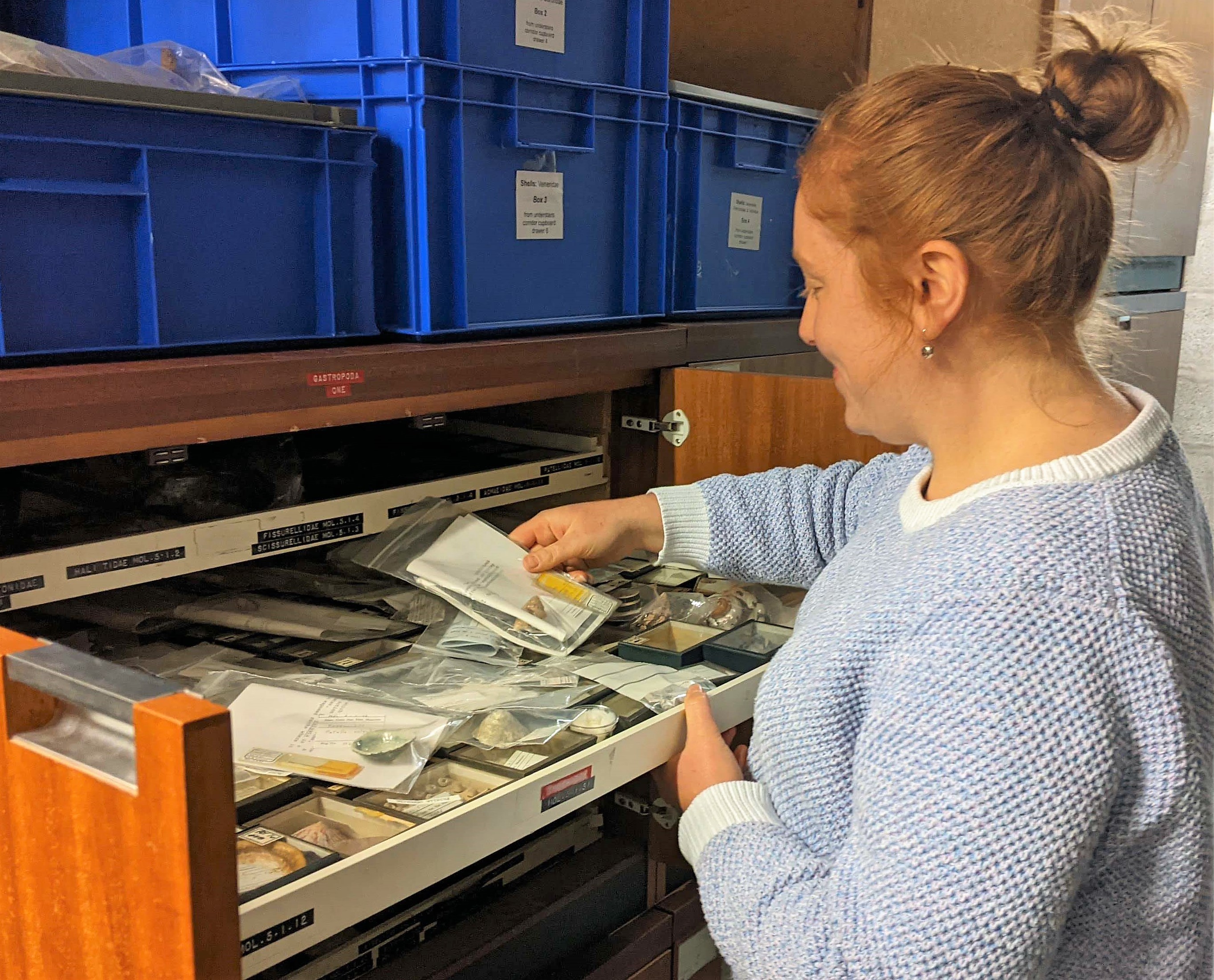
Assistant Curator, Hannah Clarke, identifying storage issues in specimen cupboards.

Having identified the collections both in storage and on display, a project plan was created that would tackle not only the rehousing, but also the documentation of the specimens on the museum database. The majority of specimens were poorly stored several layers deep in drawers, had outdated taxonomy, and lacked any database records or collections data.

Continue reading

Wikipedia, Museum Volunteers And The New Normal

By John-James Wilson, Curator of Vertebrate Zoology, World Museum, National Museums Liverpool.

Like most museums across the country, World Museum suspended its volunteer programmes shortly before the first national lockdown in March 2020. This was meant to be a short-term measure but with curators continuing to work hybridly our volunteers haven’t yet returned. Organisations like Volunteer Scotland have advised volunteers to consider if and how they can work remotely.

While some museums had existing remote volunteering activities (see great examples here and here), which saw increased participation, World Museum’s vertebrate zoology collection didn’t. An additional challenge for us has been that remote access to our collections database is limited to staff with a VDI. With the pandemic still with us for some time to come (Chris Whitty has said it will be 5 years) we have started exploring ways to engage both new and long-serving volunteers with the collection online.

During lockdown, Auckland Museum published a Wikimedia strategy citing the provocative 2018 talk by Adam Moriarty which championed the importance of collection information featuring, not solely on museum’s own webpages, but in places like GBIF and Wikipedia. This reinforced our view that we need to improve the collections’ presence in Wikipedia. Wikipedia articles are created by volunteers and can be edited by anyone with a standard web browser, potentially providing a valuable activity for remote volunteering.

Continue reading

The First Steps Of An Epic Move

Written by Clare Valentine, Head of Life Science collections, Natural History Museum, London.

Securing £182m to build a new science and digitisation centre in March 2020 was an incredible moment for the Natural History Museum, and the culmination of many years of hard work across the organisation to make the case for better facilities for the collections and research. The support from the Department for Culture, Media and Sport provides an opportunity to secure the future of the collections by moving them into bespoke, accessible storage, to accelerate digitisation of the collections to expand access for researchers globally and transform the study of natural history through an investment in new analytical facilities, technologies and techniques.

Receiving confirmation of the funding just a matter of days before the UK shutdown for the best part of 2 years didn’t come without its challenges, but it’s been incredible to see the progress that has been made towards our immense plan to build the centre and move tens of millions of specimens there by 2027.

Continue reading

A Sunfish, a Sheriff and a Register

By Eimear Ashe, Documentation Officer, National Museum of Ireland – Natural History.

NatSCA friends, I’d like to tell you a little about our current Inventory Project in the National Museum of Ireland (NMI) – Natural History. But first, back in 2009-2017, we ran a project that allowed us to catalogue 170,000 specimens in our collections management system (Adlib). We proposed another project to continue these efforts. The start date of the project regrettably coincided with the pandemic as well as the untimely loss of a key colleague (Dr Matthew Parkes). We regrouped and decided to postpone the physical inventory of objects and instead to focus on the work that could be done remotely by the team of inventory assistants.

On this project, I manage a team of three contracted inventory assistants. The cataloguers work on Natural History for two or three days per week, and other NMI projects for the rest of their week. I spend one full day each week doing project-related work, that is, supervision, answering queries, checking work and reporting.

Continue reading