4th MOBILISE Training School: “Next Step in the Digitisation Process of Natural History collections: Publishing of Biological, Geological, Palaeontological and Mineralogical data”.

Written by Olivia Beavers, Assistant Curator of Vertebrate Zoology at World Museum, National Museums Liverpool.

In December I was selected, along with 17 others, to attend the 4th MOBILISE Action Training School held in Brussels, 6–7th February. This training school gave an opportunity for students and professionals of Natural History Institutions from Europe and Israel to learn more about the publishing of our collections’ data sets. A crucial aim of the training school was to learn how to map data to the Darwin Core Standard, and as a result, create a Darwin Core Archive file to be uploaded to GBIF.

The Training School consisted of two parts: the first was an introduction to the group. This was conducted online and addressed theoretical issues associated with our datasets. Part 2 was the two-day, face to face trip to Brussels to check the cleaning and validation of our data for it to be ready for publishing on GBIF (for Biological Data) or GeoCASe (for Geological, Palaeontological and/or Mineralogical data).
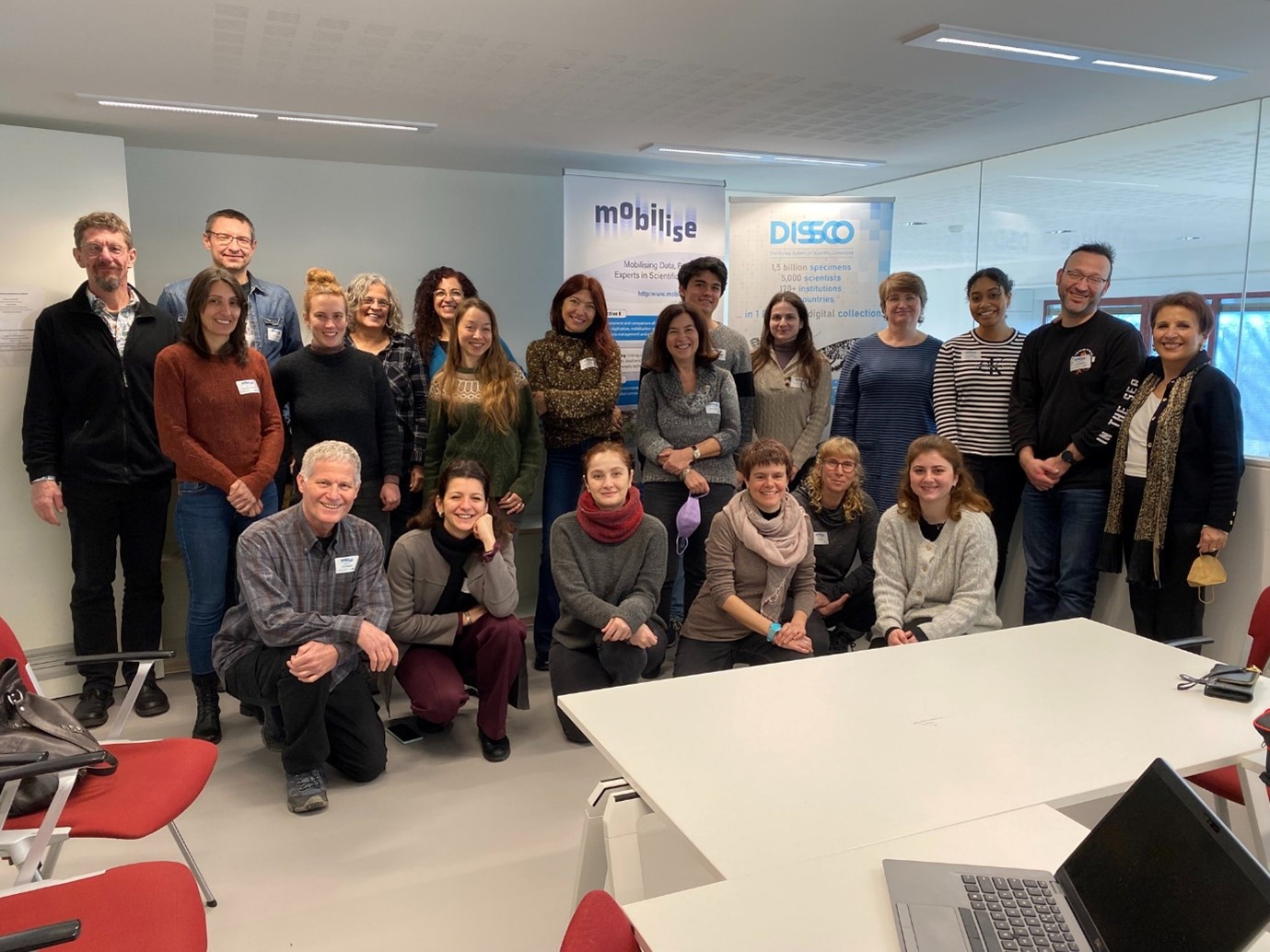
A group photo of the 21 attendees and group leaders at the 4th MOBILISE Action Training School, Brussels
Figure: 1 A group photo of the attendees and group leaders at the 4th MOBILISE Action Training School, Brussels ©Katerina Voreadou
Continue reading

Ostracod Odessey – Broadcasting the Brady Collection

Written by Dan Gordon, Keeper of Biology, The Great North Museum: Hancock.

The Great North Museum : Hancock is home to many remarkable collections, but one of the most important is perhaps one of the most unfamiliar to our visitors. The Brady collection of Ostracods.

Ostracods, sometimes called Seed Shrimp, are distinctive Class of crustaceans. A shell of two intricately textured valves almost entirely envelopes their shrimp-like bodies, with just a small opening for a cluster of rapidly moving legs to poke out. As their common name suggests, most species are very small, mostly invisible to human eye, but they’re ubiquitous, busily going about their lives wherever there is permanent or temporary water, from the poles to the tropics. Some swarm the world’s oceans in vast planktonic shoals, while others live in the still, dark pools of caves, in garden ponds or even puddles.

They’re poorly known outside of academic communities, which is a real shame, because despite being fascinating creatures in their own right, they have important roles in many aquatic ecosystems, and significantly, they’re commonly encountered in the fossil record, which means that they are particularly important indicator fossils. In addition, the chemical make-up of their distinctive shells tells us about ocean acidity and temperature, which can tell us about ocean warming and climate change.

The collection was the work of George Stewardson Brady, a local man, born in Gateshead in 1832, and one of the people who pioneered the study of these animals at a time when they were relatively poorly understood.  Housed in a row of cabinets, the Brady collection is made up of nearly 3000 microscope slides with up to 100 Ostracods on each. These specimens were collected all over the world, many of them by well-known expeditions such as the HMS Challenger expeditions in the 1870s. It contains many Types, and provides a valuable resource for the study of these animals today.

Continue reading

Unravelling the Golden Thread: The Silk and Cocoon Collection at the Manchester Museum

Written by Piotr Korpak, Visitor Team Assistant, Manchester Museum, The University of Manchester.

Last August saw the Manchester Museum entering the final phase of its capital project called hello future when it closed to the public for over a year, until February 2023. Major redevelopments like this tend to be quite stressful for most institutions, but also bring a lot of excitement and many valuable opportunities for individuals. Being closed to the public meant no visitors and so I was able to support work in other departments. Always interested in natural history collections, I welcomed the chance to work with the Curatorial Team in the Entomology Department with true delight.

The Museum’s arthropod collections are amongst the top three in the UK, with over 3 million specimens, out of which about 2.5 million are insects (Logunov and Merriman, 2012). As is the case with many museums, the collections are vast, the staff numbers small, and it can be difficult for curators to catch up with the backlog of past acquisitions and historic materials. No doubt one could find boxes, cabinets, and all other imaginable storage units full of specimens still awaiting their official accessioning, cataloguing, research, and digitisation in any museum.

Continue reading

Wikipedia, Museum Volunteers And The New Normal

By John-James Wilson, Curator of Vertebrate Zoology, World Museum, National Museums Liverpool.

Like most museums across the country, World Museum suspended its volunteer programmes shortly before the first national lockdown in March 2020. This was meant to be a short-term measure but with curators continuing to work hybridly our volunteers haven’t yet returned. Organisations like Volunteer Scotland have advised volunteers to consider if and how they can work remotely.

While some museums had existing remote volunteering activities (see great examples here and here), which saw increased participation, World Museum’s vertebrate zoology collection didn’t. An additional challenge for us has been that remote access to our collections database is limited to staff with a VDI. With the pandemic still with us for some time to come (Chris Whitty has said it will be 5 years) we have started exploring ways to engage both new and long-serving volunteers with the collection online.

During lockdown, Auckland Museum published a Wikimedia strategy citing the provocative 2018 talk by Adam Moriarty which championed the importance of collection information featuring, not solely on museum’s own webpages, but in places like GBIF and Wikipedia. This reinforced our view that we need to improve the collections’ presence in Wikipedia. Wikipedia articles are created by volunteers and can be edited by anyone with a standard web browser, potentially providing a valuable activity for remote volunteering.

Continue reading

Giving Collections An Extra Life – Making Video Games That Promote Collections Engagement (For Free)

Written by Glenn Roadley, NatSCA Committee Member, Curator of Natural Science at The Potteries Museum & Art Gallery.

(Note: this article includes interactive games. If they don’t work, your organisation may have blocked game websites through your network)

You might think that playing video games falls at the opposite end of the hobby-spectrum when compared to getting engaged with nature. But the immersion and creativity allowed often provides many of the same benefits, and nature is used as inspiration for many of the most popular video games. In this way video games can become a gateway to learning about nature in the real world – did you know that the highest grossing media franchise of all time (step aside, Marvel) started as a video game about collecting fictional animals to help a scientist with their biological recording project? You’ve probably heard of it. And the Animal Crossing franchise, a game series where a core activity involves collecting insects and fish to donate to the local museum, has sold over 70 million copies.

Games like Pokémon and Animal Crossing show that natural science collections are already on to a winner when it comes to subject matter and gaming. The collections are full of characters and stories, and games should be considered as another way to provide access to these.

The benefits of games are well-established (stress relief, improvement of memory and development of problem-solving skills are among the benefits often cited) and Learning Through Play is already a central part of how museums engage with their audiences. Many museums have used computer games to bring their interpretation to life (https://www.museumnext.com/article/how-can-games-in-museums-enhance-visitor-experience/).

Continue reading