Wild About Portsmouth – Discovering Portsmouth’s Natural History Collection

Written by Christine Taylor, Curator of Natural History, Portsmouth Museums

In March 2018 Portsmouth City Council was awarded a £79,700 grant to deliver a ‘Wild about Portsmouth project in order to raise the profile of the city’s Natural History collection. In addition to appointing a curator and an assistant, the project enables the development of natural history advocates and a team of volunteers to work on and promote the collection. The project also aims to engage with people in a variety of ways, from family activities to specialist workshops, with the view of participants helping to inform priorities for collection development and new displays.

As a curator with over 20 years’ experience in Hampshire, I have always been aware of the collection but had very little knowledge of it. The last Natural History Curator was 10 years ago and, apart from the occasional request, little had been done to develop the collection. An initial overview showed that the collection was (mainly) in good condition, packed into archival and museum quality boxes awaiting rediscovery.

One of the first tasks was to get an idea of the scope of the collections and their associated collectors. Another task was to recruit volunteers to assist with rearranging the collections to get them into taxonomic order and to catalogue them or update the Modes database with provenance data. To date 10 volunteers have been recruited and are currently working on the geology, shell and botany collections. Once the entomology collections have rehoused over the next few months (the cabinets are currently stored side-on making access to them rather difficult), volunteers will be recruited to re-stage, re-organise and catalogue them.

Continue reading

And the Winner is…

Written by Lucie Mascord, Natural History Conservator, and NatSCA Committee Member.

Through August to October this year, NatSCA ran its very first competition. Running up to the Caring for Natural Science Collections one-day conference at Oxford University Museum of Natural History (on 17th October 2018), the competition asked participants to post natural history conservation themed photographs to Twitter with the hashtags #NatSCAConservation and #photocomp.

Whilst it took a little while to warm up, buoyed by some fantastic images posted by the NatSCA conservation working group, we received some excellent entries, resulting in a close competition for first place.

The entries ranged from geology to taxidermy, from the humorous to the technical. This was the exact response we were looking for, illustrating the variety and accessibility of conservation.

When it came down to it, the winning photograph was an excellent composition, highlighting the complexities of conserving an unusual object.

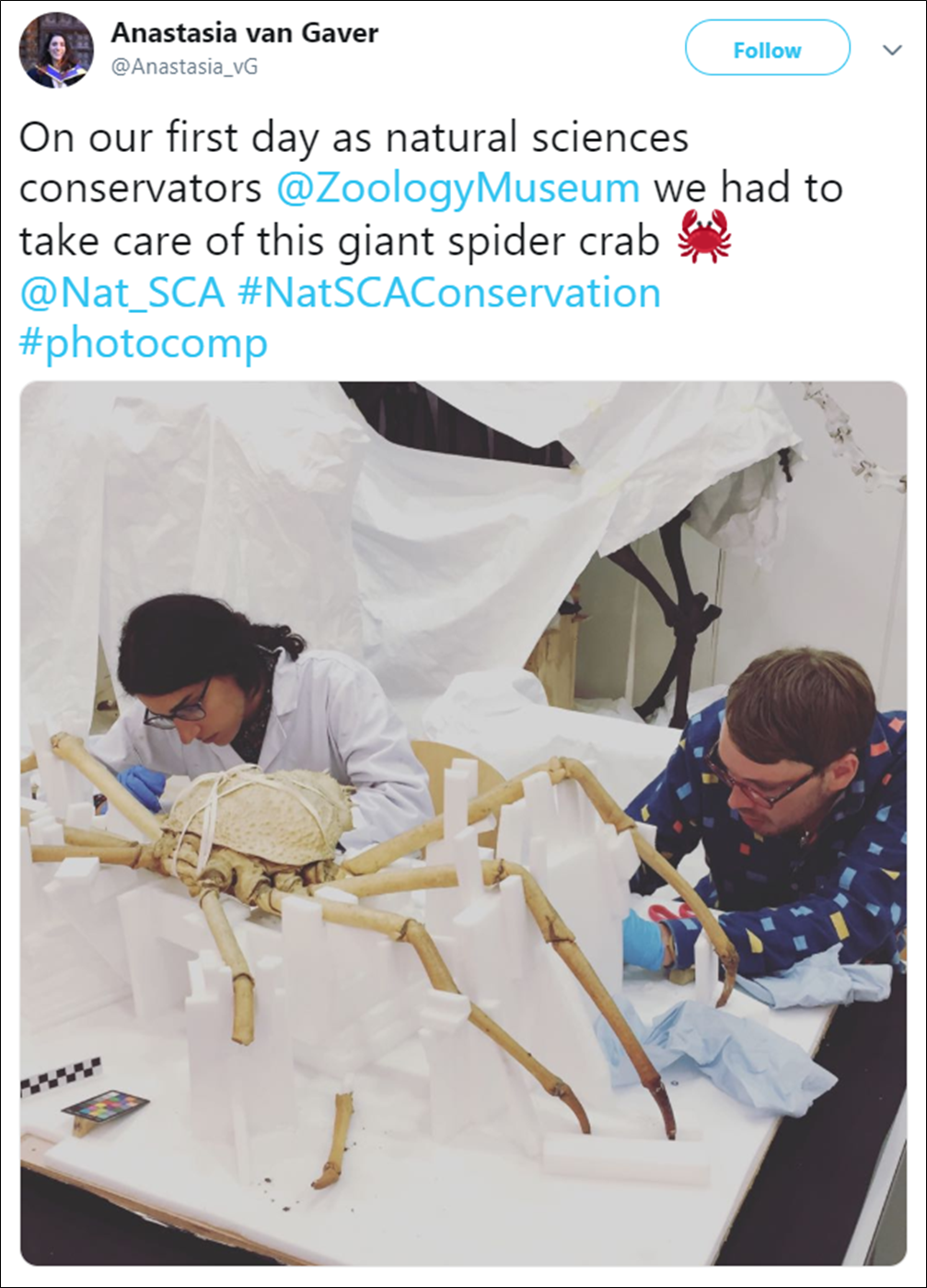
The winner is this fantastic entry from Anastasia van Gaver, which features Anastasia and her colleague Samuel Suarez Ferreira on their first day at work at the Museum of Zoology, University of Cambridge, (@ZoologyMuseum), image taken by Natalie Jones. Talk about being thrown in at the deep end with this monster of a giant spider crab. Both Anastasia and Sam attended the conference in October and gave talks on specific conservation experiences during their contracts at the Museum of Zoology. To be able to spotlight emerging professionals working with natural history collections was one of the main achievements of the conference and competition.

The winning entry from Anastasia van Gaver, Natalie Jones, and Samuel Suarez Ferreira. © Museum of Zoology, University of Cambridge.

Anastasia says; “The Cambridge University Museum of Zoology reopened in June, following a major HLF funded redevelopment. I was lucky to be one of the conservators to join the team for this project and this picture was taken on my very first day at the Museum, in August 2017. Having just visited the stores and the lab, my new colleague Samuel Suarrez Ferreira and I got given the task of making this Japanese spider crab fit for display! I submitted this picture for the competition not only because of the great memories I have of the best possible first day a natural sciences conservator could ask for, but also because it is a good example of team work: Sam and I decided on treatment together, then each conserved one side of ‘Krabby’, before the mountmaker Rebecca Ash designed an intricate bespoke metal support for it.”

Continue reading

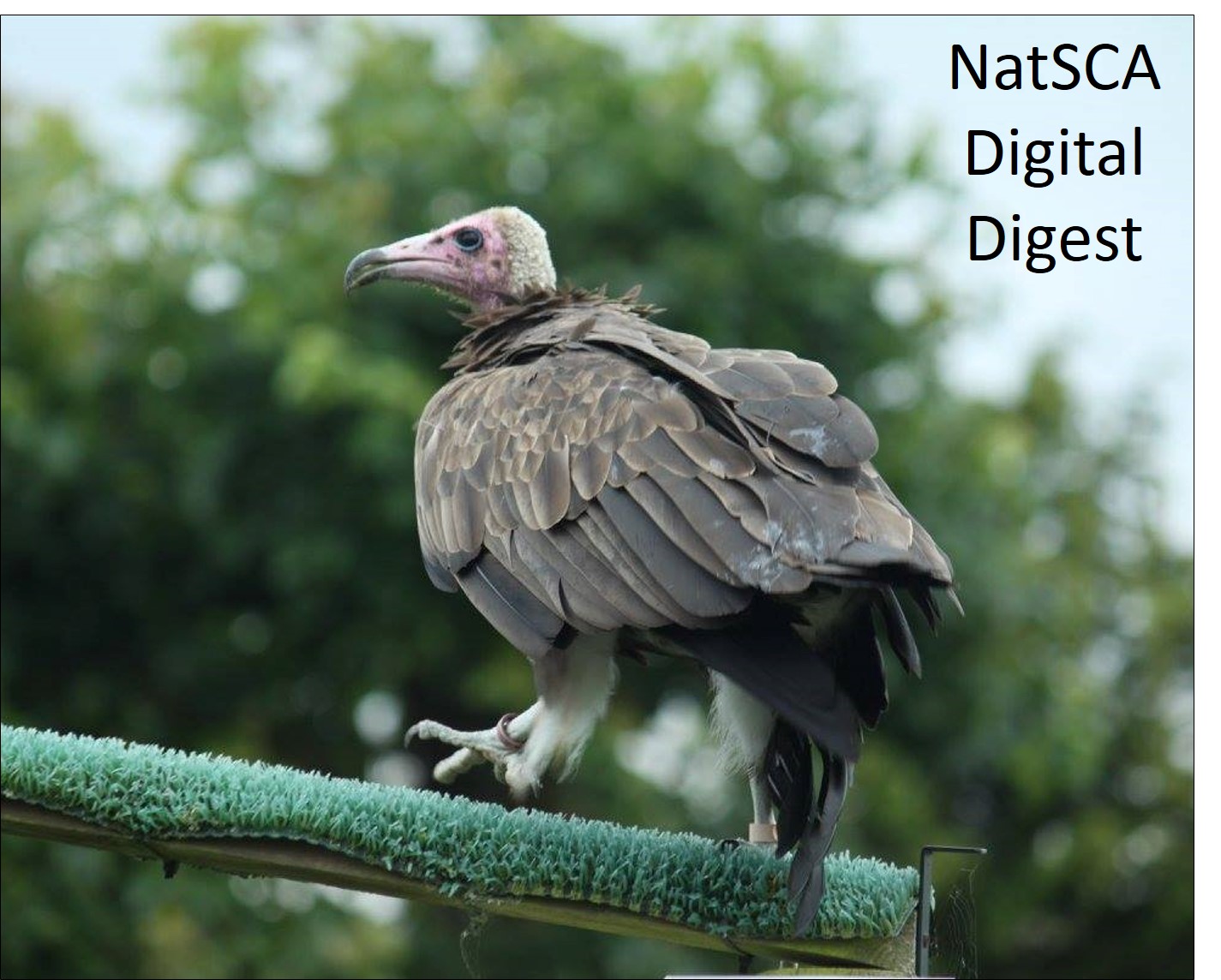
NatSCA Digital Digest – November

Written by Sam Barnett, NatSCA Volunteer and PubSci Committee Member

Welcome one and all to the November installment of the NatSCA Digest. First of all, I hope you’re all enjoying the #Museum30 social media event, which runs throughout November on Twitter. It’s not too late to get involved with it, check out the list here:

The Museum 30 list is compiled by Museum Studies and Archaeology student Gracie Price.

First, an Announcement

It’s that special time of year again when NatSCA release their Call for Papers for next year’s NatSCA Conference. Due to be held in May 2019, the conference will be exploring themes under the banner Collections Success. You have until the 4th of January to submit your abstract, and can find the full details here – we can’t wait to see what you come up with for us next year!

Where Should I Work?

Continue reading

NatSCA Digital Digest – October

Compiled by Dr Emma Nicholls, Deputy Keeper of Natural History at the Horniman Museum and Gardens.

What Should I Read?

You may or may not own/have heard of ‘Dinosaurs, How They Lived and Evolved‘ by Dr Darren Naish and Dr Paul Barrett, but either way the good news is there’s now a literally-just-released-second-edition, which is the most up to date a (printed) book can possibly be really. There is a lot of talk about it already but my tuppence is- I have a copy and it’s brilliant. That description fully extends to the captivating cover art by Bob Nicholls of Paleocreations, featuring a hungry Tianyulong (that’s a dinosaur, in case you weren’t sure).

I came across a charming article about getting children into natural sciences recently called ‘Kids and caterpillars: Fostering a child’s interest in nature by rearing Lepidoptera (moth and butterfly) larvae‘. I’m not suggesting we all go out and start rearing leps, but in an age where human lives are ruled by technology, it’s a beautiful story and heart warming example of an intra-familial cross-generational citizen science project by an Assistant Curator at the Carnegie Museum of Natural History and his son.

Continue reading

NatSCA Digital Digest – September

Lost Treasures- A Statement from the Chair

Dear all,

As most of you will no doubt be aware, the National Museum of Brazil in Rio de Janeiro, suffered a catastrophic fire that started in the evening of 2nd September 2018. Fortunately no people were killed in the blaze, but the majority of the collections housed in the building are thought to be lost. While the cause of the fire is still as yet uncertain, a significant proportion of the blame for the devastation caused has fallen on the Brazilian government, due to ongoing under-investment in the Museum’s infrastructure. This serves as a stark warning of the dangers faced by museums with inadequate support.

Continue reading