Vertebrate Collections of the Institute of Biology, UNAM, Move to the New Building of the National Biodiversity Pavilion in Mexico City.

Written by Fernando A. Cervantes, Professor and Curator of Mammals, Department of Zoology, Instituto de Biología, UNAM.

Mexico is a megadiverse country and has 10% of the world’s species. The Institute of Biology of the National Autonomous University of Mexico (IBUNAM) houses the National Biological Collections (NBC), which contain the largest and most important representation of museum specimens of Mexican biodiversity in Mexico. These include 10 zoological collections, a herbarium, and a botanical garden (Zambrano and Reynoso, 2003). Among the highlights are the National Insect Collection (CNIN), with more than 3,000,000 specimens, the National Herbarium (MEXU), with more than 1,500,000 specimens, and the living collections of the Botanical Garden. They all collaborate in the elaboration of the national biological inventory and their specimens provide knowledge on the presence, distribution, and evolution of biological diversity (Cervantes et al. 2016).

   The NBC are located at the IBUNAM facilities in the Ciudad Universitaria campus, south of Mexico City, Mexico, where they have been for approximately 22 years now. However, the rapid growth in the number of specimens in each of the collections over the last few decades has meant that the space in which they are currently housed is no longer sufficient. At the same time, the number of academic personnel associated with the NBC, students, equipment, and materials have grown in parallel and demand the need for more space to allow for the proper functioning of the NBC.

Continue reading
‘Marvellous Molluscs’ – Increasing Accessibility, Improving Storage & Unlocking Research Potential At The University Of Aberdeen

Written by Hannah Clarke, Assistant Curator (Collections Access), University of Aberdeen.

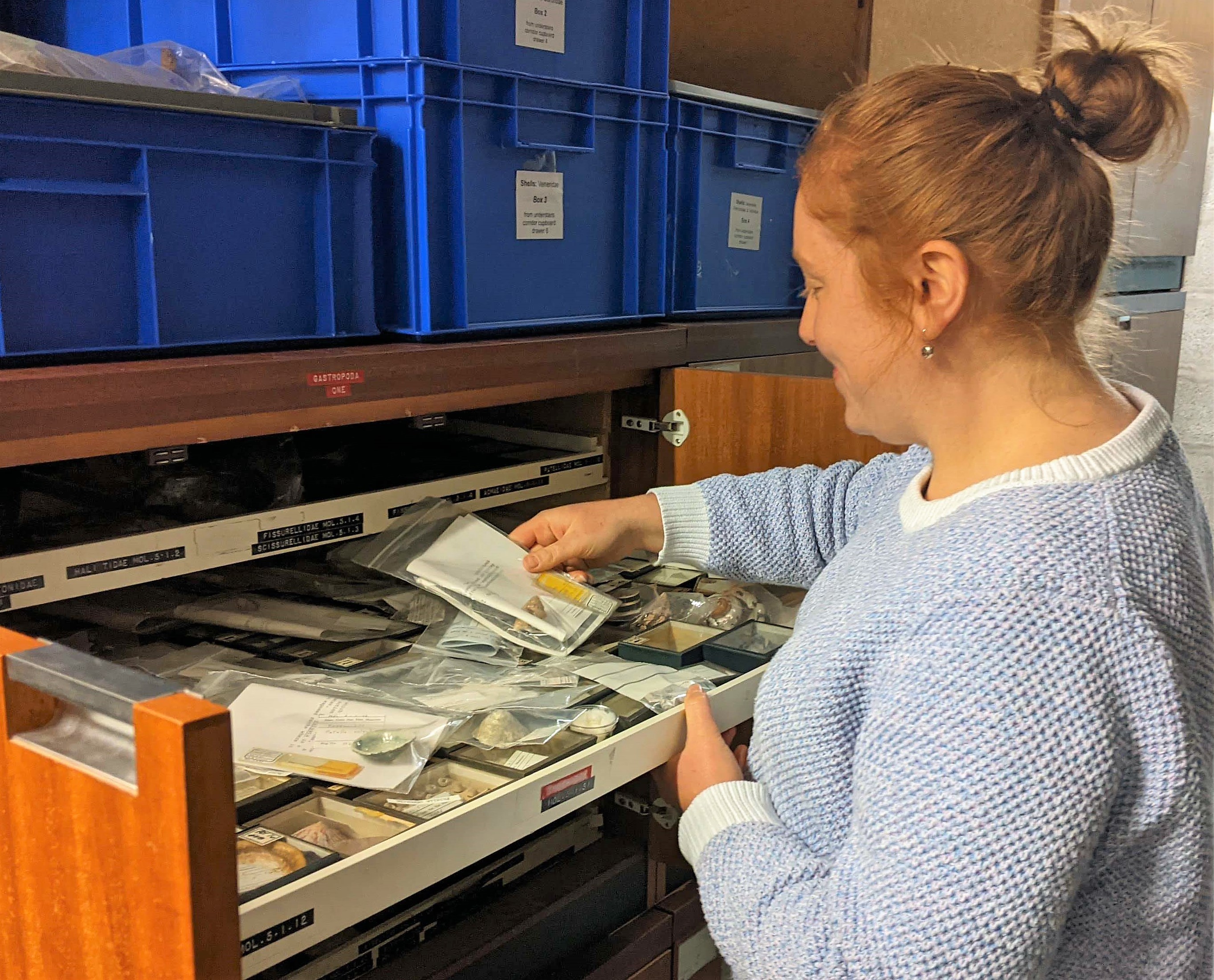
In April 2021, The University of Aberdeen’s Zoology Museum, with support from NatSCA’s Bill Pettit Memorial Award, undertook a year-long project to rehouse and improve the accessibility of the University’s mollusc collection.

The collection comprises approximately 2550, mostly British specimens, collected from the 1840s to the 1970s. The specimens were gifted to the museum by former students, academic staff, and amateur shell collectors, they also include several specimens from as far afield as the Pacific, Africa, China, Madagascar, America, and Canada.

The molluscs form part of the University’s extensive Zoology Collections, which are recognised as being of National Significance. As such, we are constantly striving to improve access to these collections, and the ‘Marvellous Molluscs’ Project aimed to do just that.

Assistant Curator, Hannah Clarke, identifying storage issues in specimen cupboards.

Having identified the collections both in storage and on display, a project plan was created that would tackle not only the rehousing, but also the documentation of the specimens on the museum database. The majority of specimens were poorly stored several layers deep in drawers, had outdated taxonomy, and lacked any database records or collections data.

Continue reading

Giving Collections An Extra Life – Making Video Games That Promote Collections Engagement (For Free)

Written by Glenn Roadley, NatSCA Committee Member, Curator of Natural Science at The Potteries Museum & Art Gallery.

(Note: this article includes interactive games. If they don’t work, your organisation may have blocked game websites through your network)

You might think that playing video games falls at the opposite end of the hobby-spectrum when compared to getting engaged with nature. But the immersion and creativity allowed often provides many of the same benefits, and nature is used as inspiration for many of the most popular video games. In this way video games can become a gateway to learning about nature in the real world – did you know that the highest grossing media franchise of all time (step aside, Marvel) started as a video game about collecting fictional animals to help a scientist with their biological recording project? You’ve probably heard of it. And the Animal Crossing franchise, a game series where a core activity involves collecting insects and fish to donate to the local museum, has sold over 70 million copies.

Games like Pokémon and Animal Crossing show that natural science collections are already on to a winner when it comes to subject matter and gaming. The collections are full of characters and stories, and games should be considered as another way to provide access to these.

The benefits of games are well-established (stress relief, improvement of memory and development of problem-solving skills are among the benefits often cited) and Learning Through Play is already a central part of how museums engage with their audiences. Many museums have used computer games to bring their interpretation to life (https://www.museumnext.com/article/how-can-games-in-museums-enhance-visitor-experience/).

Continue reading

The First Steps Of An Epic Move

Written by Clare Valentine, Head of Life Science collections, Natural History Museum, London.

Securing £182m to build a new science and digitisation centre in March 2020 was an incredible moment for the Natural History Museum, and the culmination of many years of hard work across the organisation to make the case for better facilities for the collections and research. The support from the Department for Culture, Media and Sport provides an opportunity to secure the future of the collections by moving them into bespoke, accessible storage, to accelerate digitisation of the collections to expand access for researchers globally and transform the study of natural history through an investment in new analytical facilities, technologies and techniques.

Receiving confirmation of the funding just a matter of days before the UK shutdown for the best part of 2 years didn’t come without its challenges, but it’s been incredible to see the progress that has been made towards our immense plan to build the centre and move tens of millions of specimens there by 2027.

Continue reading

A Sunfish, a Sheriff and a Register

By Eimear Ashe, Documentation Officer, National Museum of Ireland – Natural History.

NatSCA friends, I’d like to tell you a little about our current Inventory Project in the National Museum of Ireland (NMI) – Natural History. But first, back in 2009-2017, we ran a project that allowed us to catalogue 170,000 specimens in our collections management system (Adlib). We proposed another project to continue these efforts. The start date of the project regrettably coincided with the pandemic as well as the untimely loss of a key colleague (Dr Matthew Parkes). We regrouped and decided to postpone the physical inventory of objects and instead to focus on the work that could be done remotely by the team of inventory assistants.

On this project, I manage a team of three contracted inventory assistants. The cataloguers work on Natural History for two or three days per week, and other NMI projects for the rest of their week. I spend one full day each week doing project-related work, that is, supervision, answering queries, checking work and reporting.

Continue reading