NatSCA Digital Digest – May

ndd-b-rex

What’s New?

Many of us are freshly returned from a very successful NatSCA Conference, featuring over 20 speakers, trade stands and stores tours. We will be hearing more from them in the coming weeks. Watch this space on the 31st May! In the meantime you can catch up on their exploits by reading the Twitter stream.

In other conference-related news: The Royal Society Sexual Selection Conference is going on as we speak. As before, you can read all about it at the Twitter stream.

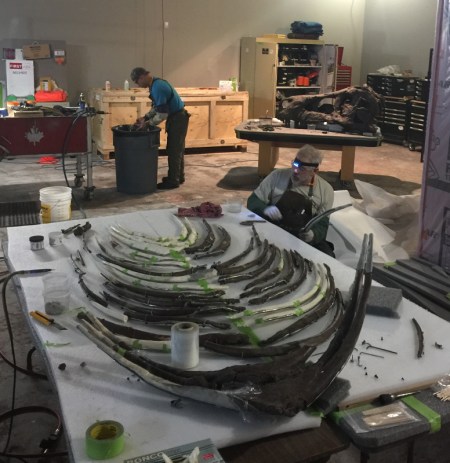
In the meantime, I’ve been on a Tyrannosaurus pilgrimage across the Mid-West. I visited some that I can talk about and others that I can’t yet but all of it was very informative.
sue-prep

The preparators hard at work re-mounting Sue at the Field Museum

Not content with rocking the conference, Jack Ashby has been tearing it up at PubSci too, regaling us with tales from his new book. From cats that are killing Australia, to unrepresented penis worms – the talk was engaging and generated copious questions.

Continue reading

Special Notice- Offer of Materials

Professor Hugh Torrens at Keele University is looking to rehouse a large quantity of material that may be of interest to many of our readers. If you would like further information on, or to re-home anything on the following list, please contact Prof Torrens directly on email, h.s.torrens@keele.ac.uk, or by phone 01782 733754.

1) Lots of spare offprints (my own, those by Ron Cleevely, or John Fuller, or by others like Martin Rudwick or John Thackray) and will be happy to try and find those by particular authors, or any other particular items for enquirers.

2) There are many large files on particular people. I may still have separate files on many of the more significant geologists or naturalists of the past, including the circa 50 for whom I wrote entries in the Oxford Dictionary of National Biography (2004).

3) Other files are on topics, particularly those related to geology and its practice, including many on the myriad failed attempts to find coal where it was never going to be found all over Britain. These strike me as a major research area which has never attracted attention. I will be happy to try and answer particular enquiries.

4) There is an enormous collection of printed obituary notices, both British and foreign

5) A large collection of books, pamphlets and notes on museums and on museology, with many lists of type and figured fossils etc.

6) Collection, in about 15 large A4 spring back files, of random obituary notices and printed scraps, on former geologists/naturalists, many of some obscurity.

Please note, the material needs to be moved asap, and at the latest by the end of June.

Playing with Time

Cave palaeontology collections as vessels of truth and creativity…

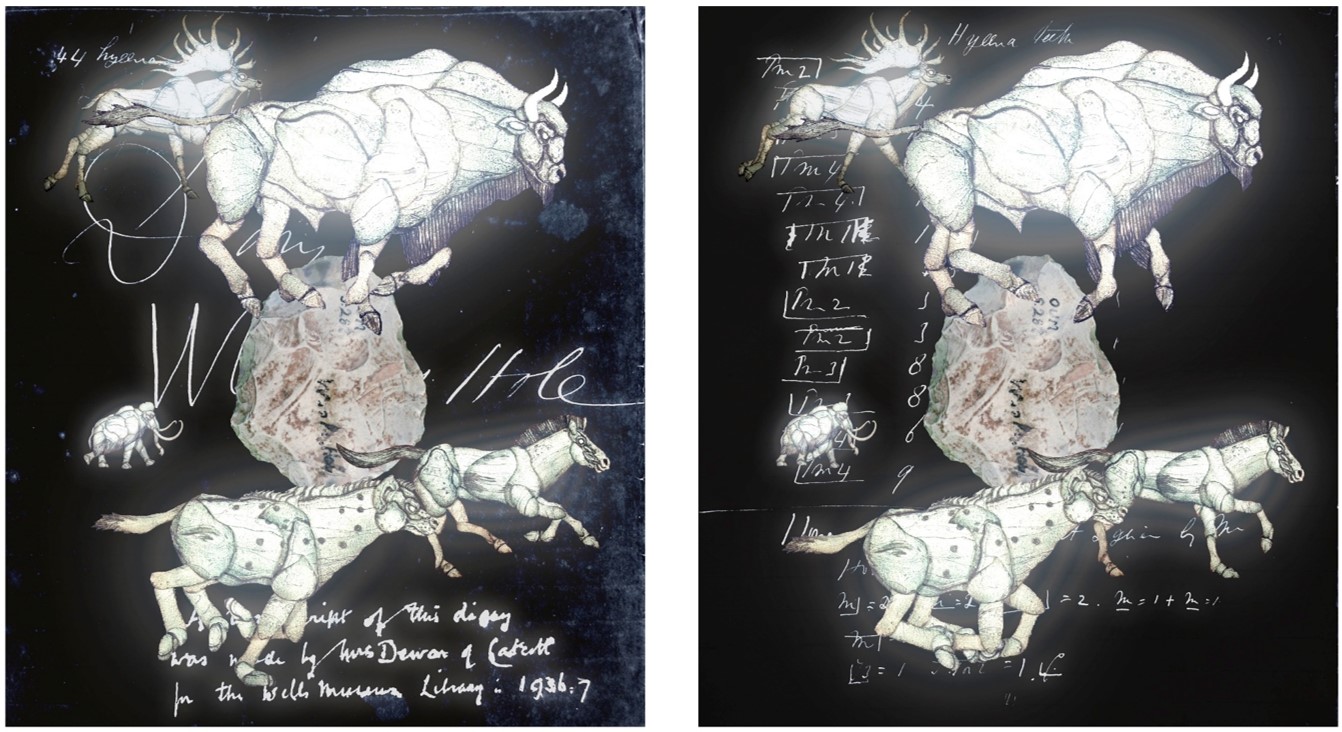
Big Beasts Stalk The Mind of Sir William Boyd Dawkins. Two pages from a flip-book showing animated giant deer, steppe bison, spotted hyaena, horse, pages from Sir William’s notebook relating to the excavation of the Hyaena Den at Wookey Hole and a Palaeolithic hand axe unearthed there. (C) Sean Harris.

Beasts of tooth and claw have always stalked the darker corners of my mind. But we could probably all say that couldn’t we? However, a recent creative collaboration – for which Wells and Mendip Museum’s seminal collection of Pleistocene mammal bone provided the focus – presented a new slant on the mind/ cave analogy.

My grandparents, who exerted such a powerful influence on my formation, did their very best to nurture a natural scientist of some shape or form. They would, I think, have been proud of a geologist, ornithologist, zoologist – also perhaps an archaeologist; maybe even an anthropologist. Someone of great standing and integrity, qualities probably manifest in a really solid moustache.

Consequently, growing up, I spent a lot of time in museums, in hides and ranging across fields with a geologist’s hammer; all activities accompanied with a notebook and pencil. However, to the considerable bafflement (and perhaps frustration) of my well-intentioned elders, a compulsive urge to express the images and narratives that formed themselves in my mind’s eye – ironically borne of hours gazing into cases at the minutiae of taxidermied creatures, patinated bones, geological specimens – won out and instead of a scientist they got an artist and animator.

However, having now, over the course of a career, worked with a diverse array of researchers in museums and conservation organisations, I know that I’m on the same spectrum as a great many of them – albeit perched at a slightly different position along it. Whilst our motivations and the languages we use to communicate our discoveries may be different, we’re all explorers of a type. I wish I could have the opportunity to explain that to my grandmother – though maybe she knew it anyway.

Continue reading

NatSCA Digital Digest – April

Dear Digital Digest-digesters, it has been an extremely busy month but there are just enough hours in the month to put out the April edition. Continue reading for a round up of all the things you need to know…

What Should I Read?

After much to-ing and fro-ing and panicking from various factions, it has been announced that “accredited museums and galleries will be granted an exemption in legislation… that bans the trade of elephant ivory in almost all circumstances”. This is great news for museums. Read the full story on the Museums Association website here.

There has been a lot of coverage of the dinosaur tracks found in Scotland, but if you missed it all, here’s what the BBC had to report. Both sauropod and theropod tracks are present and they’ve gotten everyone all excited.

Wildlife Photographer of the Year is in the news for another year as another photographer falls foul of either not reading, or else ignoring, the rules. The anteater in one of the winning images has been investigated and concluded to be a taxidermy specimen. The image was therefore disqualified and the photographer told to er… get stuffed.

Continue reading

Brexit & the Customs Union: The practical impact on museums

With less than one year to go before Britain officially leaves the European Union, it’s high time we got to grips with what Brexit means for those of us working with museum collections. The most talked-about issues have tended to be the impact on visitor numbers, hits to funding and the loss of skilled and knowledgeable staff, as museum professionals reconsider staying in a more divided (and some might even say openly xenophobic) Britain.

brexit

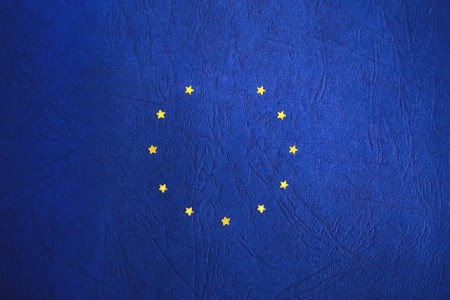
Brexit – Public domain image courtesy of freestocks.org, 2016

However, there are also practical issues that need to be considered right now, as the UK government wrangles over the deal for borders and trade relationships that will impact on how museums undertake their day-to-day business. In particular there are significant issues relating to how membership of the Customs Union plays out.

This became a reality for me when I  was assessing the status of research loans to the UK from the National Museum of Ireland, where I am the Curator of Zoology & Entomology. I have to deal with quite a lot of research loans of type specimens to taxonomists and getting material across borders can be quite nerve-wracking thanks to the attitude of the occasional overzealous border official – who can forget the horrific incident last year in which 105 botanical specimens (including six types) were incinerated by Australian border control?

Continue reading