Wild About Portsmouth – Discovering Portsmouth’s Natural History Collection

Written by Christine Taylor, Curator of Natural History, Portsmouth Museums

In March 2018 Portsmouth City Council was awarded a £79,700 grant to deliver a ‘Wild about Portsmouth project in order to raise the profile of the city’s Natural History collection. In addition to appointing a curator and an assistant, the project enables the development of natural history advocates and a team of volunteers to work on and promote the collection. The project also aims to engage with people in a variety of ways, from family activities to specialist workshops, with the view of participants helping to inform priorities for collection development and new displays.

As a curator with over 20 years’ experience in Hampshire, I have always been aware of the collection but had very little knowledge of it. The last Natural History Curator was 10 years ago and, apart from the occasional request, little had been done to develop the collection. An initial overview showed that the collection was (mainly) in good condition, packed into archival and museum quality boxes awaiting rediscovery.

One of the first tasks was to get an idea of the scope of the collections and their associated collectors. Another task was to recruit volunteers to assist with rearranging the collections to get them into taxonomic order and to catalogue them or update the Modes database with provenance data. To date 10 volunteers have been recruited and are currently working on the geology, shell and botany collections. Once the entomology collections have rehoused over the next few months (the cabinets are currently stored side-on making access to them rather difficult), volunteers will be recruited to re-stage, re-organise and catalogue them.

Continue reading

And the Winner is…

Written by Lucie Mascord, Natural History Conservator, and NatSCA Committee Member.

Through August to October this year, NatSCA ran its very first competition. Running up to the Caring for Natural Science Collections one-day conference at Oxford University Museum of Natural History (on 17th October 2018), the competition asked participants to post natural history conservation themed photographs to Twitter with the hashtags #NatSCAConservation and #photocomp.

Whilst it took a little while to warm up, buoyed by some fantastic images posted by the NatSCA conservation working group, we received some excellent entries, resulting in a close competition for first place.

The entries ranged from geology to taxidermy, from the humorous to the technical. This was the exact response we were looking for, illustrating the variety and accessibility of conservation.

When it came down to it, the winning photograph was an excellent composition, highlighting the complexities of conserving an unusual object.

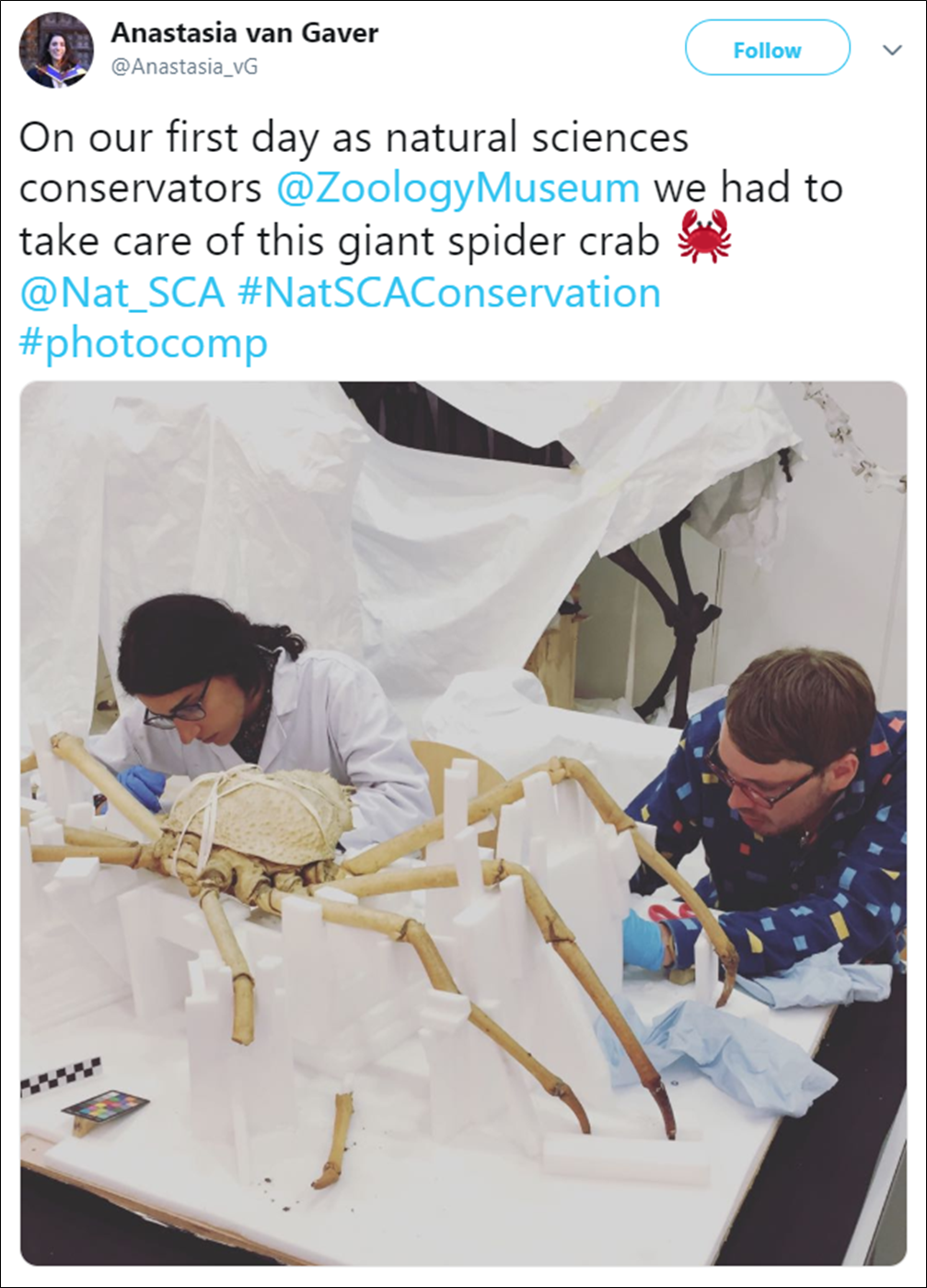
The winner is this fantastic entry from Anastasia van Gaver, which features Anastasia and her colleague Samuel Suarez Ferreira on their first day at work at the Museum of Zoology, University of Cambridge, (@ZoologyMuseum), image taken by Natalie Jones. Talk about being thrown in at the deep end with this monster of a giant spider crab. Both Anastasia and Sam attended the conference in October and gave talks on specific conservation experiences during their contracts at the Museum of Zoology. To be able to spotlight emerging professionals working with natural history collections was one of the main achievements of the conference and competition.

The winning entry from Anastasia van Gaver, Natalie Jones, and Samuel Suarez Ferreira. © Museum of Zoology, University of Cambridge.

Anastasia says; “The Cambridge University Museum of Zoology reopened in June, following a major HLF funded redevelopment. I was lucky to be one of the conservators to join the team for this project and this picture was taken on my very first day at the Museum, in August 2017. Having just visited the stores and the lab, my new colleague Samuel Suarrez Ferreira and I got given the task of making this Japanese spider crab fit for display! I submitted this picture for the competition not only because of the great memories I have of the best possible first day a natural sciences conservator could ask for, but also because it is a good example of team work: Sam and I decided on treatment together, then each conserved one side of ‘Krabby’, before the mountmaker Rebecca Ash designed an intricate bespoke metal support for it.”

Continue reading

NatSCA Digital Digest – November

Written by Sam Barnett, NatSCA Volunteer and PubSci Committee Member

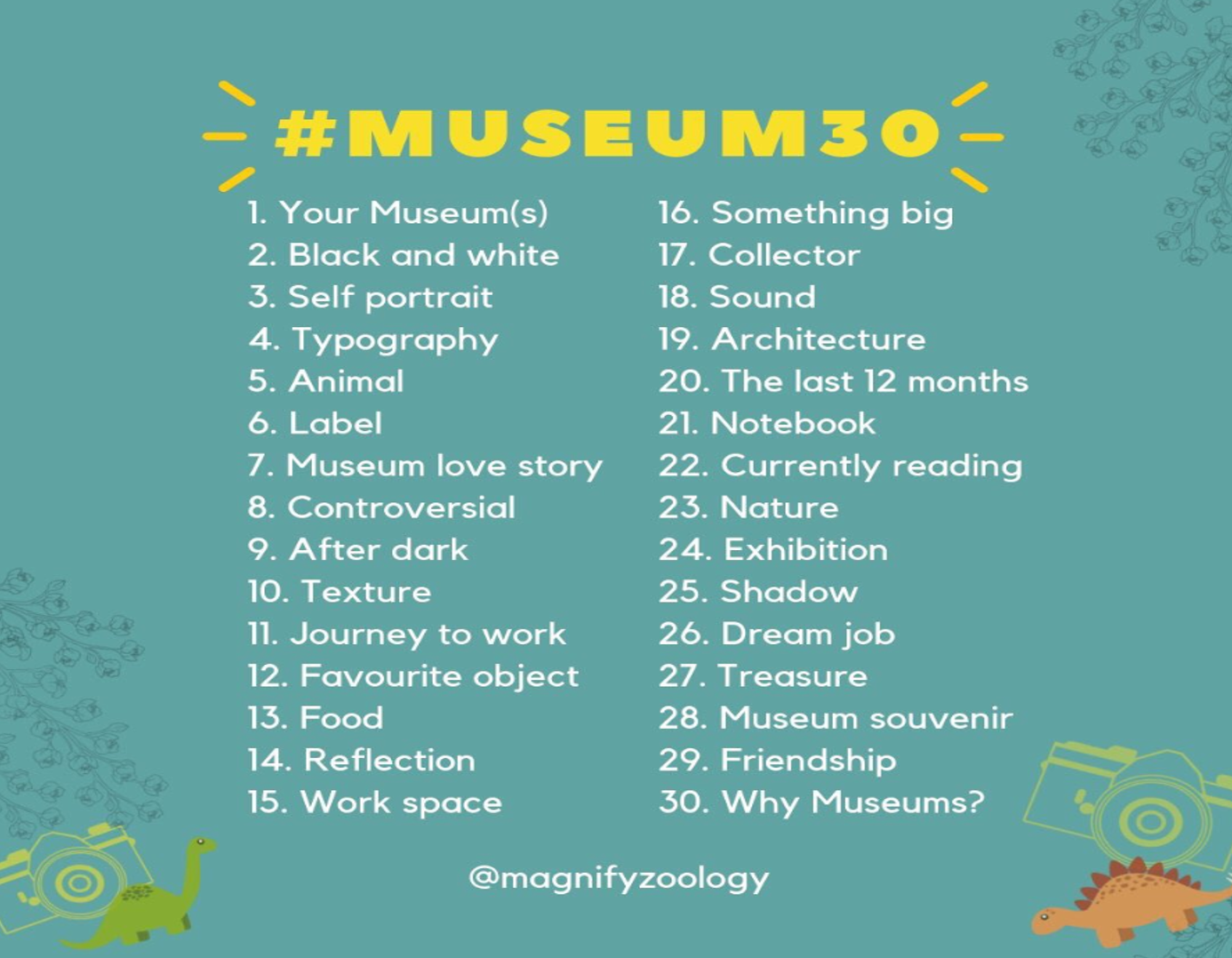
Welcome one and all to the November installment of the NatSCA Digest. First of all, I hope you’re all enjoying the #Museum30 social media event, which runs throughout November on Twitter. It’s not too late to get involved with it, check out the list here:

The Museum 30 list is compiled by Museum Studies and Archaeology student Gracie Price.

First, an Announcement

It’s that special time of year again when NatSCA release their Call for Papers for next year’s NatSCA Conference. Due to be held in May 2019, the conference will be exploring themes under the banner Collections Success. You have until the 4th of January to submit your abstract, and can find the full details here – we can’t wait to see what you come up with for us next year!

Where Should I Work?

Continue reading

Collectors, Collections and the Geology of SW Britain – A View from the Audience

Written by Nadine Gabriel, a recent UCL geology graduate and an emerging museum professional.

This article is a joint paper for the Geological Curators’ Group and the Natural Sciences Collections Association, and has subsequently been published on both blogs.

On the 18th September 2018, I attended the Collectors, Collections and the Geology of Southwest Britain meeting. This joint meeting between the Geological Curators’ Group (GCG) and the History of Geology Group (HoGG) was held at the Bath Royal Literary and Scientific Institution (BRLSI), and it was also my first ever GCG event! If you have an interest in British geology, you probably know that the southwest of Britain has amazing geology, but this meeting – with around 80 attendees – also looked at the people who have dedicated their lives to exploring this geologically diverse region.

The day started off with a keynote speech from Steve Etches who spent over 35 years collecting fossils from the Jurassic Kimmeridge Clay deposits of southwest England. His collection of over 2,300 fossils found an exciting new home in 2016; the Etches Collection museum in Kimmeridge, Dorset. It was interesting to find out about the difficulties associated with starting a museum from scratch, but despite the initial challenges, the museum looks incredible and is filled with a diverse array of scientifically important specimens.

Many of the talks focused on the enthusiastic collectors of the southwest. My favourite story was about Charles Moore (1815-1881), a palaeontologist from Ilminster, Somerset. In 1858, he purchased three tonnes of gravel from Holwell, Somerset for 55 shillings. This massive purchase turned out to be filled with Rhaetian (208.5 to 201.3 million years old) fish, mammal and reptile fossils. Moore also collected fossils from the Lower Jurassic limestone of Strawberry Bank in Ilminster, and these fossils are now cared for by our hosts, the BRLSI. During the coffee break, Matt Williams (the BRLSI collections manger) showed us a selection of Moore’s stunning fossils.

Continue reading

Harry Higginson: Distributing Dodos in the 1860s

Written by Clare Brown, Curator of Natural Science, Leeds Museums and Galleries.

Curators are often asked to name their favourite object. I’ve got loads and swap between them all the time: the adult longhorn beetle that emerged from someone’s wooden sofa after a few years of chewing, our thylacine mount, the dude-y little rock hyrax with attitude, the Peruvian “mummy’s eyes” (read squid lenses), that gorgeous La Brea tar pits water beetle… My favourites at the moment are our dodo bones. Yes they’re dodo bones and so, obviously, are amazing but the story behind how Leeds came to have them is wonderful too.

It all started in 1838 in Thormanby near York where little Harry Higginson was born. He progressed through school in Leicester and an apprenticeship in Manchester to a railway construction job in Mauritius in 1862. Harry’s completely brilliant ‘Reminiscences of Life and Travel‘ is a great read. It’s packed full of amazing 19th century colonial derring-do from out-galloping the monsoon in a gorge to unbelievable childcare practices (burying them up to their necks in sand) to feeding a friend a dead – and extremely tough – donkey ‘as a lark’. It is in this book that Harry describes the moment when the dodo story gets more interesting:

Shortly before the completion of the railway I was walking along the embankment one morning, when I noticed some [locals] removing some peat soil from a small morass. They were separating and placing into heaps, a number of bones, of various sorts, among the debris. I stopped and examined them, as they appeared to belong to birds and reptiles, and we had always been on the lookout for bones of the then mythical Dodo. So I filled my pocket with the most promising ones for further examination.

And guess what? They were dodo bones and Higginson then kindly sent a box full to York, Liverpool and Leeds Museums. We all still have them.

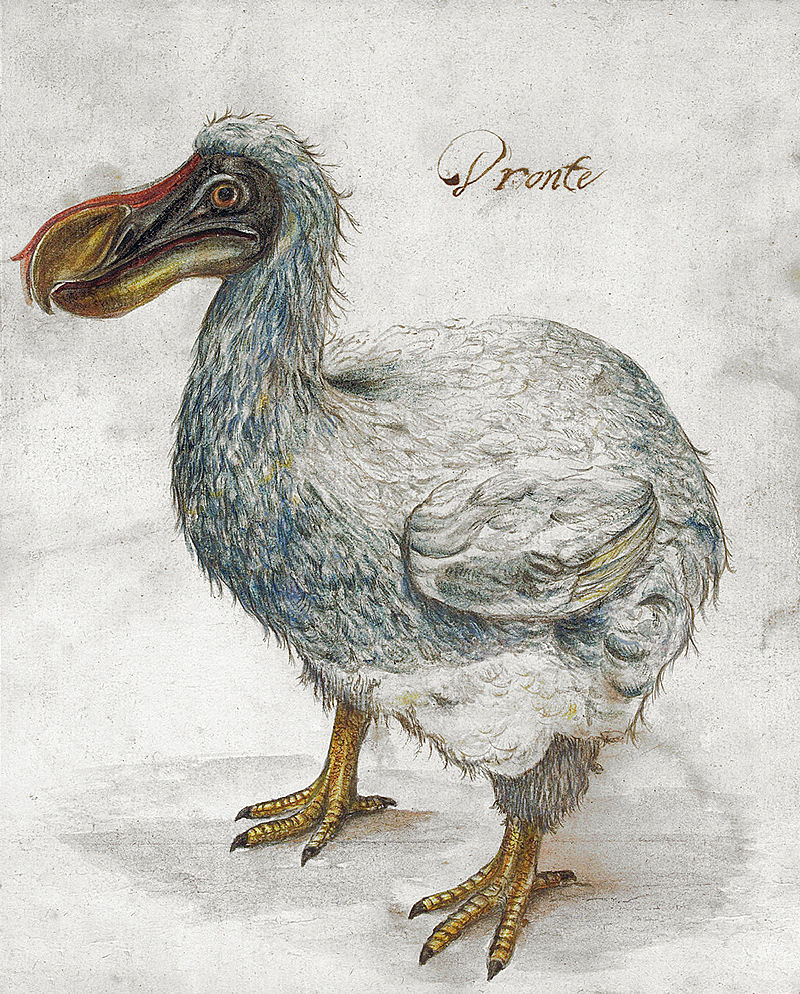
This beautiful watercolour of a dodo dates back to the 17th Century. During this period, ‘dronte’ (as seen in the image) was the word used in Dutch, French and Italian for the dodo. © Image in public domain.

Continue reading