NatSCA Digital Digest – February 2024

Compiled by Ellie Clark, Collections Moves Team Leader at the Natural History Museum.

Welcome to the February edition of NatSCA Digital Digest.

A monthly blog series featuring the latest on where to go, what to see and do in the natural history sector including jobs, exhibitions, conferences, and training opportunities. We are keen to hear from you if you have any top tips and recommendations for our next Digest, please drop an email to blog@natsca.org.

Sector News

The Society for the History of Natural History (SHNH) Early Career Researcher Symposium – Registration open

The Early Career Researcher Symposium is an event dedicated expressly to showcase research into the history of natural history being done by doctoral and early career researchers across the globe.

This online event will be on Thursday 22 February 2024. Registration is free but required. You can find the programme along with more information here.

The SHNH have a range of other events happening throughout the year including a joint seminar with the Animal History Group, a visit to the University Herbarium at Winterbourne House and Gardens, as well as their Annual Conference. Note that their AGM will be held online and separate from the conference to ensure as many members as possible can attend.

Geological Curators Group 50 Year Anniversary – Call for Abstracts

The Geological Curators Group 50 Year Anniversary will be held from the 17th – 18th of May 2024 at the University of Leicester.

Day 1: Presentations on the theme of past, present and future of geological collections at the University of Leicester. Reception at Leicester Museum & Art Gallery, followed by an evening meal.
Day 2: Presentations and tours at British Geological Survey Nottingham and Charnwood Forest Geopark

Please send abstracts of up to 250 words to events@geocurator.org and state whether it is for a poster or platform presentation. Abstract deadline is 1st March 2024. Presenters will be invited to submit papers for a special golden anniversary issue of Geological Curator.

Continue reading
Snagged Setae 2, The Sequel: Packing Materials After 14 Years in Fluid Storage

By Lu Allington-Jones (Senior Conservator), Wren Montgomery (FTIR Specialist) and Emma Sherlock (Senior Curator), The Natural History Museum, London UK

Many years ago, we undertook some research into a suitable replacement for cotton wool as bungs for vials holding small fluid-stored specimens. In 2008 we placed samples of Parafilm MTM, white Plastazote® LD45 and colourless HDPE (high-density polypropylene) lids in 10% formalin, 100% ethanol, and 80% IMS (Industrial Methylated Spirit, aka Industrial Denatured Alcohol) and allowed them to steep for 3 years. We undertook visual inspections, pH tests and FTIR analysis and concluded that Parafilm MTM was an unsuitable replacement, but that the other materials had undergone no change and had caused no contamination of the host fluids.  

We decided to revisit the samples after an additional 11 years on a south-west facing sunny lab windowsill, for a total of over 14 years of storage in the various fluids. 

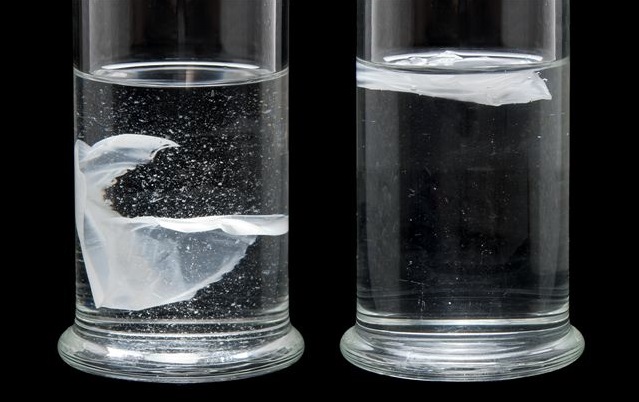
The state of ParafilmTM after only 3 years: particles are visible to the naked eye in the 100% ethanol on the left. The ParafilmTM in the formalin on the right showed a thinning and perforation at its edges. ©The Trustees of the Natural History Museum
Continue reading

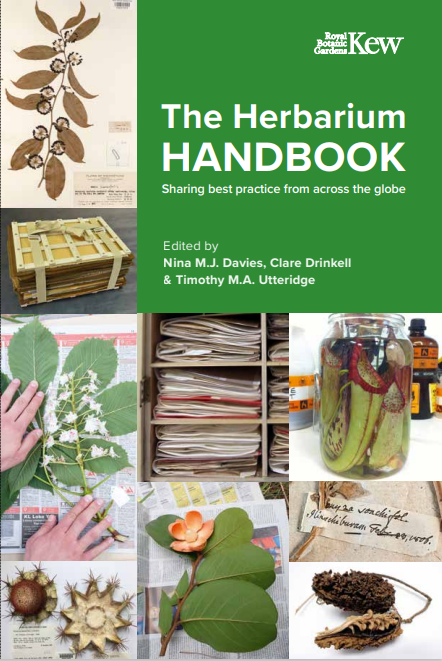
The Herbarium Handbook – Sharing Best Practice from Across the Globe.

Submitted by Clare Drinkell, Senior Curator Botanist at the Royal Botanic Gardens, Kew.

Editors: Nina Davies, Clare Drinkell, Timothy Utteridge. 290 pp, 234 x 156 mm. Over 700 colour photographs. Paperback, ISBN 9781842467695. Kew Publishing, TW9 3AE, UK 2023. £25.00. https://shop.kew.org/kew-herbarium-handbook

Cover page of The Herbarium Handbook

The new Herbarium Handbook is a key new addition to Kew Publishing’s series of handbooks, including The Plant Glossary and The Temperate Plant Families Identification Handbook. Unlike the other books in the series the Herbarium Handbook is a new version of a book first compiled and edited by Kew botanists some thirty-four years ago. The initial Herbarium Handbook came about following an extremely popular International Diploma Course in Herbarium Techniques at Kew. The demand to attend the course was so high that the number of applicants far exceeded places on the course. In view of the interest, the main information imparted during the course was published as a manual, widely recognised as an important reference for fundamental aspects of herbarium care and management.

Continue reading

NatSCA Digital Digest – January 2024

Compiled by Milo Phillips, Assistant Curator of Entomology, National Museums Scotland.

Welcome to the January edition of NatSCA Digital Digest.

Wishing a Happy New Year to all our readers!

Digital Digest is a monthly blog series featuring the latest on where to go, what to see and do in the natural history sector including jobs, exhibitions, conferences, and training opportunities. We are keen to hear from you if you have any top tips and recommendations for our next Digest, please drop an email to blog@natsca.org.

Sector News

NatSCA 2024 – Submission Reminder

There’s still time to submit for the 2024 NatSCA Annual Conference! The Annual Conference & AGM of the Natural Sciences Collections Association will be held on Thursday 18th and Friday 19th April 2024, in the Oxford University Museum of Natural History.

Papers can be presented in any of several formats: A 20-minute presentation (consisting of a 15-minute talk followed by 5 minutes of Q&A) or a 5-minute lightning talk. Talks can be presented in person or by submission of a pre-recorded presentation, with the option of an in-person or live stream Q&A (via Zoom).

Deadline for submission: 5pm GMT Friday 19th January. More info and submission forms here.

Museums and Galleries History Group 2024 Symposium

A one-day symposium held at the University of Leeds and online. Microhistory aims to direct attention towards marginal(ized) voices and perspectives and emphasizes the agency of the ‘ordinary’. This symposium will explore the relationships between large historical narratives and individual case studies and their use in disrupting established grand historical narratives, countering oversimplification.

The symposium will be held on January 26th. More information and registration here.

Continue reading

Top NatSCA Blogs of 2023

Compiled by Jen Gallichan, NatSCA Blog Editor.

To celebrate all of your wonderful contributions to the blog in 2023, here is a round up of the top ten most read blogs of the year. I want to take this opportunity to thank everyone who contributed an article. And what a bumper year it has been with articles covering decolonisation work, collections moves, exhibitions, workshops, collections research and management. The NatSCA blog is driven solely by your contributions and it is stands as a testament to the hard work you are all in doing despite challenging times.

I am pleased to say that the 2024 blog calendar is open for business, so drop me a line if you would like to contribute.

In descending order…

10. William Thomas March, a Jamaican Collector, Naturalist and Early Pioneer of Biological Data Recording in Jamaica. Written by Olivia Beavers, Assistant Curator of Vertebrate Zoology at World Museum, National Museums Liverpool. We kick of with a great blog looking at the work Olivia Beavers has been up to in Liverpool to highlight the work of a collector whose contributions to understanding Jamaican biodiversity are not yet fully recognised.

9. People and Plants Workshop Three: Sharing Knowledge in the Amazon. Written by Fiona Roberts (Collaborative ESRC PhD student, Cardiff University & Amgueddfa Cymru-National Museum Wales) and Violet Nicholls (Assistant Curator in Herbarium, Portsmouth Museums). The People & Plants workshops were an interesting series of training events focusing on decolonising collections. This article reviews the last of these events which addressed the question of how ethnobotanical collections in museums can best be used to support Indigenous communities.

Continue reading