Taxidermy and the Country House: Where Natural History Meets Social History – a review 

Written by Jack Ashby, Assistant Director of the University Museum of Zoology, Cambridge.

Pat Morris is the authority on the history of British taxidermy, and there is arguably no-one better to write an exploration of the specific context of taxidermy collected for and displayed in private country houses. Although their materiality is identical, by their nature, these collections are often conceptually very different – the antithesis, even – to those in public museum. These differences are not the focus of the book, nonetheless this perspective offers great potential to help us consider more roundly the story of taxidermy and those that made and collected it.

The similarities museum and country house collections do share include their origin-stories, and of course the practicalities of preserving specimens. Like museums, these private collections trace their histories back to cabinets of curiosities. Preservability was fundamental to what could be kept, and Morris begins by explaining that early cabinets of curiosities in country houses were mainly items that required no preservation – dry materials like shells and bone. The only skins that were widely kept were those that could be simply dried without being prone to insect attack, which is why durable specimens like taxidermy crocodiles, hollowed-out armadillos and inflated pufferfish were commonplace in these early collections, rather than the birds and mammals which later became the norm.

Continue reading

NatSCA Digital Digest – March 2024

Compiled by Olivia Beavers, Assistant Curator of Vertebrate Zoology at World Museum, National Museums Liverpool.

Welcome to the March edition of NatSCA Digital Digest.

A monthly blog series featuring the latest on where to go, what to see and do in the natural history sector including jobs, exhibitions, conferences, and training opportunities. We are keen to hear from you if you have any top tips and recommendations for our next Digest, please drop an email to blog@natsca.org.

Sector News

NatSCA Annual Conference & AGM 2024

Registration is open for the 2024 Annual Conference & AGM of the Natural Sciences Collections Association. Trials and Triumphs: sharing practice across the museum sector will be held on Thursday 18th and Friday 19th April 2024 in the Oxford University Museum of Natural History. This practical conference aims to celebrate triumphs and amplify successes in museums, but also highlights pitfalls and lessons learned from situations that didn’t go as planned. Members – please remember to contact membership@natsca.org for your promotional code to release discounted tickets.

The event will be physical/digital hybrid, with attendees able to attend in person or online via Zoom. Follow the link for more details and to register.

Continue reading

Mainstreaming Biodiversity in Museums

Written by Henry McGhie, Curating Tomorrow henrymcghie@curatingtomorrow.co.uk.

Link to the guide: https://curatingtomorrow236646048.files.wordpress.com/2023/11/mainstreaming-biodiversity-in-museums_2023.pdf

‘Mainstreaming’ is a policy and planning approach that means that we don’t just create a new programme or strand of work, but that we embed it across all activities. We can embed support for biodiversity and environmental concerns across museum activities. Why is this important? Well, for a few reasons. Firstly, biodiversity is not yet fully mainstreamed into museum thinking – in terms of their goals, actions, or evaluation. Second, museums present a massive potential to support biodiversity in different ways, notably through education, research, public awareness and partnerships. Third, museums make big negative impacts on biodiversity and the environment, through their contributions to climate change (from use of energy, waste, and visitor emissions), and their involvement in environmentally damaging activities (e.g. how their investments are used). Fourth, because biodiversity is in deep crisis: species continue to decline, major challenges are getting worse, and there is no clear prospect of a change for the better. Lastly, fifth, because people and nature are interdependent: if the environment suffers, people and communities suffer.

Continue reading

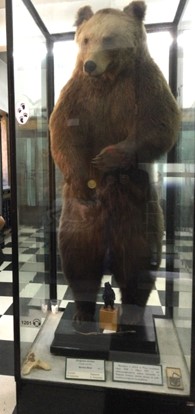
A Prize Winning Brown Bear in Sofia.

Written by Richard Crawford, who has just completed a PhD thesis at the University of the Arts London, entitled ‘Re-presenting taxidermy; Contemporary Art interventions in Natural History Museums’.

I am used to seeing trophy specimens in mainstream natural history museum collections – for example, the crouching tiger shot by King George V in 1911 that is on display in the natural history galleries at the Royal Albert Museum in Exeter – but I was surprised to see a taxidermy specimen of a big Brown Bear at the National Museum of Natural History, Sofia, holding a medal that it had been awarded at the Berlin International Hunting Exhibition in 1937.

The prize winning brown bear in Sofia Natural History Museum

The 1937 Berlin International Hunting Exhibition showcased all manner of hunting trophies including mounted antlers, boar heads, bear skins and various taxidermy animals. It also featured demonstrations with live animals, including hunting eagles and a pack of beagles. The event was given official approval by the then prime minister, Hermann Goering, who opened the exhibition amid fluttering Nazi flags and rows of hunters dressed in smart grey uniforms. In his opening remarks, Goering stated his view, that hunting could promote international peace:

Continue reading