NatSCA Digital Digest

natscaYour weekly round-up of news and events happening in the world of natural sciences
Jobs

Curator, Grant Museum of Zoology, UCL I can tell you from three years of first-hand experience (pseudo-first-hand; as curatorial assistant) that this is the job all curators should be applying for. The Grant Museum of Zoology is an amazing place to work and in this role I know you will have the opportunity to spread your curatorial wings and make a real difference in the natural history sector. The kind of job where you don’t mind getting up in the morning. Closing date for applications is 3rd August. Good luck!

If only for the superb job title, anyone with experience of learning programmes for families and children with ASC (Autistic Spectrum Condition) should definitely take a look at the current vacancy for the Dawnosaurs Programme Co-ordinator at the Natural History Museum. This looks like an amazing opportunity for the right person. The closing date for applications is the 22nd July.

See the job page of the NatSCA website for more exciting opportunities.

News

The next Museums Association exhibition and conference is due to take place on 5th and 6th November, in Birmingham. There is still time to register as an early bird who gets the cheaper worm rates. Early bird registration ends on the 7th August, click here for more.

Around the Web

Sun bear, fox, hippo or pangolin. What tickles your natural history bones the most? Choose your favourite to be the new museum mascot for Derby Museum and Art Gallery! If you are on Twitter, you can whip up some support for the sun bear, errr, I mean, your favourite using: @DMNature and @derbymuseums. The winning specimen will be announced on the 7th August. I’ve already chosen mine, can you guess what it is…?

The Friends of Crystal Palace Dinosaurs have been working up a storm of support lately, with ongoing events at the park complemented by a very dynamic talk at the Grant Museum by the master of science comedy- Prof Joe Cain, from UCL. These incredible statues are a vivid reminder of the evolution our concept of dinosaur appearances has gone through. They are also an important part of our British cultural heritage, that helped shape the palaeontological world in the mid 1800s. Find out more about these iconic statues that are in desperate need of conservation on the Friends of Crystal Palace Dinosaurs website.

 

Handle with care: bringing museum egg collections to life

This post is another in our series of presentation write-ups from the 2015 NatSCA Conference, Museums Unleashed!


How can we bring museum egg collections to life?

Egg collecting is now illegal in the UK and has been for many years. Possibly because of the legal situation, and the social stigma understandably attached to egg collecting today, museums can be reluctant to publicise their egg collections, even though they are entitled to do so. For example, out of the thousands of eggs held by Glasgow Museums, only a handful are currently on public display, which is a pity as they are beautiful and fascinating objects.

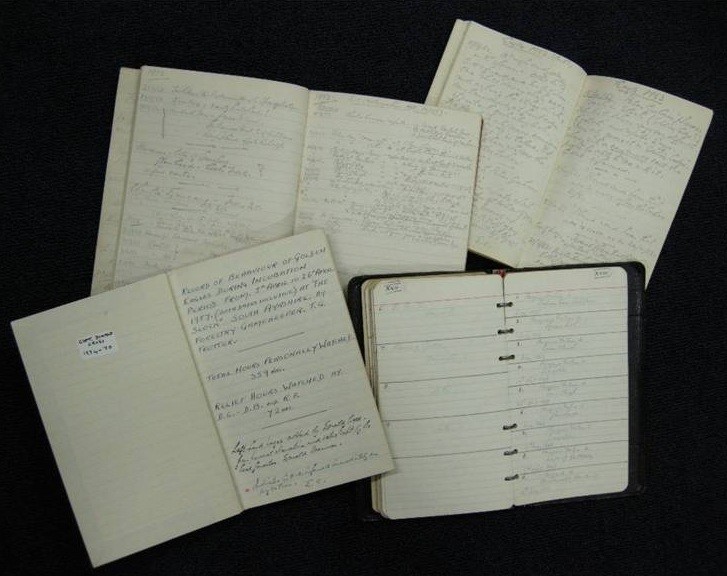
These issues form the basis of my PhD, which is a Collaborative Doctoral Award with Glasgow Museums and the Geography Department at the University of Glasgow. I have been researching the cultural and social aspects of egg collecting (also known as ‘oology’), which was a very popular pastime among both adults and children from the Victorian era well into the twentieth century. I have been researching collectors’ diaries held by Glasgow Museums, and also investigating the wider world of British egg collecting via old egg collecting magazines. This material has revealed some of the people, places, and practices of egg-collecting, which could provide new possibilities for communicating the stories of the birds’ eggs held by Glasgow Museums.

A selection of egg collectors' notebooks and diaries

A selection of egg collectors’ notebooks and diaries

Egg-collecting interconnections

One of the most striking aspects of this research has been the interconnectedness of the British egg-collecting world. These connections can take various different forms. For example, egg collections have been donated to Glasgow Museums by individual collectors who knew each other, such as Captain Donald Cross and Peter Hay, who both lived in Ayrshire in the 1940s, where Cross was a farmer and Hay was a schoolboy. Cross shared his collecting knowledge with Hay, and sometimes even gave him eggs to add to his collection.

Eggs taken by a collector called E. S. Steward over 100 years ago have arrived at Glasgow Museums by two very different routes. Some were given by Steward to his friend Robert Arbuthnott, whose son donated his collection in 1967. More recently, in 2014, we received an egg collection confiscated by police after a collector was convicted of trading in eggs, some of which were very old. A few of these eggs were also taken by Steward, and must have passed through various different intermediate collections, along convoluted geographical journeys, before arriving at Glasgow Museums.

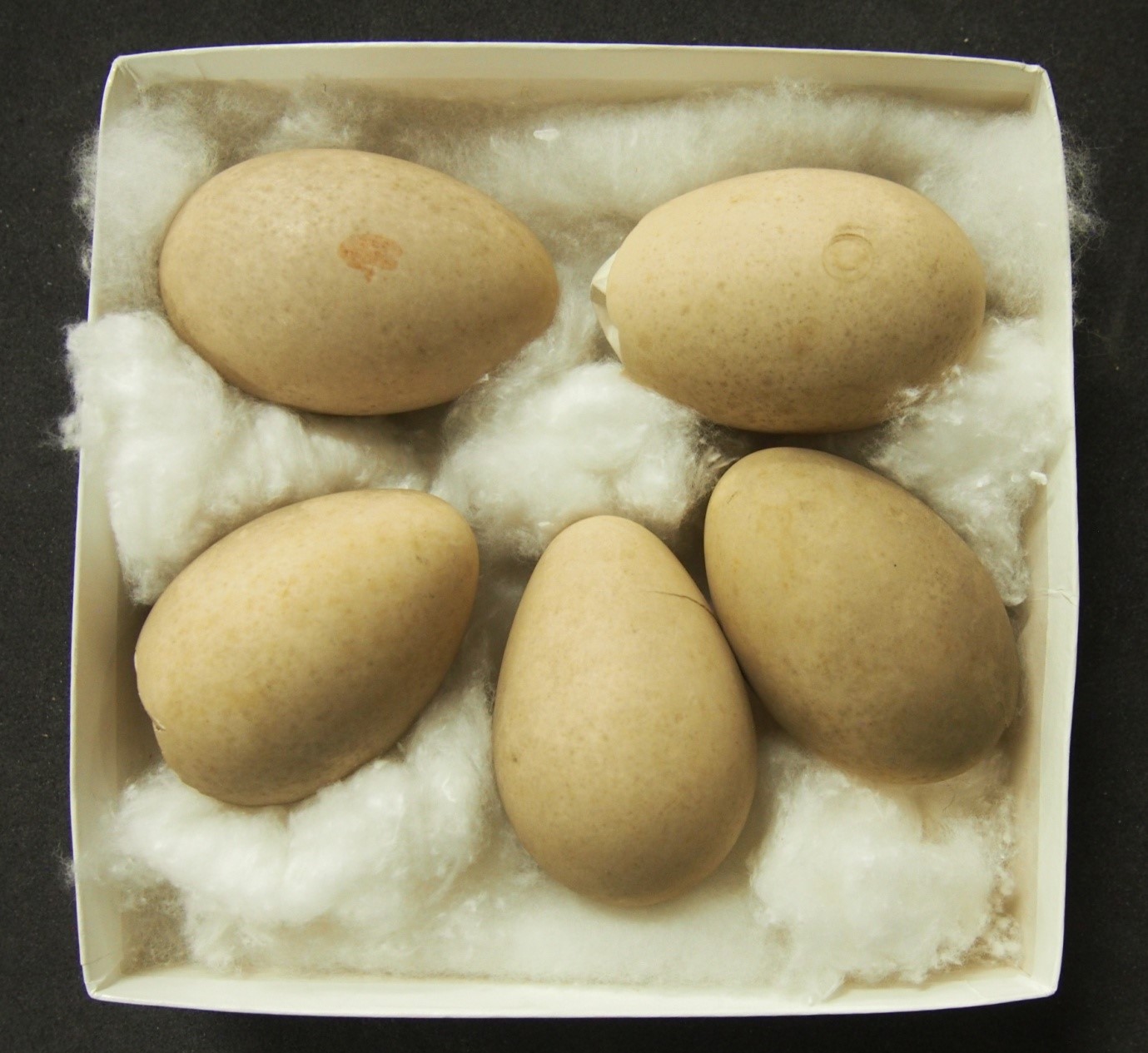
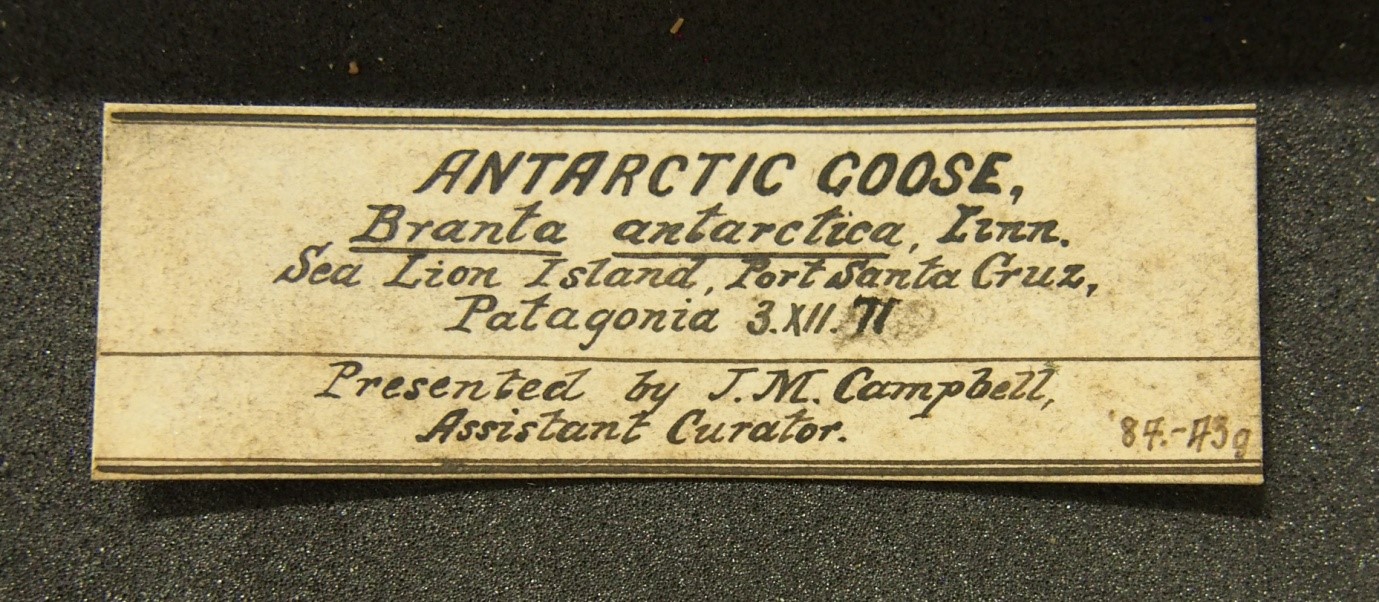
Eggs taken by another collector have ended up at different museums. On National Handwriting Day in January, the Natural History Museum’s brilliant oology Twitter feed featured a beautifully scribed red-legged cormorant egg from a collector called John MacNaught Campbell. He was the second Natural History curator at Kelvingrove Museum in Glasgow, and one of the earliest egg collectors to visit South America. Glasgow Museums also have some of his eggs, including this Antarctic goose set collected just three days after the Natural History Museum’s egg, on 3 December 1871.

Clutch of Antarctic goose eggs collected by John MacNaught Campbell in 1871

Label for Campbell's goose egg clutch

Clutch of Antarctic goose eggs collected by J. M. Campbell in 1871

Telling the interconnecting stories of these collectors, and others, could be a way of showing the human side of egg collecting, while being careful not to encourage the practice today. This could be via traditional media, such as museum exhibitions, online catalogues, or using social media.

Finally, a request: I’m keen to trace any other eggs that were collected by ES Steward, as I’d like to see how widely his collection has been dispersed. If any of you know of any of his eggs in your collections, I’d be very interested to hear from you, at e.cole.1@research.gla.ac.uk.


Edward Cole
PhD student, University of Glasgow/Glasgow Museums

NatSCA Digital Digest

natscaYour weekly round-up of news and events happening in the world of natural sciences

Events

12th-14th October: Discovering Collections, Discovering Communities: Exploring new digital destinations for heritage and academia at The Imperial War Museum North, Manchester. Free conference exploring the use of digital, in museums environments.

22nd July: Digital vs. Analogue at Oxford University Museum of Natural History. One day conference looking at four themes: Tactile Engagement, Story Telling, Families and Schools, and Digital Displays.

8th September: Osteology Day at University Museum of Zoology, Cambridge. A one day hands-on workshop covering aspects of osteology such as bone cleaning, rearticulation, restoration, identification and preparation.


News

The Palaeontological Association is advertising for a new Executive Officer, after the sad news of Tim Palmer’s retirement. Closing date for applications is 21st August 2015.

Did you know that Dubai Aquarium in the UAE has the world’s largest single piece of acrylic. It is pretty hefty at an impressive 70 cm thick, but it is not always with the most reliable seals, as they found out in 2010


Around the Web

What do you do with a dead fish? Check out this blog for a unique idea: Printing and Reanimating the Dead.

**JURASSIC WORLD IS OUT** And smashing Box Office records. Of course. This review is great, but if you haven’t seen the film yet (firstly- why not? and secondly…) it contains spoilers!


Got a submission for the blog or Digital Digest? Email us at blog@natsca.org

Objects, Meet World! Using Tumblr to Bring Collections to New Audiences

This post is another in our series of presentation write-ups from the 2015 NatSCA Conference, Museums Unleashed!


In 1901, Victorian tea trader Frederick Horniman opened his museum (The Horniman Museum and Gardens, in London) with the ideal of bringing the world to Forest Hill. His collections were vast and varied, encompassing Anthropology, Natural History, and Musical Instruments. They have been added to extensively over the years.

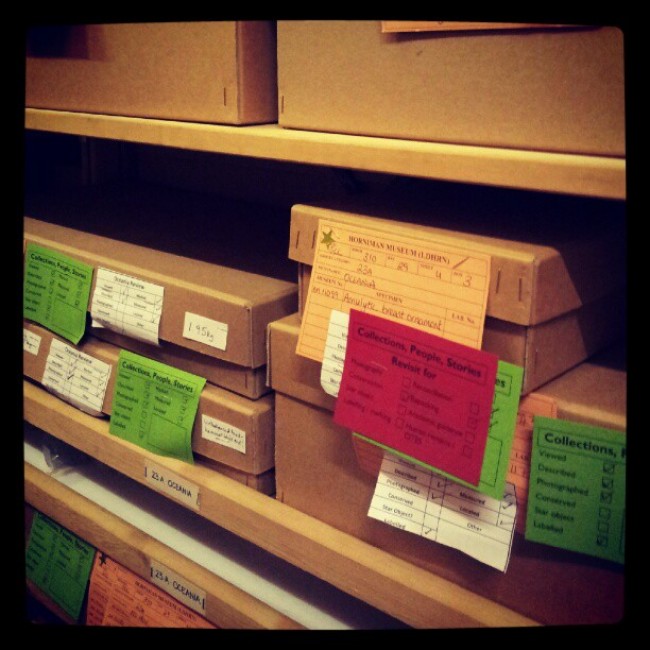
In 2012, the Horniman embarked on a three-year review of our Anthropology collections, Collections People Stories, with the aim of getting a clearer picture of what we now have and learning more about our objects, in order to inform a planned redisplay of some of our galleries.

The review project was an enormous undertaking, involving staff from across the museum as well as external experts and community groups. The progress of the project was shared on the museum’s blog, but we also wanted a more informal way to share the day-to-day work of our review team, and to highlight some of the amazing objects we saw every day as we ploughed systematically through the Study Collections Centre.

Boxes of objects in the Horniman's stored collection

A review in action: lots of coloured labels!

Tumblr fit the bill nicely: it is a microblogging (think very short-form) platform that can accommodate a variety of content, including text, pictures, video, and audio. We’ve found it works best with images, plus a small amount of text to explain what the object is and why it’s interesting. Posting is quick and simple, so it can fit into a busy workflow easily. Tumblr is also a great way of reaching a large audience with little initial effort, thanks to the snowball effect: followers can ‘reblog’ our posts, sharing them on their own page, and then other people reblog it on from there, and it can just keep going!

Our page, In the Horniman, was set up in September 2012. The review team were given control of the page, and let loose! Our agenda with Tumblr is not overtly educational; we aim simply to share our enthusiasm for the collections with our followers. We choose objects just because we like them – anything that makes us say ‘Wow, that’s amazing!’ is an instant Tumblr candidate.

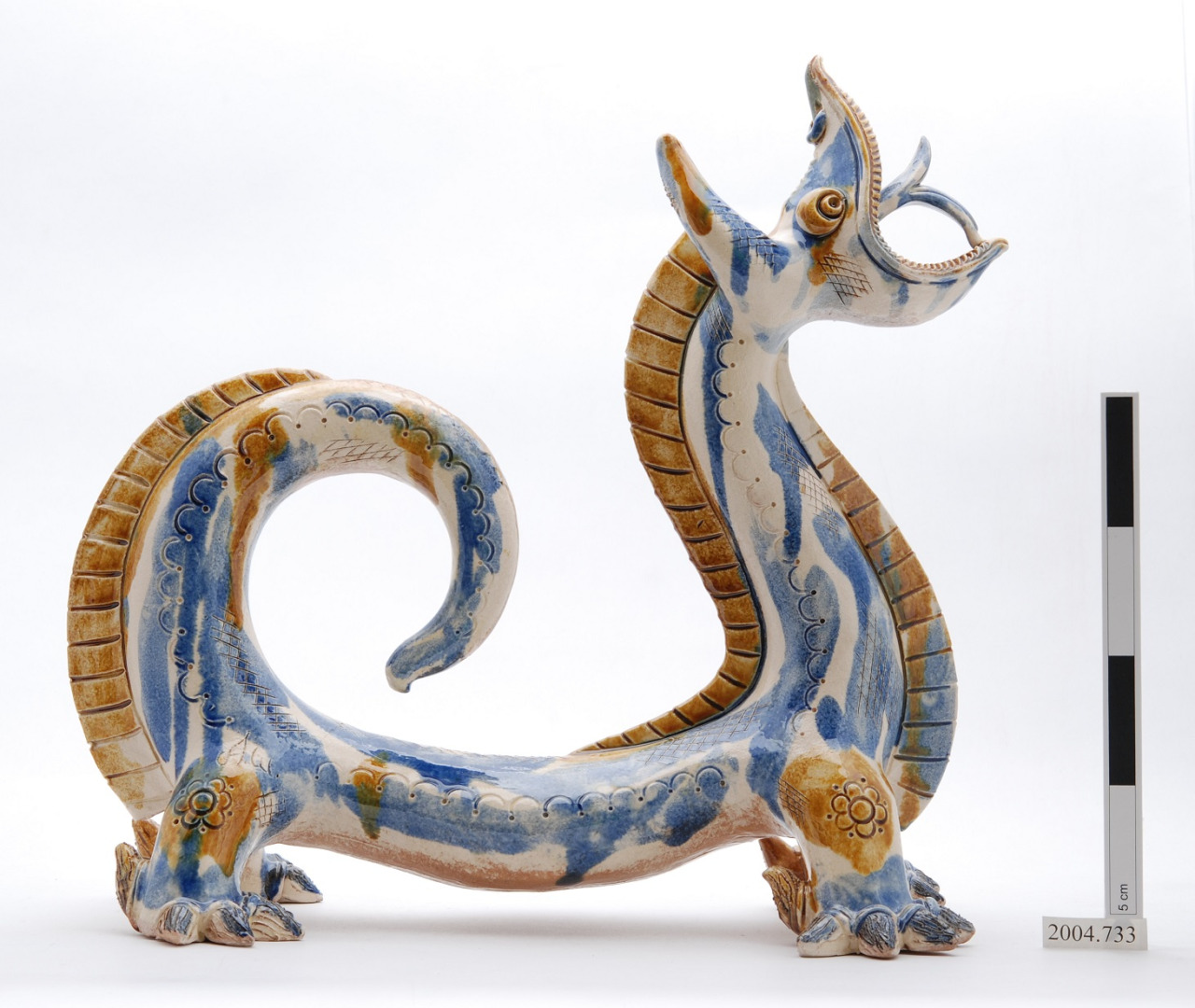
"Wow, that's amazing!" - a beautiful ceramic dragon from Uzbekistan (Image: Horniman Museum & Gardens)

“Wow, that’s amazing!” – a beautiful ceramic dragon from Uzbekistan (Image: Horniman Museum & Gardens)

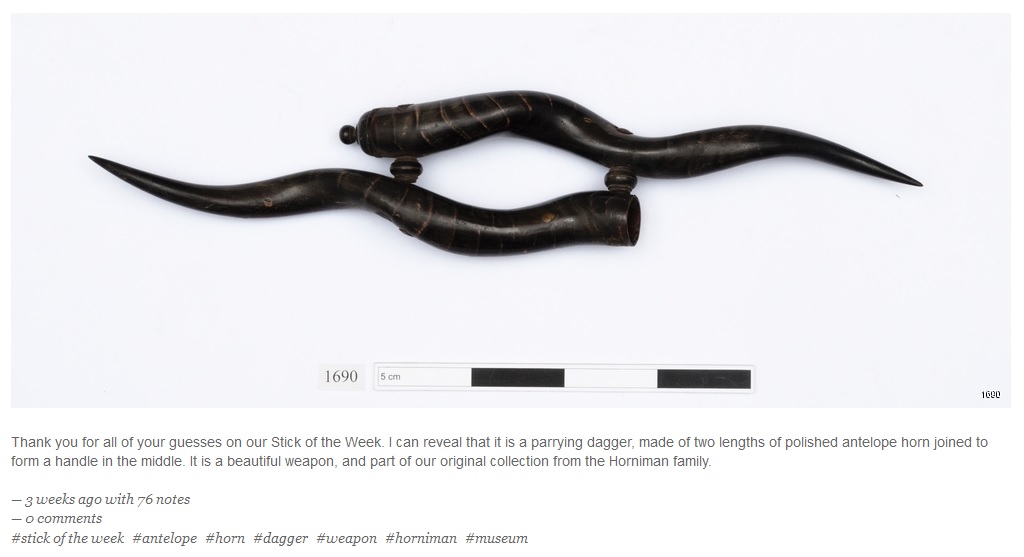
We didn’t just want to share pretty pictures with our followers, though. We also wanted to encourage engagement. This is not as easy as it sounds, because of the way Tumblr works: followers can ‘like’ or ‘reblog’ posts with one click, but commenting is less common because it takes more effort. But without us even trying, it was happening: people were commenting on our posts, sometimes even telling us things we didn’t know about the objects. So we started an interactive feature called Stick of the Week, in which we share an image of a stick-like object and ask the good people of Tumblr to guess what it is. We have many such objects in the collection, and wanted to share them to highlight that any object can be interesting when you know its story! Stick of the Week sounds silly, but it has (hopefully!) got our followers looking at and thinking about objects differently, and allowed us to open up a dialogue.

Stick of the Week: a parrying dagger made of antelope horn

Stick of the Week: the reveal (Image: Horniman Museum & Gardens)

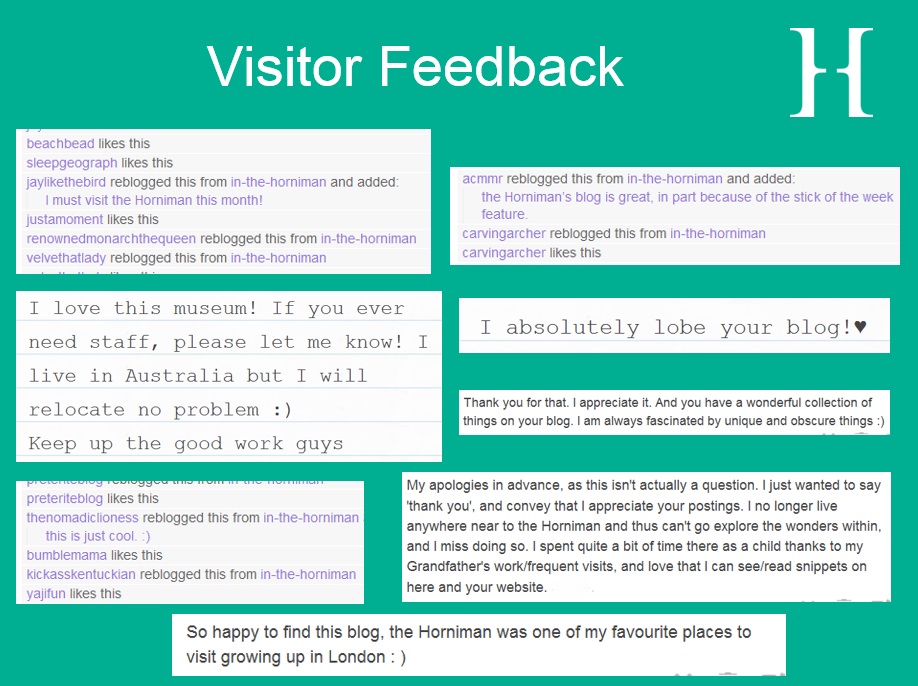
In The Horniman has achieved our aim to share the progress of the Collections People Stories review, and wildly exceeded our expectations. Since 2012 it has gained over 39,000 followers (up by 2,000 since I delivered this talk at NatSCA 2015!), received over 90,000 page views from 158 countries, and even won an award (Best Social Media at the Museums & the Web Awards 2014)! But the reason we keep doing it is the wonderful feedback from our audience:

Visitor feedback for In The Horniman Tumblr page

In The Horniman: people lobe it!

Tumblr has given us a platform to share our collections with audiences all over the world, and a new way to engage people with our objects. Mr. Horniman’s aim in founding the museum was to bring the world to Forest Hill. Through Tumblr, we are now bringing Forest Hill to the world.

Rachel Jennings
Documentation Assistant, Horniman Museum & Gardens

Taxidermy and the Country House: Information Needed!

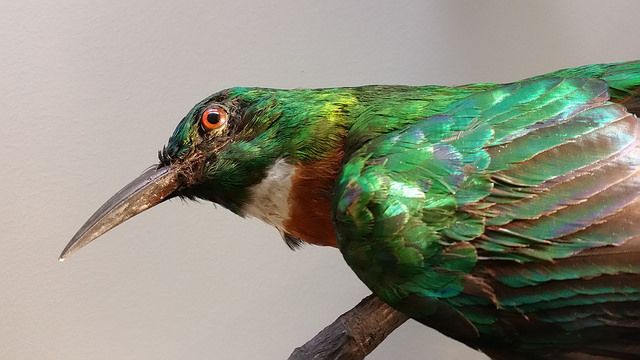
birdpic

Today we would like to share a research request from historic taxidermy expert Pat Morris. Pat says:

I have been commissioned by the National Trust (NT) and English Heritage (EH) to write a book about ‘Taxidermy and the Country House’. I know about collections in houses managed by NT and EH, but finding out what’s where in privately owned mansions is proving difficult. I have been checking 19th century literature (county avifaunas particularly) for references to past collections, and I am trying to find out how many are still extant. I have also been asking around, which is what I’m doing now. If you know of any old collections of birds or hunting trophies in major country houses, I would be glad to know where, please. Many of the big houses, especially in East Anglia and in Shropshire, had substantial taxidermy collections that ended up in local museums, having been donated when no longer wanted at the Big House. If you know of any of these collections, who collected them and the house in which they were previously displayed, I would be grateful for your assistance.

If you have any information that could help in this matter, please contact Pat Morris at: pat.morris5@outlook.com