How ‘The Beetles’ Changed my Life

Beetles are one of the most successful groups of organisms on the planet. In the UK there are over 4000 species, compared to fewer than 600 wild bird species and around 90 mammal species. Beetles are critical to the health of many habitats, through their roles as feeders on plants and fungi, recyclers of animal and plant debris, and as predators.

When I first began volunteering with natural science collections at Plymouth City Museum, I occasionally assisted local entomologist Peter Smithers of Plymouth University, who regularly ran ‘Bug Hunts’ with schools around the Devon and Cornwall area. It was here that I came across some of my first beetles. In 2010, whilst walking along the South West Coast Path near the chalk cliffs at Beer, I found a black beetle with a vinyl-like sheen. It was beautiful, but unlike anything I had seen before. I later discovered that it was from a distinctive group called Oil Beetles (Meloidae), which possess one of the most extraordinary life cycles of any UK insect: they are nest parasites of solitary mining bees such as Andrena, Anthopora, and Lasioglossum.

After a female Oil Beetle lays her eggs in a nest hole, the larvae (known as triangulins) wait on a plant until they can attach themselves to a passing bee, using hooks on their feet. The larvae then eat the stored pollen and nectar in the bee’s nest. The strategy means minimal effort from the adult female in raising her young, and the larvae have all the food they need.
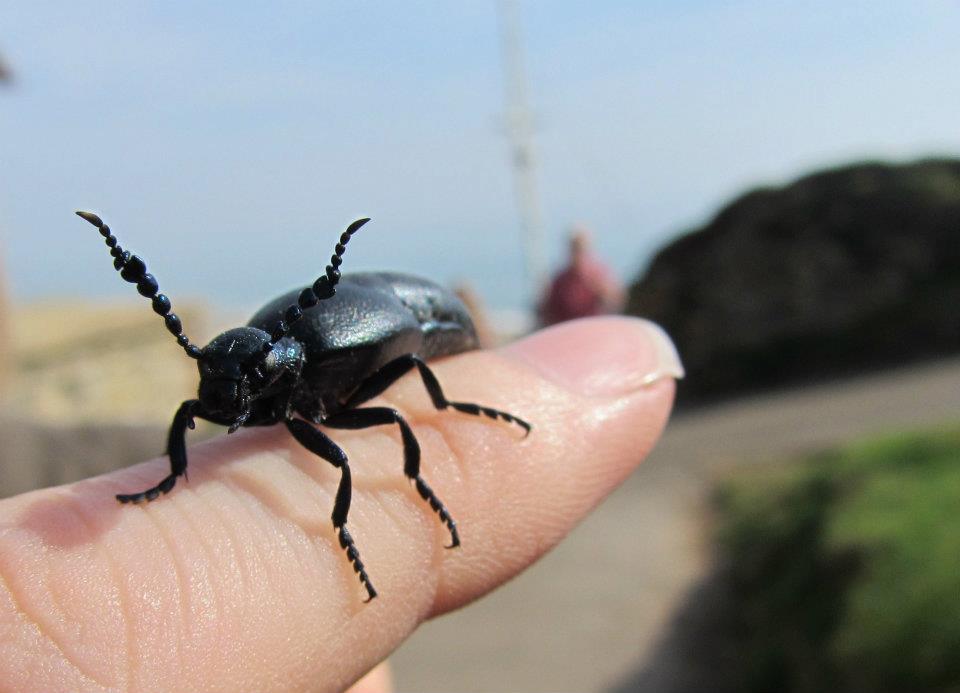
Black Oil Beetle (Meloe proscarabaeus)

Black Oil Beetle (Meloe proscarabaeus)

At the time of my discovery, Buglife was leading the way in trying to understand the state of Oil Beetle populations in the UK, which had suffered severe declines over the past 100 years. With four species believed to be extinct already, there was an urgent need to understand the distribution of the remaining Black, Violet, Rugged and Short-necked Oil Beetles. Buglife launched an Oil Beetle Recording Scheme to map their distribution and engage people of all ages through citizen science.

The survey results have enabled Buglife to learn more about the habitat preferences and hosts of the remaining species, and gain a better understanding of the health of the UK landscape, as Oil Beetles are restricted to wildflower-rich habitats, unimproved coastal grasslands, and woodland edges. Two species of Oil Beetle that were believed to be extinct in the UK have been re-discovered. The Short-necked Oil Beetle was found in South Devon in 2006, before a much larger second population was found on the Isle of Coll in Scotland in 2010. The rare Mediterranean Oil Beetle was found on the same Devon site in 2012, having been last recorded in Kent in 1906.

The efforts of Buglife, local recorders and naturalists have produced valid records to create time series of biodiversity data. Museum collections can also provide useful time series data for conservation efforts, based on specimen label data in terms of location and distribution in a given year. Where a species has been recorded in a particular place and time, we can perhaps find relic populations or sites for reintroduction.
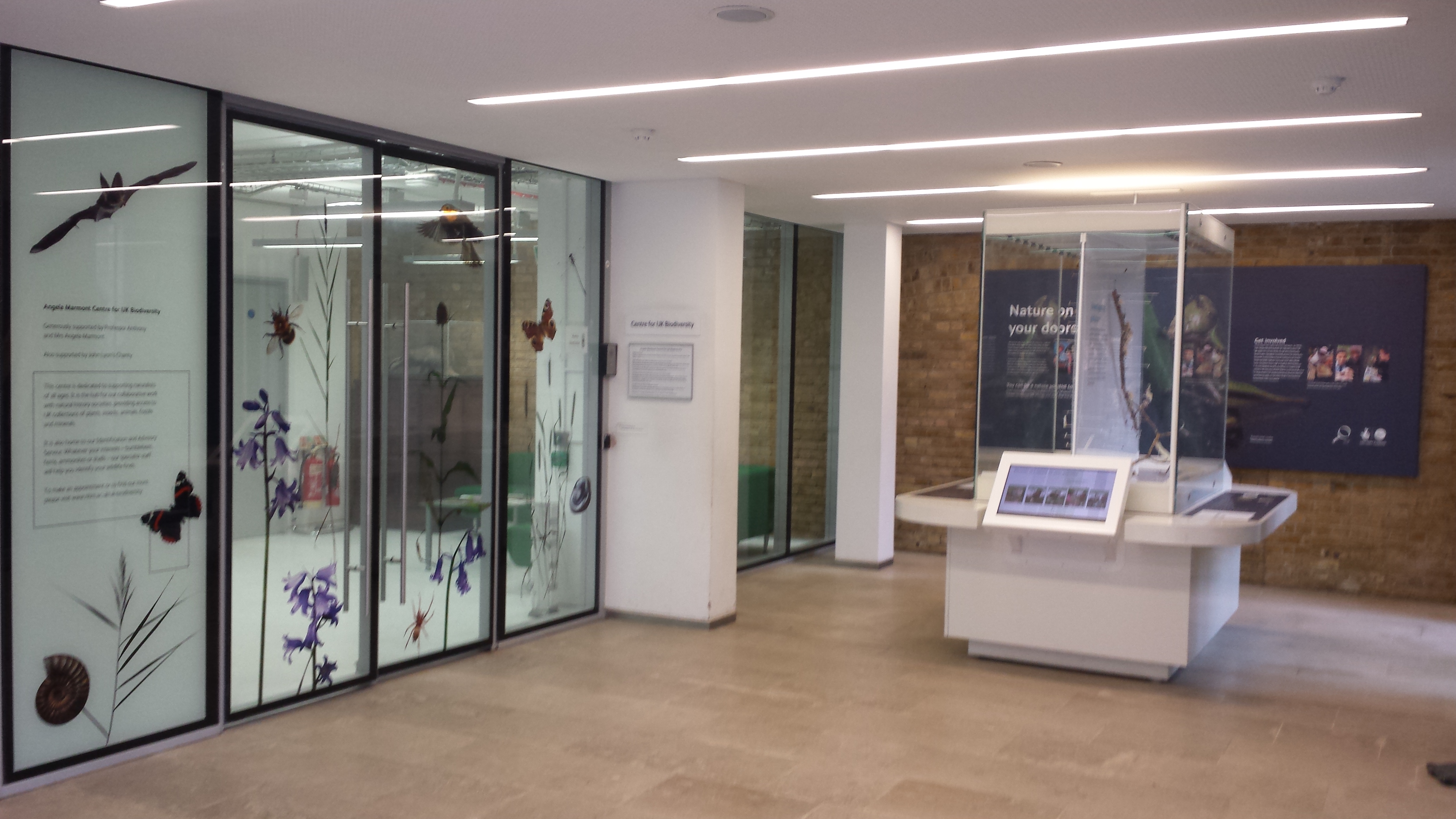
Interior of the Angela Marmont Centre, NHM

Angela Marmont Centre, NHM

It was my interest in Buglife’s Oil Beetle recording scheme that led me to recently join the Natural History Museum’s Angela Marmont Centre for UK Biodiversity (AMC) as an Identification Trainee. The AMC provides world-class facilities in the museum’s Darwin Centre for citizen scientists, as well as expert and amateur naturalists, to enable them to identify UK species using the AMC’s extensive reference collections. Working here is brilliant, and I hope to be trained to identify the key UK biodiversity groups, gain more practical experience of surveying UK wildlife, assist the AMC team in developing citizen science projects based around museum collections, and continue to develop collections management experience through curatorial projects.


Anthony Roach
Skills for the Future Trainee & Science Educator
NHM


A Tale of Two Playing Cards

The Museum Ethnographers Group conference is being held on Monday and Tuesday at the excellent Powell-Cotton Museum in Kent. The theme is ‘Nature and Culture in Museums’, and the relationship between the two.

I am a zoologist by background, but for the last three years I have been immersed in a different world, working on a review of the Anthropology collections at the Horniman Museum and Gardens. I have learned an enormous amount about material culture from all over the world, seen some incredibly stunning objects, and been surprised by how relevant my Natural History knowledge has been. Many of our objects are made of animal materials, and it’s been a great opportunity to learn new skills in identifying ivories, bone, and antler. Only a few weeks ago I was very excited to be able to identify an Inuit flint-sharpening tool as being made of mammoth ivory!

I have also been asked to add taxonomic data to some Anthropology object records in our Collections Management System, so that we can record the species that are represented by objects. This provides richer contextual data, and links between objects that can be navigated on our website.

Victorian playing cards featuring exotic species (Horniman Museum & Gardens)

Victorian playing cards featuring exotic species (Horniman Museum & Gardens)

One such group of objects is this set of Victorian playing cards. They are cute: on one side is a cryptic clue to the identity of an animal, and on the other is an illustration of that animal. I didn’t anticipate how much the taxonomic information would add to our understanding of the objects, or that it would enable them to tell a story about discovery and extinction…

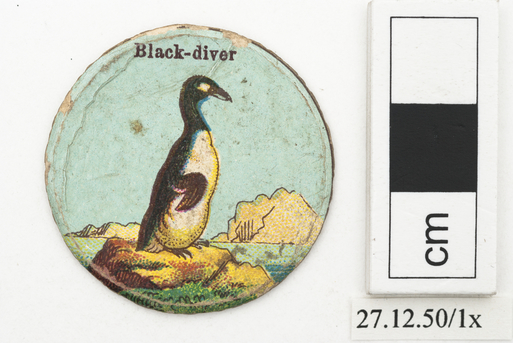
Two cards in the pack, together, tell this tale. The first is the ‘Black-diver’:

Black-diver playing card (Horniman Museum & Gardens)

Black-diver playing card (Horniman Museum & Gardens)

Mounted Great Auk specimen (Horniman Museum & Gardens)

Mounted Great Auk specimen (Horniman Museum & Gardens)

Which is actually a Great Auk (Pinguinus impennis). I have never heard ‘black diver’ used as a common name for this bird, but the likeness is unmistakable. The last recorded sighting of this species is from 1852, following the death of the last individuals to be shot, in 1844. I was intrigued to see this species represented in the pack, and was left wondering whether any of the Victorian children who played with the cards had ever actually seen a live Auk.

A second card could potentially hold the clue to this:


Reverse of animal playing card (Horniman Museum & Gardens)

Reverse of animal playing card (Horniman Museum &Gardens)

Gorilla playing card (Horniman Museum & Gardens)

Gorilla playing card (Horniman Museum & Gardens)

The Eastern Lowland Gorilla (Gorilla beringei) was not described until 1903, so it seems much more likely that this card represents the Western Gorilla (Gorilla gorilla), described in 1847.

The date of the discovery of the Western Gorilla, combined with that of the extinction of the Great Auk, could potentially narrow down the date at which these cards were made enormously: there is only a five-year period in which both species were known to exist together, between 1847 and 1852. However, the actual date of manufacture could be much later: following their discovery, gorillas were incredibly popular with the public for many years, particularly in the 1860s after the publication of Darwin’s Origin of Species in 1859, and the first live specimen reached a European zoo in 1876. ‘The Auk’ was taken as the title of the American Ornithologists’ Union’s journal, founded in 1884. So the Great Auk was clearly still in the public consciousness long after its extinction. Given this information, it seems quite possible that the original owners of the playing cards may never have seen either species in the flesh!

But that is as far as my research has taken me for now. This is a story that I hadn’t expected to find in these objects. As museum professionals, we are custodians of more than just collections: we are the keepers of specialist knowledge that we use to interpret our collections, to tell stories that will engage our audiences. Sometimes, to find their stories, you need to look at objects from more than one perspective. By working across disciplines and sharing our expertise, we can find new tales and new ways to tell them.


Rachel Jennings
Documentation Assistant, Horniman Museum and Gardens

Getting Funding for Natural Science Collections

With the current financial year almost at a close, many of our thoughts are firmly on next year’s budget. With this in mind, here is Clare Brown with some advice on obtaining funding for work on your collections:


The 2014 Geology Curators’ Group conference and AGM dealt with how to raise money for natural science collections. The first speaker of the day was Nick Poole, CEO of the Collections Trust. He gave a great talk on where to look for funding, and how to get it once you’ve found it. I’ve converted my notes from his talk below, and the slideshow of his presentation can be found here (the slides are comprehensive and brimming with tips).

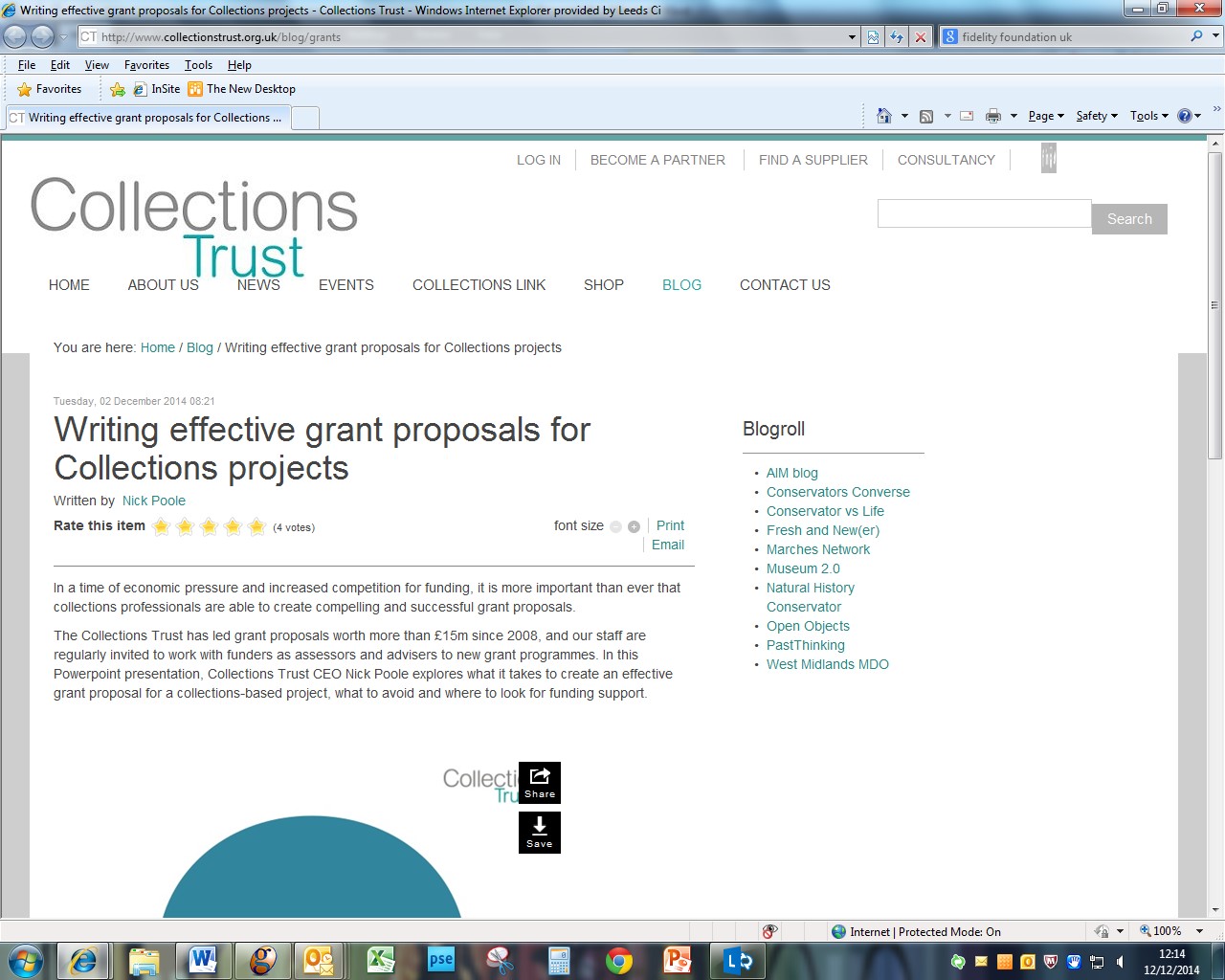
Screenshot of Nick Poole's web article on obtaining funding

Nick Poole’s advice on applying for grants

Sources of Funding

Nick Poole mentioned that the National Council for Volunteer Organisations has a good website for looking at who funds what, but after a bit of clicking around I couldn’t turn up anything particularly useful. If I’d had more time, and perhaps a membership number, I might have had a better experience.

A great resource is Funding Central. This website allows you to search 4,000 potential funders using the criteria of your choice.

At present the Heritage Lottery Fund (HLF) is in a cash-rich situation. However, they are concentrating on funding projects concerned with social utility or financial resilience. It’s quite hard to squeeze collections into those two titles.

At the end of Nick’s slides he has listed several organisations that fund UK museum projects and collections (slides 39 – 45). It’s well worth taking a look at. If you are lucky enough to work in London, Kent, Surrey, Birmingham or Manchester, the Fidelity UK Foundation also funds museum projects.

How do I get Funding?

When considering applying for a grant, only ever apply for money for a project that is consistent with your museum’s aims, otherwise delivering it will be hell.

Be prepared before the funding call goes out. Have a variety of projects ready to go, with need/scope/budget/supporting evidence available.

When writing a grant:

  1. RTFM (read the … manual).
  2. Give yourself time.
  3. Produce a good solid ‘hearts and minds’ story, with hard evidence to back it up.
  4. Many funders have one eye on the press release. Believe it or not, the projects with great names do seem to get funding. Create drama and make it unique and compelling.
  5. Don’t focus on your collections as a problem – focus on the problem to which your collection is the solution.
  6. Be realistic about cost.
  7. Understand how your proposal will be assessed.
  8. Always quote the funders to themselves: “As you yourselves said …”
  9. Don’t be insecure. Use the word ‘successful’. Don’t keep writing ‘if we get the grant’; write ‘when we get the grant’.
  10. Don’t bother with hubris (unless they ask for it). Avoid death by citation and focus on outcomes, not process.
  11. Build your reputation: become well known for delivering great projects.

If at first you don’t succeed, then ask for feedback, adjust your technique, and try again.


Clare Brown, December 2014

Curating a Deep Sea Fish Collection at Glasgow’s Hunterian Museum

Hunterian Zoology Museum, Glasgow University. Photo: Glenn Roadley

Hunterian Zoology Museum, Glasgow University (Photo: Glenn Roadley)

The third week-long placement of my HLF Natural History Curatorial Traineeship took place at The Hunterian Zoology Museum, part of the University of Glasgow’s impressive campus. I had visited The Hunterian in Glasgow once before, in November, as part of a meeting with my traineeship mentor, Maggie Reilly, the Curator of Zoology. While before I only had time for a quick tour of the museum galleries, this time I was able to get hands-on with a full project.

Shelves of fluid-preserved animal specimens in jars, in the Hunterian's spirit collection. Photo: Glenn Roadley

The Hunterian’s spirit collection (Photo: Glenn Roadley)

During 2011, a research team from the University of Glasgow set out to trawl the Porcupine Abyssal Plain, ~4800m deep in the Atlantic Ocean, as part of an investigation into the effect of commercial fishing on the marine ecosystem. As fish stocks are depleted, commercial fisheries are trawling deeper and deeper. Much of life on the sea floor is unknown, and investigating the diversity of deep sea organisms will help us to understand the potential effects of deeper trawling. The fish collected during the research cruise were measured (body length, head length, tail length and wet weight), assigned a unique number, labelled, and preserved in a formalin solution. These were then transported to the Hunterian Zoology Museum, to be added to the spirit collection. The fish had been identified as well as possible, rinsed of the formalin, and transferred to 70% ethanol solution, but still needed to be separated out by taxon, stored in their own jars (rather than plastic buckets), and added to the museum database. This was to be my task.

A toothy anglerfish: a gloved hand holds a fluid-preserved specimen of an anglerfish. Photo: Glenn Roadley

A toothy anglerfish (Photo: Glenn Roadley)

Deep sea fish are definitely a bizarre and fascinating lot. The collection I was working with contained a wide range of taxa, with ghostly-looking members of the genus Coryphaenoides occurring particularly often. Anglerfish and common fangtooth also stood out for their menacing looks – the former rather closely resembling a scrunched up bin-liner with teeth. Some had been identified all the way to species level, while others were yet to be identified. Who knows, maybe I handled a yet-undescribed species during my time at the Hunterian?

After preparing a large batch of 70% ethanol solution, in which the fish are preserved, I set about recording them on the Hunterian’s database, KE Emu. Pulling a specimen from a bucket of mixed fish and laying it onto a tray, I was able to use the unique collection number and site of collection on the label to match it to the records on the research cruise data sheets, which contained the exact location co-ordinates, date, species ID, and measurements. I could then enter this data into KE Emu and assign the fish a unique museum accession number. Once the fish label had dried (though care had to be taken not to let the specimen dry out too), it could be permanently marked with the accession number, before the specimen was sorted into a jar of ethanol by site and species ID.

Coryphaenoides leptolepis: a fluid-preserved specimen of a fish sits in a clear container. Photo: Glenn Roadley

Coryphaenoides leptolepis (Photo: Glenn Roadley)

It was fascinating to work with such a wide range of rarely seen species, and served as a good boost to my knowledge of fish taxonomy. Most importantly, I was able to see the true context of the collection – working from start to finish to accession the collection – while using the cruise research data and reports to populate the database enabled me to really understand where these specimens had come from and their value to science. These deep-sea fish will now be housed in the Hunterian Museum, accessible for further scientific research for decades to come.

Glenn Roadley
Natural History Curatorial Trainee
batdrawer1.wordpress.com

And the Winner is…

Well, there were two fantastic projects that we wanted to give the NatSCA Bill Pettit Memorial Award to this year. Here are the details:

Saving the World’s Rarest Skeleton

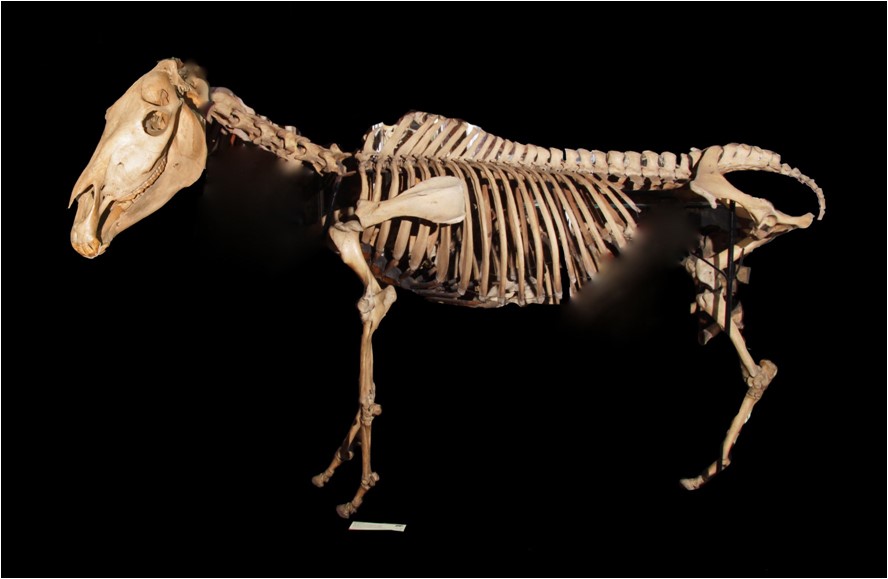
The specimen of the quagga at the Grant Museum.

The specimen of the quagga at the Grant Museum.

In 2014-15 the Grant Museum will undertake a major project in remedial conservation to disarticulate, clean and remount its skeleton of the extinct quagga. It is the only articulated quagga in the UK, and can be considered the rarest skeleton in the world. The work is intended to secure the long-term preservation of the specimen – that no subsequent work would be necessary in the future.

The quagga would be the focus – and most involved element – of a major project of conservation of 39 large specimens, many of which have been on open display for over a century without any treatment. Interventions will range from cleaning (in the majority of cases) to remounting (quagga and dugong).

As much of the conservation as possible will be performed in the public eye in the gallery, shedding light on a crucial element of museum work which gets little public attention.

Curation of Discovery deep-sea samples at the National Oceanography Centre, Southampton

The Discovery Collections are an internationally important historical collection of deep-sea marine invertebrate and fish specimens. The first samples were collected in the Southern Ocean by RRS Discovery, the ship used by Captain Robert Falcon Scott for his first Antarctic expedition in 1901. The collections are closed to the public, yet specimens are displayed and used at a variety of public engagement events (e.g. festivals, open days, school visits) by a wide spectrum of people.

This application is to support the engagement of a temporary staff member to assist in the curation and cataloguing of three large collections of deep-sea samples held in the Discovery Collections. These are the result of three major research programs: the Crozet Island collection (a 42-day cruise in 2006 on the RRS Discovery), the ECOMAR collection (a 4-year project studying the fauna of the Mid-Atlantic Ridge) and the Arabian Sea Collections (5 month-long research cruises 2002-2003). The samples are in urgent need of care and attention to ensure their future use by the scientific community.

The Bill Pettit Memorial Award

A big congratulations to the winners. If you would like to know more about the Bill Pettit Memorial Award, you can find out on our Awards and Bursaries page or read more about previous year’s winners here.