NatSCA Digital Digest

Welcome to the weekly digest of posts from around the web with relevance to natural science collections. We hope you find this useful and if you have any articles that you feel would be of interest, please contact us at blog@natsca.org

1. Blog: Natural History Blog

Russell Dornan

Synopsis

A great blog worth checking out:

‘My name is Russell Dornan and I was the biology curatorial trainee at Hereford and Ludlow Museums. I blogged throughout my 12 month journey through their natural history collections and went on to be the Natural History Project Co-ordinator at the Horniman Museum in London.

I am now the Web Editor at Wellcome Collection.

All views expressed in this blog are mine alone and do not represent the opinions of my employer.’

Russell Dornan's #MuseumSelfie

Russell Dornan’s #MuseumSelfie (Image by Russell Dornan)

Wunderkammer

2. Volunteer Position: Mudchute Volunteer Coordinator

Mudchute, East London Countryside

Synopsis

We have a fantastic opportunity for an experienced Volunteer Coordinator to join our team at Mudchute Park and Farm to manage the recruitment, supervision and support of our volunteering programme.

We are looking for an organised, dynamic and enthusiastic individual who has the experience of working in a multi-cultural environment Inner City Environment with groups and individuals from a diverse background. Experience of working with and the ability to enthuse and motivate disadvantaged individuals is essential.

If you think this could be you, we’d love to hear from you! For more details about this part time position, including how and when to apply, please download the application pack by following the website below.

Please note that applications must be received by noon on Friday, August 29th.

Mudchute Volunteer Position

3. Training: Accreditation Plus Training- Making your objects accessible

University of the Arts, London

Synopsis

Wednesday 10 September 2014, 1.30-4pm

Central St Martins

http://www.arts.ac.uk/csm/about-csm/find-us/

‘Research has proven that touching and handling objects is an important part of the learning experience. However for many museums, allowing visitors to handle objects is an area in which they lack confidence or ‘trained’ staff. This training will address the issue of how we balance the care and conservation of objects against issues of access. Experienced practitioners from Central St Martins will provide guidance on best practice in object handling and discuss how robust systems can make it possible to manage access to collections through handling whilst still protecting them for future generations.

In the session you will:

  • Look at a range of things to consider in order to handling by your visitors.
  • Explore why we use object handling in our museums
  • Learn best practise for handling objects

It is aimed at staff and volunteers who will be developing and delivering handling sessions within their museums.’

To book, fill in an online application form on the Regional Programmes website:

Training Programmes

Training course booking form

Compiled by Emma-Louise Nicholls, NatSCA Blog Editor

Lepidoptera Project

20140711-112651.jpg

Molly and Gina work at the Oxford University Museum of Natural History on a 2 year project to re-curate the Lepidoptera collections. This involves the databasing of the entire World Moth collection in the Hope Entomology Department.

As part of our day to day routine we document drawers of moths to species level. This means we record the genus and species, the author, and how many specimens we have of each species per drawer. Another important part of our role as curatorial assistants is to repair the wings and bodies of any damaged specimens. This also involves the replacement of any old pins that are causing verdigris, which can pull a specimen apart, although we keep any pins of historic importance.

We also look for “lost” type specimens in the collection. These are types that may have been overlooked or are not immediately obvious to the casual observer. Learning to recognize handwriting is a useful skill to have when looking for types. We then check the appropriate literature to verify its type status and move the specimen to the type collections. So far we have found over 50 putative type specimens.

Type specimens aren’t the only interesting thing we find while recurating collections. Specimens collected by Charles Darwin, Alfred Russell Wallace, and Henry Walter Bates have been found in the moth collections, as well as drawings of caterpillars by Frederic Moore, 5 species of extinct moths and most recently, a butterfly from Tonga that was collected on the H.M.S. Challenger expedition in 1874.
We also are responsible for handling enquiries about the Lepidoptera collections. This includes artists, researchers, students, and interns and can be in person or via email. We have also facilitated a 6 week internship to work on the Sudanese butterfly material.

20140711-112808.jpg

Gina: At the moment I’m currently working on the family Noctuidae, which is the largest Lepidoptera family. To give you an idea of how large, I’m nearly done with this family but have documented over 30,000 specimens. My favourite aspect of this job is detective work. The handwriting on old labels attached to specimens can tell you a lot about the history of a specimen and the collector. It takes a while to learn someone’s particular style of handwriting, but once you do, it can open a world of information for you. For example, we have a lot of type specimens described by Francis Walker. By recognizing his handwriting, we know that a label marked with his hand may possibly be an overlooked type specimen. Label shape and colour can also tell you who might have handled or determined the specimen in the past. John Obadiah Westwood, the first Hope Professor of Entomology, often put blue, diamond shaped labels on specimens in his collection.

20140711-112947.jpg

Molly: Throughout the project both of us have been presented with different challenges as we are working on different families and they often require specific treatment. You can’t treat Cossidae the same as Pyralidae. Due to the size difference, although the basic requirements are the same, Cossids tend to be more robust.

I am currently working on Pyralidae and I’ve heard numerous anti-moth comments: “Didn’t realise you were such a fan of the 70’s”, “Oh look, more beige moths!” There are many more comments, including the popular reference to a drawer of Lepidoptera as “flying stamps.” Phooey. Moths and butterflies draw people in, they are family friendly and are often the first port of call for amateur naturalists. The Lepidoptera Project has over 700 followers on twitter. That works out at just over 100 new followers a month. Moths might be beige, but they sure are popular.
You can follow us Twitter: @hopeulikemoths

New loose taxidermy storage at Canterbury Museums

The following is a review by Philip Hadland, of a storage project undertaken by the Canterbury Museums:

Introduction

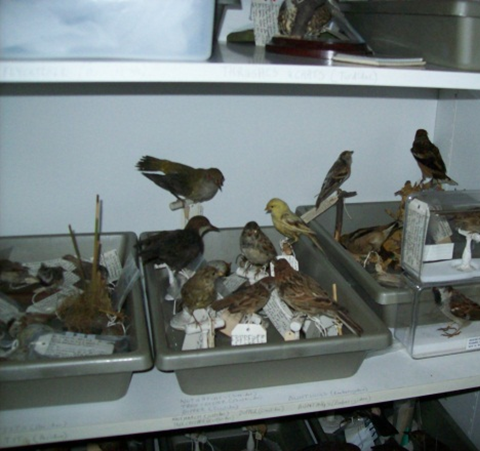
Much of Canterbury Museums taxidermy collection is loose taxidermy and is stored in shelved cupboards without any additional physical protection from handling, movement, or insect pest damage. A pilot project was carried out in 2013/14 to develop a new storage system for this section of the taxidermy collection to improve its care and management.


Aims of the Project

  1. Improve storage conditions and long term care
  2. Improve the management of the collection
  3. Free up storage space


Evaluation of Potential Storage Methods

To get a feel for what might work in practice I sent an email to the NATSCA Mailing List asking for ideas on what works well and what works not so well. Based on the plentiful feedback I received, I evaluated the advantages and disadvantages of the methods suggested.

From this initial research it is clear that there is no single method that can satisfy the needs of the great variety of sizes and shapes of taxidermy that exist in museum collections. Some methods are of course better than others in satisfying similar aims but cost is also an issue.

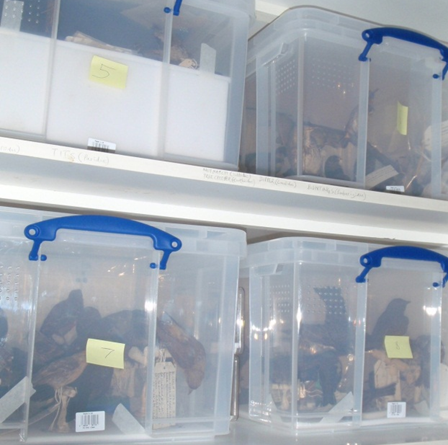
It was decided that a method based on Really Useful boxes was the best solution. The main reasons were the amount of time needed to prepare each box was minimal, there were very good offers available to acquire the boxes cheaply at the time and the sizes available matched up very well to the storage cupboards.


Method

2014-06-03_birds

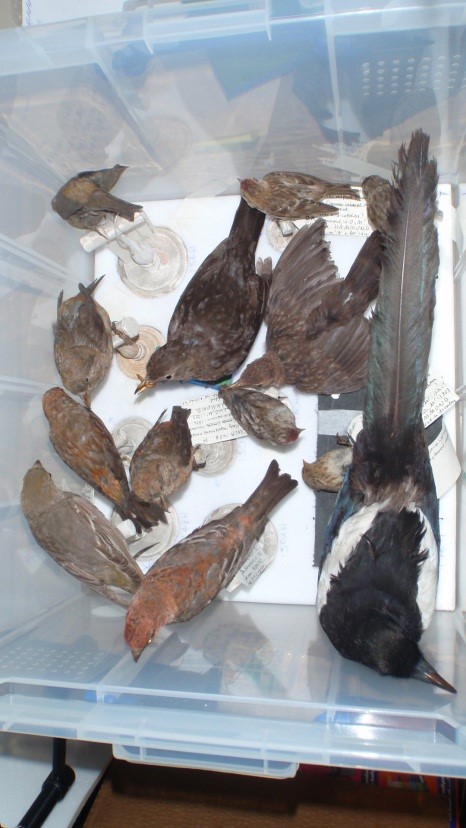
Plastazote was first cut to fit the boxes. Then the bases of specimens were drawn around in pen with the specimen number written alongside and orientation to enable easy identification of what goes where. A list was also kept of the contents of each box.

2014-06-03_cut-foam

The foam was cut using a Stanley knife and affixed to the bottom of the box using masking tape.
The birds were then carefully slotted into place and the boxes were labelled and the location documentation was updated.

Before

2014-06-03_before

After

2014-06-03_after1

2014-06-03_after2

Resource breakdown and cost

Really useful boxes x 10 £110
Approximate cost of Plastazote used £20
Fixings and adhesives £1
Mothballs £4
Total material cost £135
Curatorial time (including planning) £300
Volunteer time (for photography and documentation 10 hours
Total cost £435


Summary

127 items of taxidermy have been rehoused and are well supported in robust, waterproof and conservation standard materials that are easily moved without the birds toppling and they are transportable. This will limit damage to the collections through preventing unnecessary handling, toppling, and pest attack – increasing their long term care. Each specimen now has a specific box location linked to the database so that it can be found easily when required.


I’d like to thank my colleagues and the NatSCA community for their help with this project.