Making the Most of a Move

Making the Most of a Move: Geological Curators’ Group Conference, Day Two

We like to share the goodies in the field of natural history, so in the first ever cross-over of its kind, Part I (comprising Day One) of this blog can be found over on the Geological Curator’s Group website. No need to take the time to google it, let me give you a hand over there.

Night Early Morning at the Museum

The only thing that beats going to a natural history museum is visiting it when you’re not meant to be. The trump card of such a visit, is when you’re allowed to go to parts of the collections, not normally accessible to the general public. After a day in the lecture theatre, the 35+ members of the “Making the Most of a Move” conference assembled the following morning outside the Natural History gallery of the National Museum of Ireland, in order to tick off every one of the above, on the Museum Treats Bingo Card*.

Continue reading

The Addition of Enthusiasts

In a blog series hosted by the Horniman Museum, each month I (the Deputy Keeper of Natural History at said Museum) select a specimen from our collections, do a little research, hopefully find out some riveting and hitherto unknown piece of historical information about it that can be added to our database, and write a blog in a format accessible for the general public. It is one of my pride and joys in my job as it covers so many different aspects of museum life- public engagement, outreach, research, museum documentation, collections management, etc. This month I managed to go a step further and incorporate not just exhibition content into the article (British Wildlife Photographer Awards temporary exhibition), but also a new avenue of research and interest; a 6000 strong army of hawfinch enthusiasts who take to Twitter to record sightings of this shy but glorious little bird. I asked the followers of @HawfinchesUK if they would like to publish an image they had taken and was subsequently presented not just with photographs, but with fascinating insider information of the birding world that I may not have found by my own research.

What a wonderful collaboration of scientists and enthusiasts, and an exceptional reward for the utilisation of social media. Please enjoy:

Continue reading

‘Provocative Practice’: New Ways of Working with Natural Science Collections

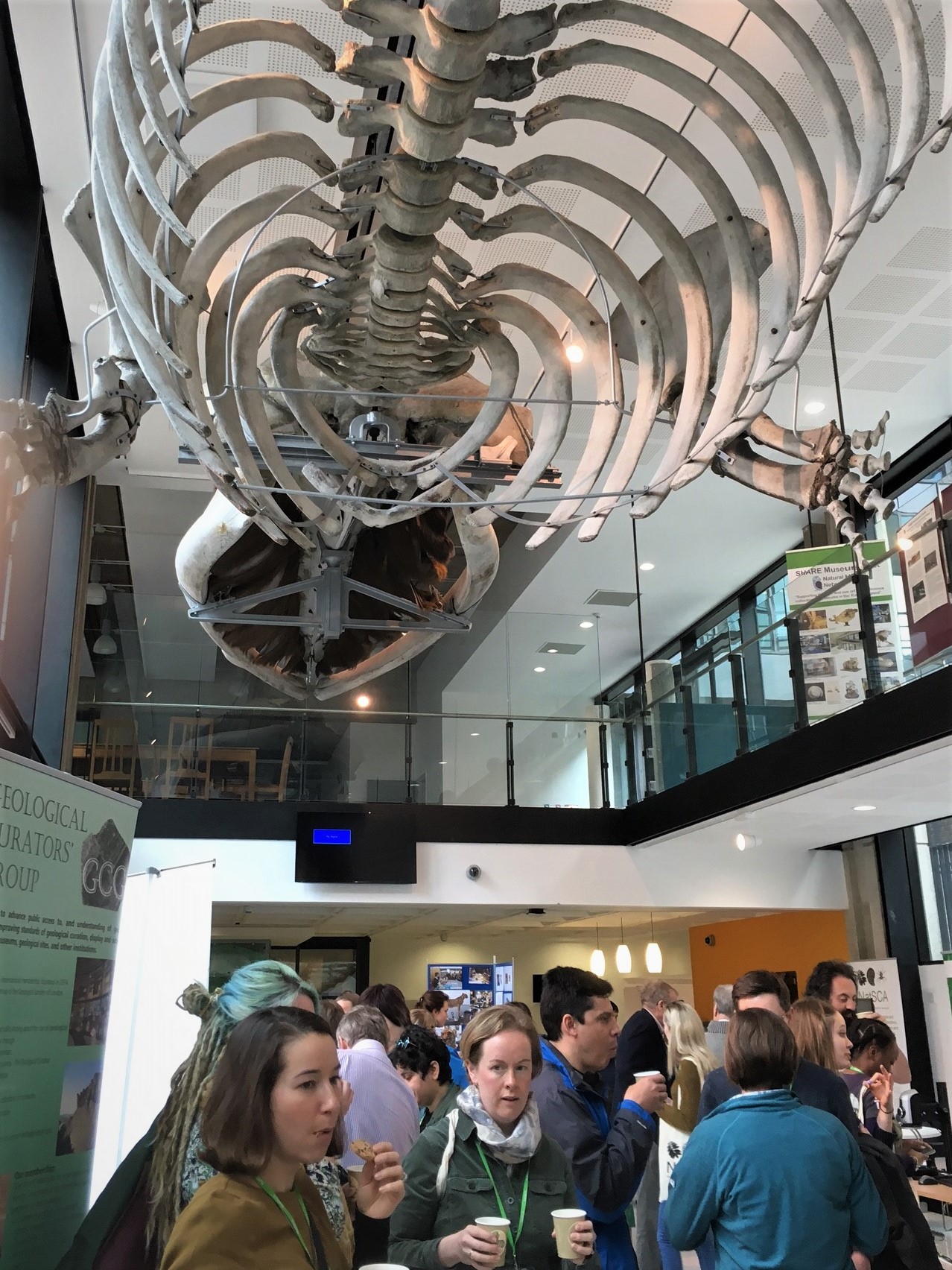
A 70 foot long whale skeleton hangs overhead a fantastic ‘collection’ of natural science curators, collection managers, conservators, and education and museum professionals, busily gathering around and eagerly greeting each other at this year’s annual Natural Sciences Collections Association (NatSCA) conference. As Natural History Museum ‘fly’ specialist Erica McAlister tweeted: “If that fell that’s most of UK’s natural history curators & conservators wiped out”.

NatSCA delegates gathering below the newly hung Fin Whale. Photograph by Simon Jackson, shown thanks to University Museum of Zoology, Cambridge.

This year’s event (#NatSCA2017), at the University Museum of Zoology, Cambridge, had a record 110 delegates, and as such was the biggest NatSCA conference to date. At the heart of the conference was the new Whale Hall, part of an enormous redevelopment project of the David Attenborough Building. As many of us marvelled at the huge leviathan overhead, the rest of us rushed between advertising sponsor stalls, exchanged ideas, caught up with one another and most importantly, fuelled up on coffee!

Feeling inspired, we were ready to begin this year’s talks on the theme: “Evolving Ideas: Provocative New Ways of Working with Collections” as Paolo Viscardi, NatSCA Chair, keenly ushered us in to the main lecture theatre. Continue reading

Object Lessons; Manchester Museum

Most curators have those niggling objects at the back of their stores. Models and illustrations previously used for teaching or display in the dim and distant past, but kept for a rainy day. Not quite real objects and not the kind of thing you would necessarily want to accession.

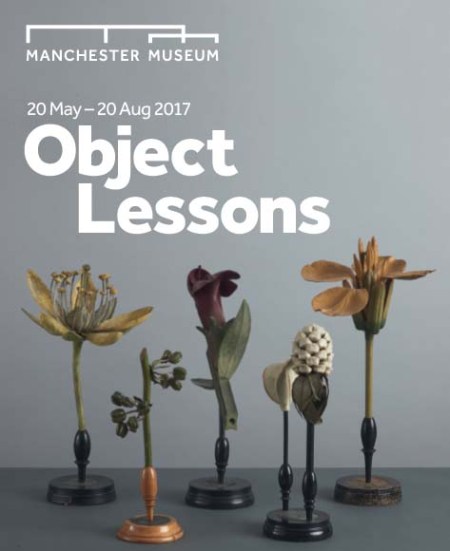
Well, we’ve embraced these wonderful objects in our new exhibition: Object Lessons.

Brendel Models, George Loudon Collection

Brendel Models, George Loudon Collection

Object Lessons celebrates the scientific model and illustration collection of George Loudon. Each of these finely crafted objects was created for the purpose of understanding the natural world through education, demonstration and display.

The object-rich exhibition will look at this incredible collection through themes such as Craftsmanship, the Teaching Museum and the Microscopic. Continue reading

To Dress a Wolf

I like a nice little link to a place I am visiting. And there is a wonderful (if not a little tenuous) link between where I work in Plymouth and Cambridge. Charles Darwin studied theology at University of Cambridge in the old oak clad lecture theatres. And it was through the connections he made at Cambridge that set him on board the HMS Beagle, on a journey that would change the world of scientific thinking forever. The HMS Beagle, with Darwin and all the crew, set sail from in Plymouth after a three month delay. It’s a neat little link.

With such a strong historic links to science, there was perhaps no better place suited to hold the NatSCA  conference 2017. Even the theme title linked in, with a little nod to Darwin (those clever committee members): Evolving ideas: provocative new ways of working with collections.

Continue reading