Decolonising Manchester Museum’s Mineral Collection – A Call To Action

Presented by David Gelsthorpe, Manchester Museum.

Abstract

The history of Black people, people from indigenous cultures and the role of empire in museum natural history collections is largely ignored. This talk uses Manchester Museum’s mineral collection to take the first steps to uncover these stories, analyse the role of empire and expose racism. For the first time, archive photographs from the early 1900s are used in a new display, to tell the story of the people who mined the Museum’s South African gold ore specimens. Recent research and the Museum’s Sierra Leone diamond are used to tell the story of ‘Blood Diamonds’. Data analysis of the mineral collection reveals that 24% of the collection comes from colonial countries. 50% of the Museum’s minerals from the British Empire are Australian, of which 33% came from the Imperial Institute. This research has shown that Manchester Museum’s mineral collection is intimately connected to empire, but the history of Black and indigenous people is ignored or unknown. This is institutional racism and museums need to be proactive in addressing this. There are enormous opportunities to develop this research through fostering partnerships with source communities around the world. This paper is a call to action.

Continue reading →

Nature Read in Black and White: An Update

Presented by Miranda Lowe, Natural History Museum and Subhadra Das, University College
London.

Abstract

There has been an enthusiastic uptake of ideas and practices around decolonising the natural history museum in the wake of the publication of our paper ‘Nature Read in Black and White: Decolonial Approaches to Natural History Collections’ in the NatSCA Journal in 2018. People have written blogs, there have been exhibitions relating to the topic and even the Daily Mail scare quoted cancel culture fears when they heard the Natural History Museum in London was reviewing the colonial histories of its collections. A highlight moment was when Sadiq Khan, the Mayor of London, complimented one of the co-authors of the
paper, saying he had read all sixteen pages and how it was accessible and easy to read. We are gladdened by the national and international impact of our words and research, and this has encouraged us to reflect on this success and raise some other related issues that we would like to share with you in this keynote presentation. In addition to listing recent successes within our own organisations and some plans for future work, we also plan to talk about two further topics about decolonising natural history museums. The first will consider the colonial roots and context of the environmentalist movement, while the second will examine the question of representation in the natural history museum workforce. We will consider the current state of the discourse around decolonising museums, and discuss what continues to be required in the interests of long-term, equitable change.

Continue reading →

Diving into a Coral Reef with Cambridge Communities

Written by Sara Steele, Museum Education Assistant, Museum of Zoology and Roz Wade, Learning Officer, Museum of Zoology.

This article was first published as a blog for University of Cambridge Museums, 1st June 2020.

Our audiences are full of creativity, something we see in bucketfuls at our events and workshops. We wanted to go further, and showcase audience creations and collaborations in our programming and displays.

As a Museum celebrating the wonders of the natural world, we have an innate desire to protect it. We have committed to embedding sustainability into our public programme : tackling the materials we use and considering the impacts of activity outputs. Not all craft day creations end up on the fridge, let alone as an item cherished for life. Could we bear the thought of our logo sitting atop a landfill?

With this focus on collaboration and sustainability in mind, and with the help of the artistic mind of volunteer Fanny Bara Moreau, we designed a summer activity with longevity at its core.

Every summer, the University of Cambridge Museums box up their wares and head out into the weather with themed activities to communities across the city with Cambridge City Council’s Big Weekend and Children and Young People’s Participation Service (ChYpPs). Summer 2019 had a tropical oceans theme at the Museum of Zoology, with the goal of inspiring conversations around the conservation of our coral reefs. We wanted to use this as an opportunity to bring audiences together through shared making and showcase their creations in our programmes and displays.

Continue reading →

Frequently Asked Questions in Taxidermy

Written by Ella Berry (also available here), amateur taxidermist & MSc Conservation Practice student, Cardiff University. An extended version of this blog was published here on 12 March 2020.

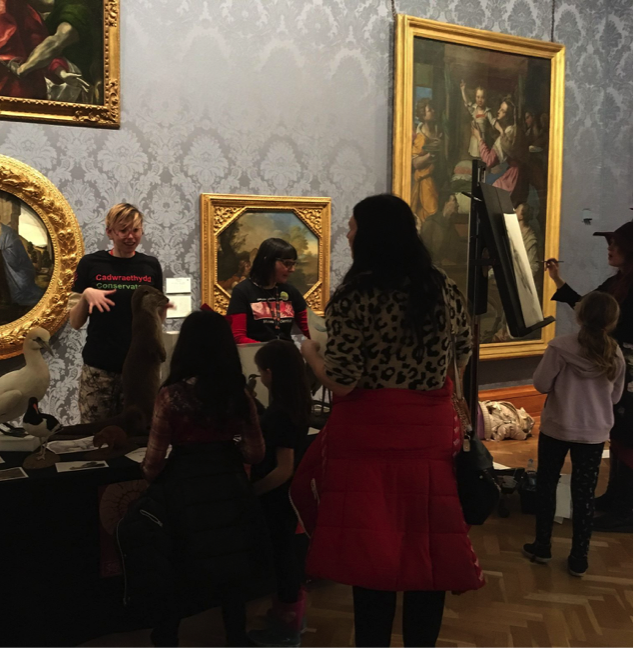
In March of this year I helped out on the Conservation stand at an evening event as part of my role as Volunteer Intern at National Museum Cardiff. It was a fun event, with a turnout of 852 curious visitors. Art conservators and natural history conservators collaborated to show how natural history specimens could inform and create imagery and art.

Photo of me (left) talking to guests at the National Museum Cardiff ‘After Dark’ event alongside Vertebrate Curator Jennifer Gallichan (centre) and local artist Nichola Hope (right) drawing. Photo courtesy of Caitlin Jenkins.

Throughout the event both children and adults came up and asked a lot of questions about the objects, and I noticed some reoccurring queries, especially around the ethics of taxidermy. I have attempted to answer some of these here, so that if anyone else reading this faces the same conundrums, this article will set their mind at ease, or enable them to answer the questions confidently.

Is it ‘ethical’?

‘Ethical’ is a subjective term, therefore what is considered ethical varies between taxidermists. Whether the preservation of animal remains, without the inherently unobtainable consent of the animal, is in itself ethical is up to each individual to decide. ‘Ethical-taxidermy’ has become a more frequently used term generally referring to the animal not being killed specifically for the purpose of becoming a mount. However, this refers to a wide range of sources and can range from accidental deaths such as finding an animal dead or road kill, right through to by-products of culling, pet food supply animals and pest control salvages.

Continue reading →

Museums Beyond Covid

Written by Jan Freedman, Curator of Natural History, The Box, Plymouth.

The sun was hot on my neck as I walked up the stone steps of the largest museum in America. The Smithsonian National Museum of Natural History is on every natural curators museums to visit list, and I was full of youthful excitement!

Inside was cool, and I was met with a grand hall, with a beautiful taxidermy elephant in the centre. The space buzzes with the echoing chatter and the scuttling of excited little feet. I walk on to the stairs, past the large mass of people queuing for the lift, and head up the stairs, patiently waiting for people to pass, so I can meet my ancestors. Here in the Human Origins gallery, there are wonderful displays and interactives all about the evolution of our species. Children run from case to case. Prams block display panels. Interactives are bashed.

I move along to the mammal gallery, where it seems like twenty different schools have chosen to visit at the same time. The cases are two deep with visitors peering at mammals from continents away: children squashed at the front, adults squeezing and pushing to get a glimpse. Reminiscent of a Friday night at our student bar. The air is stale and dry. The noise of a thousand different conversations ring loud in my head. There’s a feeling of being moved along by an invisible force of hunger: not for food, but to ‘see’ the next thing.

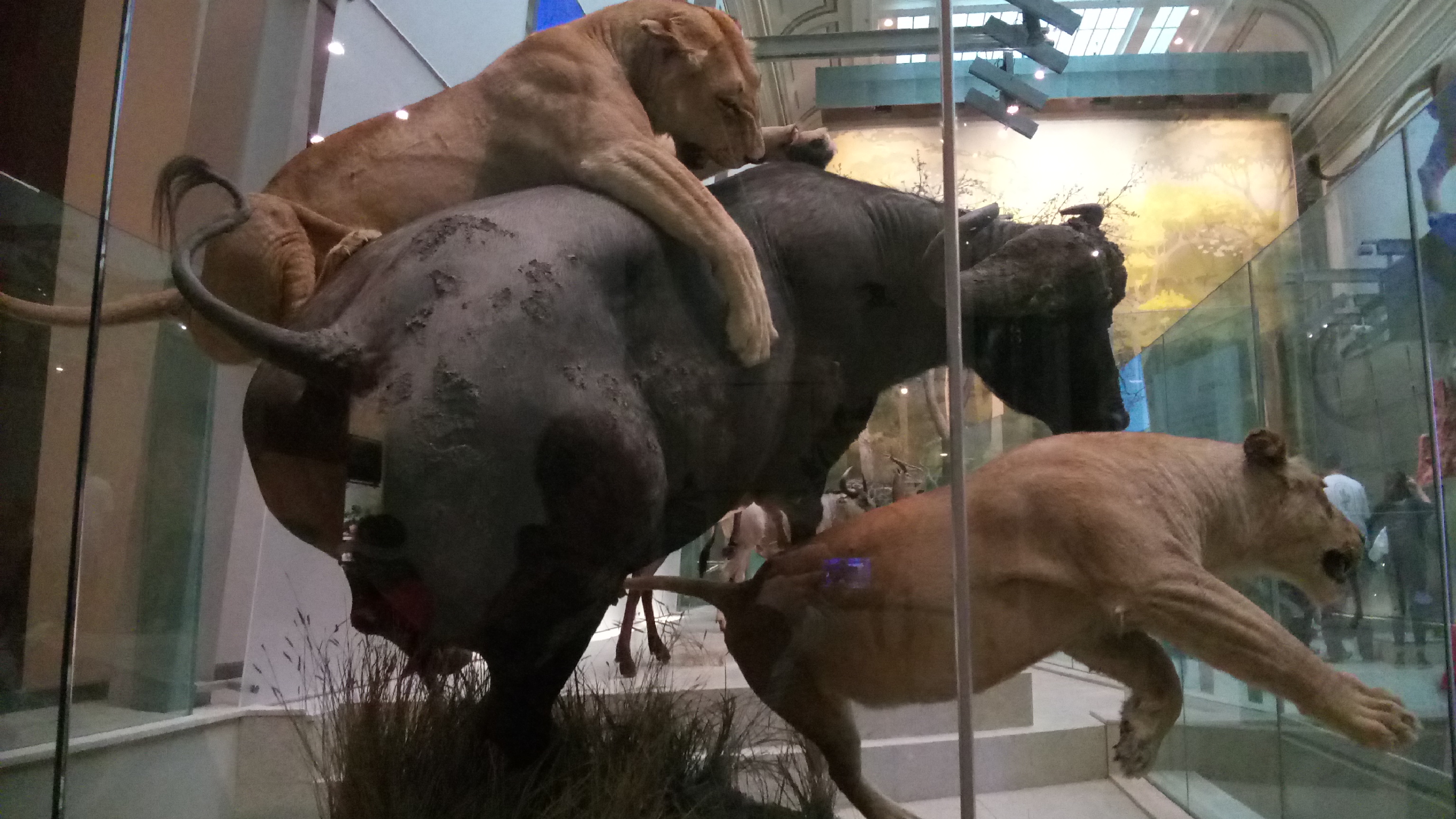
Beautiful taxidermy work of lions attacking a buffalo. I patiently waited 15 minutes until the case was clear of visitors for this photo. Photo by Jan Freedman.

Continue reading →