Paddy the Pangolin: Conservation of a Taxidermy Museum Specimen

This article is re-posted from a piece that appeared on the Amgueddfa Cymru blog page, 3 August 2023 with permission from the author.

Written by Madalyne Epperson, MA Conservation Practice student, Durham University – when on placement at Amgueddfa Genedlaethol Caerdydd – National Museum Cardiff.
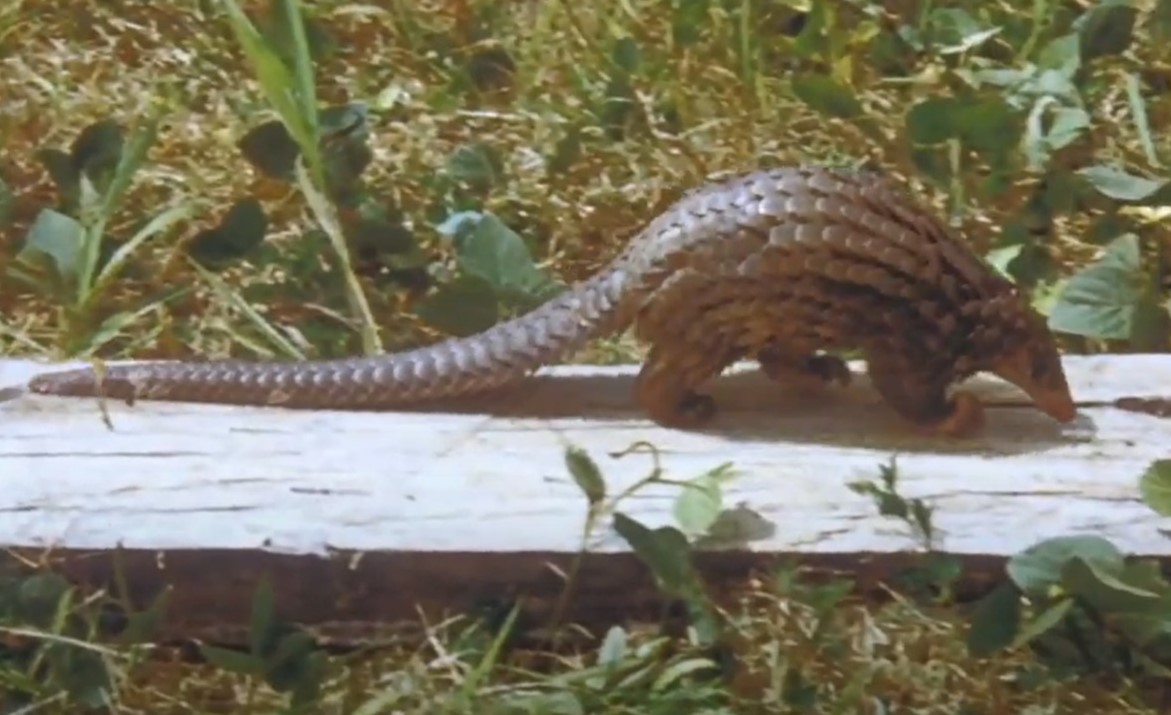
Paddy in the Wild During the Cambridge French West Africa Expedition 1957 (Pan Golin 2018)

Natural history collections are often central to our understanding of evolution, population genetics, biodiversity, and the environmental impacts of pesticide use and climate change, among other things. For this reason, caring for these collections is of great importance. A taxidermy tree pangolin – named Paddy by the conservation team – was brought to Amgueddfa Cymru – Museum Wales in 2017 in need of attention. Paddy was collected on August 4th, 1957, by researchers during Cambridge University’s French West Africa Expedition. According to the expedition diary, Amgueddfa Cymru had asked the researchers to retrieve a pangolin to make a museum specimen, as was common practice at that time. The mounted pangolin was feared lost after the expedition’s drying tent went up in flames on August 25th, 1957. Paddy was terribly singed by the fire, which greatly disheartened the expedition team. It is perhaps for this reason that Paddy never made it to the museum when the expedition concluded. It was not until 2016/2017 that Paddy was found in Staffordshire in the home of one of the expeditions members and sent over to the museum.

Continue reading
How to Reimagine a 117-year-old Diorama of Seabirds for a 2021 Gallery.

Written by Patricia Francis, Natural History Curator, Gallery Oldham. 

An account of ‘how to’ reuse an old, forgotten about diorama and turn it into a display highlighting a widespread and major environmental problem of today.

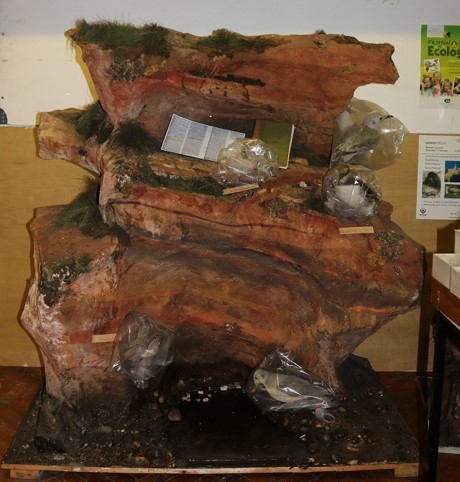
I first found this large sea stack diorama in a corner of a museum storeroom. The storeroom being in a basement of a building without lift access, so the display obviously had had a bit of a rough arrival to its resting place. It had been left uncovered for many years and was in a bit of a sorry state. There were a few birds left in position covered by plastic bags, sad remnants of a previous splendid display. It is a four-sided diorama and on one side at the base of the display is a ‘rock pool’ where a large sea worn pebble bears the following: Fred Stubbs, Oldham 1905.

After a bit of background research, I found this exhibit had four periods when it has been displayed. Firstly, in Oldham’s first Museum which opened in 1883 and where it was made – one of four original dioramas mentioned in a notebook and in the local newspaper the ‘Oldham Chronicle’ in an article of 1909 when it was described as: ‘A splendidly conceived stack, an isolated sandstone rock in the sea…provides accommodation on its ledges for a number of seabirds…makes up a beautiful picture at once artistic and scientific’. At this time a young Fred Stubbs was a leading light in the Oldham Natural History Society. Although the Museum was overseen by the Borough Council, the Society had been charged with the day to day running and creating natural history displays.

Very strangely three of these dioramas were coastal – sea stack, salt marsh and seashore, the fourth was woodland. Quite odd for a town museum like Oldham, far from the sea and where the largest local habitat is the Pennine and Peak District moorland! The maker, Fred, was born in Liverpool – so I wondered if his continued family connections with the coast had influenced this?

Continue reading

NatSCA Digital Digest – November 2023

Compiled by Glenn Roadley, NatSCA Committee Member, Curator of Natural Science at The Potteries Museum & Art Gallery.

Welcome to the November edition of NatSCA Digital Digest.

A monthly blog series featuring the latest on where to go, what to see and do in the natural history sector including jobs, exhibitions, conferences and training opportunities. We are keen to hear from you if you have any top tips and recommendations for our next Digest, please drop an email to blog@natsca.org.

Sector News

GCG AGM and seminar – Building bridges between collectors and museums

The Geological Curators Group will be holding their annual AGM and seminar on November 28th – topics will include:

  • Many important specimens are held in private collections. How can museums gain an understanding of the scope of these collections and the needs of collectors?
  • How can museums gain the trust of collectors and start to find ways to work around the sometimes strict conditions imposed upon them?
  • How do collectors feel that museums can improve the way that they deal with such donations?
  • Lack of ‘proof of legal ownership’ or ‘documentation of permission to collect’ can be major sticking points for museums; however, such provenance was rarely required or given historically (or even more recently). How can we ensure that important historic specimens can be integrated into museum collections? Do we need a more flexible approach to the ‘ownership’ of geological specimens collected from casual sites that are not SSSI’s or other protected statuses?
  • What can we learn from previous experiences?
  • Can museums produce advice to help private collectors to document their collections and highlight or label specimens that might ideally end up in a museum in the future?

For more information and to register, see the GCG website: https://www.geocurator.org/events/162-50th-annual-general-meeting-and-winter-seminar

Continue reading

Discovering Treasures in the Depths of the Dagnall.

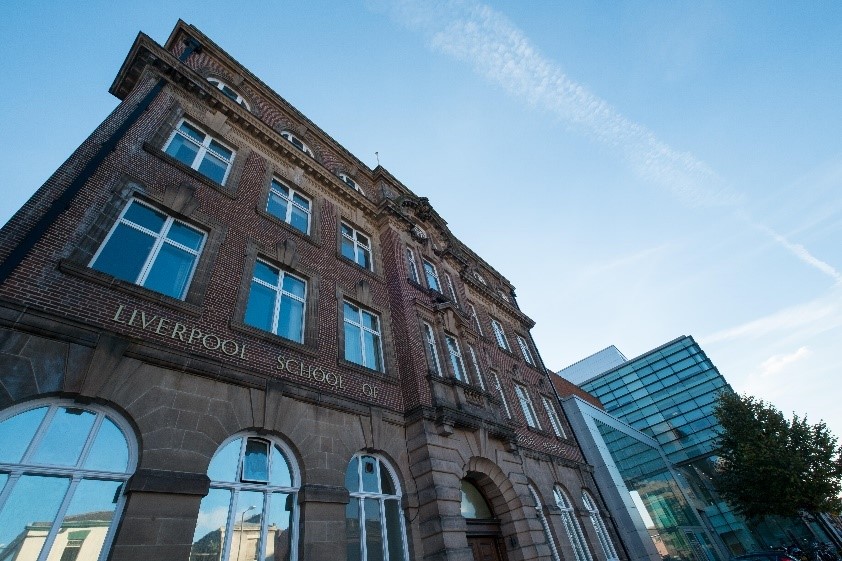
Written by Ruth Cowlishaw of Liverpool School of Tropical Medicine.

This year marks Liverpool School of Tropical Medicine’s 125th anniversary. The school was the first institute of its kind back in 1898, built to help investigate some of the tropical diseases brought back to the busy port city from shipping expeditions and trade. To celebrate such a major milestone an array of events and activities have been planned by the school, including outreach events and fundraising, whilst also giving us a chance to reflect on our history. One such planned scheme was the distribution of internal funds for exciting projects, proposed by staff members that would make a difference in this very special year.

Mary Kingsley Building, LSTM. ©LSTM

The Dagnall Laboratory situated in the Mary Kingsley Building is the main teaching laboratory for the school. Within its walls it houses many historical pathological and entomological samples, from mosquito wings and blood films to seven-meter-long tapeworms. Throughout the years a selection of these samples has been used to help educate thousands of medical professionals, postgraduate students and armed forces personnel. However, a large part of the collection became forgotten and neglected as specimen preservation skills and staff were lost over time. With news of potential funding myself and the team saw an opportunity to rediscover these “lost” specimens and decided to put together a bid with the aim to reinvigorate our collection. The project not only aligned with the 125 Anniversary theme of Heritage and History but also looked forward to the future.

Continue reading

How to Find Ectoparasites on Study Skins and Explore Natural Heritage Shared between Colonial and Provincial Museums

Written by John-James Wilson, Lead Curator of Zoology at World Museum, National Museums Liverpool & Jing Jing Khoo, Postdoctoral Research Associate at Institute of Infection, Veterinary & Ecological Sciences, University of Liverpool.

Selangor Museum was established in Kuala Lumpur by British colonial officials in 1887. A purpose-built museum building, opened in 1907, was designed by Liverpool-born architect Arthur Hubback, but there is a stronger link between Selangor Museum and Liverpool.

Selangor Museum’s early director Herbert Robinson was also born in Liverpool and had worked as an assistant at the Liverpool Museums, now known as World Museum. Selangor Museum wasn’t a large institution, with just three British curators and three museum hunters from Sarawak, one being Charles Ulok. But through the museum’s work, a European knowledge system was imposed onto the local wildlife.

The museum’s work included extensive hunting on the hill and mountains and islands of Malaysia, Thailand and Indonesia. The museum soon ran out of storage space in Kuala Lumpur and specimens were routinely sent to England. Hundreds of specimens were sent to Robinson’s former workplace, World Museum, in 1914.

https://archive.org/embed/from-selangor-museum-to-liverpool

Click link above for 3-minute video about Selangor Museum and its connection to Liverpool made for the Green Representatives Network at Monash University in Selangor.

Continue reading