What is Taxidermy? An Intimate Relationship between Death and Maker.  

Written by Jazmine Miles Long, Taxidermist. https://www.jazminemileslong.com, Twitter: @TaxidermyLondon; Instagram: @Jazmine_miles_long

For taxidermy to exist an animal must have died. This brutal truth creates unease and leaves the viewer to ponder how the death occurred. And secondly how the death and the body is managed. A fluffy rabbit, cute and cuddly in life, suddenly becomes hideous and untouchable in death. Due to my profession, I am raising a child who has been exposed to dead animals and the concept of death his whole life. This has not made him desensitised to death, I’d say the opposite. He is deeply hurt by the death of any animal; he is a self-proclaimed vegetarian and last week at the age of 4 he asked me if his job when he grows up could be to stop people eating animals. He shouts at cars to slow down in case they hit anything and one of my favourite things he asks me when we meet new people is if they are a vegetarian or a carnivore eyeing them up suspiciously. Does a good understanding of death at a young age give a person greater empathy for animals and take us closer to not seeing them as ‘other’? 

When my son is asked what a taxidermist does, he says they look after animals when they die. I get at least one phone call a week from someone mourning their dead pet, I give advice on what to do next, ideas for memorials and how to store the body in the freezer while they decide what to do. I didn’t expect as a taxidermist to be a councillor, a listening ear, someone who is qualified to talk about death. 

Continue reading

William Thomas March, a Jamaican Collector, Naturalist and Early Pioneer of Biological Data Recording in Jamaica.

Written by Olivia Beavers, Assistant Curator of Vertebrate Zoology at World Museum, National Museums Liverpool.

Figure 1. William Thomas March’s bird skins stored in the Vertebrate Zoology collection at World Museum, National Museums Liverpool © National Museums Liverpool (World Museum: NML-VZ T1134, NML-VZ T760, NML-VZ T5652, NML-VZ 1989.66.1279, NML-VZ T19525, NML-VZ T12817, NML-VZ T9981, NML-VZ T1128, NML-VZ T14037, NML-VZ T14031/ Olivia Beavers)

August celebrates Jamaican independence, so what better way to celebrate than to talk about a Jamaican collector from the 1800s whose contributions to understanding Jamaican biodiversity are not yet fully recognised. 

I recently finished the project stage of the Associateship of the Museum Association (AMA). My project focused on helping to tell untold stories of the collections held at World Museum. 

Through trial and error, I started to look through World Museum’s database and Google the names of collectors to see if we had collectors who had black or brown heritage – with a focus on collectors with specimens from the Caribbean. I ended up finding William Thomas March. Only two previous papers were written about him, both by Catherine Levy (Managing Director of Windsor Research Centre, former President of the Caribbean Birds, and of BirdLife Jamaica). 

To coincide with the research and my project, I created a new dataset titled ‘Bird skins from Jamaica in the collections of World Museums Liverpool’ – now available on the Global Biodiversity Information Facility (GBIF) website. It includes specimens from William Thomas March.

Continue reading

Biobanking on a Shoestring

Written by Louise Gibson, ZSL biobank manager at the Institute of Zoology, Zoological Society of London (ZSL).

Lurking in the depths of the Zoological Society of London (almost 200 years old), are vast collections of frozen, wet, and dry biological specimens. Amassed over several decades, procurement of these items has come via scientific fieldwork researching wildlife conservation, standard pathological investigation of captive animal mortality, contributions from Border Force and police wildlife crime investigations, and from the occasional public donations, dropped off on our doorstep.

Photo of octopus preserved in formalin – a octopus was left on the doorstep of ZSL, 2021, donor unknown. © Louise Gibson/ ZSL

Although the collections are extensive, knowledge of their contents is limited to those who have collected samples or managed them, many of which have long since left ZSL. Potential was seen to create a biobanking programme with the objective of preserving the collections and the knowledge that comes with them and in turn creating an accessible biological archive open to the scientific community and beyond. As a not-for-profit charity with minimal resources, we are aiming to achieve this on a shoestring budget.

Continue reading

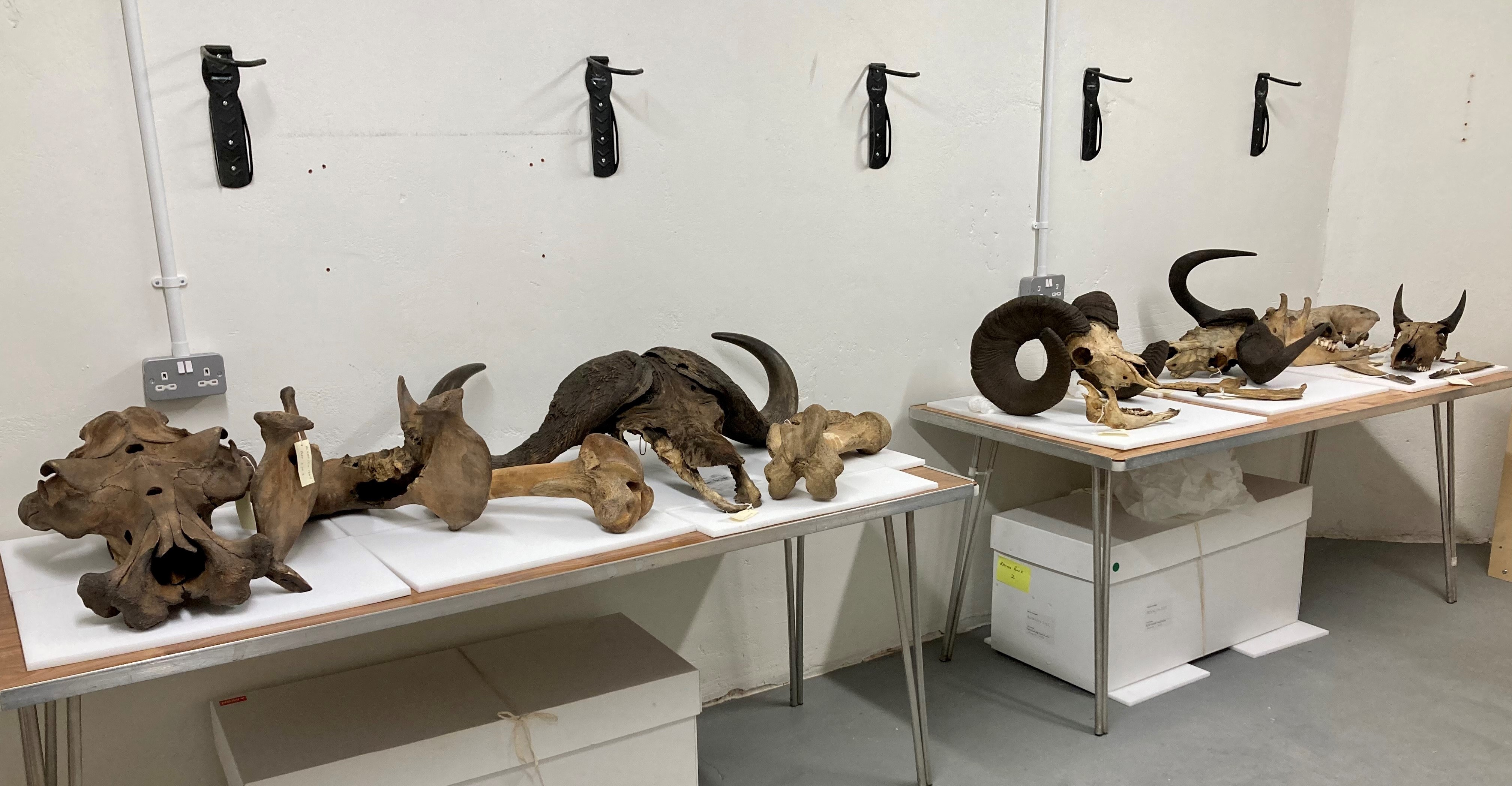
Hunterian Heads: Cleaning Large Skeletal Specimens

Written by Caitlin Jenkins, Project Conservator at Parliamentary Archives (previously Assistant Conservator at Royal College of Surgeons of England).

The Hunterian Museum at the Royal College of Surgeons (RCS) in London closed in 2017 for redevelopment. This necessitated the temporary removal, storage, and condition assessment of its contents. One particularly challenging project was the conservation of 19 large animal skulls. These specimens are part of the museum founder John Hunter’s original collection, dating from the 18th century.

Although the skulls had been sealed in secure crates since the museum’s closure, most had some noticeable dust and dirt accretions and needed attention before they could be redisplayed. Due to their size and number, a team of conservators from Virtu Conservation Housekeeping was brought in to assist with this task. There was a lack of suitable bench space to accommodate so many large specimens at once, so temporary cleaning stations were set up.

Continue reading

Rights-based Environmental Action: A key element of Sustainable Development

Written by Henry McGhie, Curating Tomorrow, henrymcghie@curatingtomorrow.co.uk.

Bio: Henry McGhie has a background as an ecologist, museum curator and manager. He set up Curating Tomorrow in 2019 to help empower museums and their partners to contribute to sustainable development agendas, including the SDGs, climate action, biodiversity conservation, Disaster Risk Reduction and human rights. He is a member of the ICOM Sustainability Working Group, and a Churchill Fellow working on these topics.

This blog post takes in some of the development over the last couple of years, and sets out some current opportunities for museums with natural history collections to strengthen their contributions to environmental sustainability.

This blog post builds on a previous post, on the Convention on Biological Diversity and the Paris Agreement. 

Museums can seem to have lots of rules – conditions for loans, environmental conditions, rules for acquisition and disposal, rules on what people can and can’t do in galleries, and so on – but what about the goals? What is the point of museums? If we look at museums from a rights-based approach (i.e. from the perspective of respecting and fulfilling human rights), we can easily see museums as related to the right to participate in cultural life, to education, to information, to take part in public affairs, freedom of expression, and more. Yet museums don’t make much of human rights or rights-based approaches. The same can be said of environmental protection and restoration. 

As I wrote in the last post, the Framework Convention on Climate Change and the Convention on Biological Diversity are both now over 30 years old, yet their main aims are not written into the work of the museum sector, or indeed the wider cultural sector. This is unfortunate on three counts: first, it holds back the international agreements from making progress to address these massive challenges; second, it denies people the opportunity to even know about these agendas and related programmes; and third it stops the museum sector from contributing effectively to achieving these agendas. 

Continue reading