Natural Connections

This is a modified version of two articles originally published on the Gallery Oldham webpage by Patricia Francis, Natural History Curator, Gallery Oldham. May & June 2020.
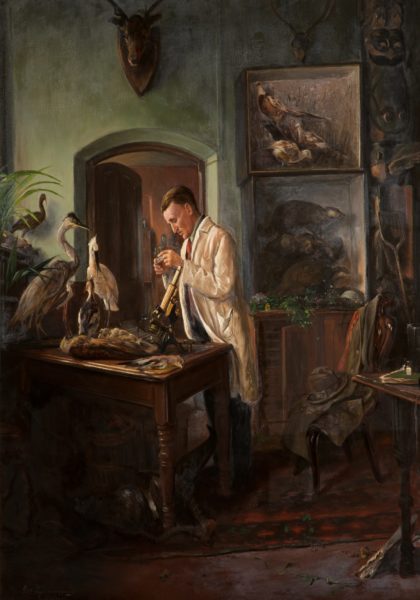
Fred Stubbs shown in The Naturalist by George Henry Wimpenny

This painting reveals a hidden Oldham story. It dates from the 1920s and has always been a great favourite with our visitors. Several years ago it inspired me to look more deeply and investigate, the person, the place and the specimens.

The person is Fredrick J. Stubbs

Fred was born in Liverpool in 1878 and moved with his family to Oldham where he became apprenticed to an upholsterer. He joined the Oldham Microscopical and Natural History Society, his first love being birds. Fred volunteered at the Oldham Municipal Library, Art Gallery and Museum which was long connected with the Natural History Society. When a vacancy arose at Stepney Museum’s Nature Study Centre, he was successful in getting the job and in 1909 left Oldham for London. Completing the booklet, ‘The Birds of Oldham’ in 1910.

Returning to Oldham in April 1919 he became the Deputy Librarian and Curator at the Library and Museum. He became president of the Yorkshire Natural History Society; was a member of the Beautiful Oldham Society and help found the Oldham Society of Artists. He worked at the Library and Museum until his death caused by pneumonia in 1932.

Continue reading →

Virtual Fieldwork during Lockdown – Part 2

Travelling to Socotra with the British and Liverpool Museums Expedition (1898/99).

This is part two of a blog written by John-James Wilson, Curator of Vertebrate Zoology, World Museum, National Museums Liverpool. See Part One here.

The journey continues…

Homhil proved a “successful and delightful sojourn, adding largely to both the flora and fauna [collected]”. The camp, surrounded by the iconic Dragon’s Blood Trees (see them yourself here), had an ideal climate, 26°C during the day, 18°C at night.

Sketch of the cucumber tree of Socotra by J. R. Wellsted, another unusual endemic tree, made during an earlier expedition to Socotra. The sketch is part of the Royle collection at LIV herbarium, World Museum. © National Museums Liverpool (World Museum).

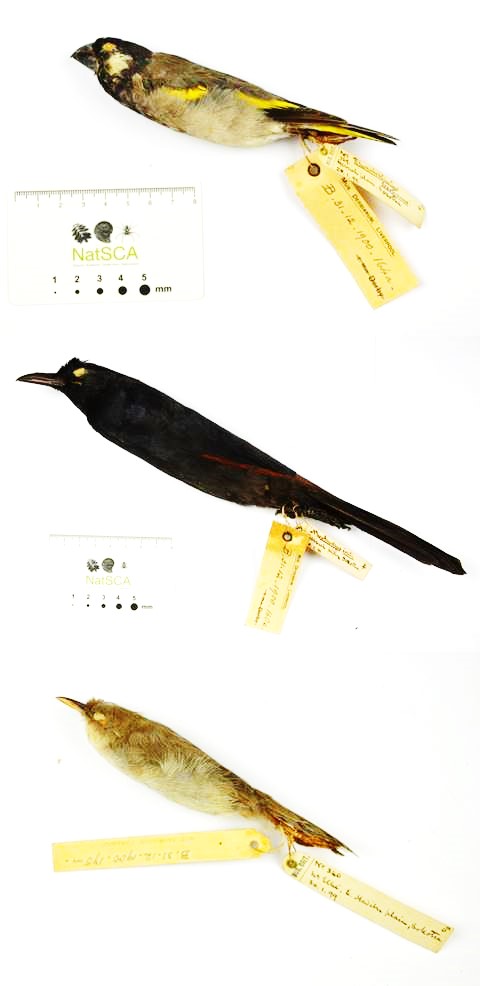
Ten days later, after difficulties agreeing the onward route, the party retraced their steps to the Hadibu Plain. Turning southwards they pitched tents at Elhe and spent two days preparing fresh camels. On the second day, Forbes forgot to put one of his gaiters on and suffered a severe sunburn on his leg (having my own prominent sunburn scar, this is another field experience I can empathise with). While back on the plain, Ogilvie-Grant collected the endemic – Socotra Grosbeak, Socotra Starling, and Socotra Warbler – amongst other animals.

Socotra Grosbeak – Rhynchostruthus socotranus Sclater and Hartlaub, 1881 [accession number: 31.12.1900.164a] (top); Socotra Starling – Onychognathus fratus (Sclater and Hartlaub, 1881) [accession number: 31.12.1900.160e] (middle); and Socotra Warbler – Incana incana (Slater and Hartlaub, 1881) [accession number: 31.12.1900.175m] (bottom). © National Museums Liverpool (World Museum).

The party resumed their trek into the mountains, reaching an elevation with stunning sea views. They remained at Adho Dimellus (also spelt Adhoh di-Melhoh), the “roof of Sokotra”, until February 17th. Fieldwork often fuels friendships and an evening was spent entertaining an Austrian expedition party Forbes had met earlier in Aden.

Photograph of the camp at Adho Dimellus (H. O. Forbes from The Natural History of Sokotra and Abd-el-Kuri). Public Domain.

Continue reading →

Virtual Fieldwork during Lockdown – Part 1

Travelling to Socotra with the British and Liverpool Museums Expedition (1898/99).

By John-James Wilson, Curator of Vertebrate Zoology, World Museum, National Museums Liverpool

I’m one of the many field biologists whose fieldwork has been cancelled due to the coronavirus lockdown. It’s a tiny price to pay to get this unprecedented global pandemic under control but it’s hard not to dream about the tropical adventures that could have been. Fortunately for natural history curators, re-living the fieldwork of our predecessors while exploring (from home) the collections we look after, can go some way to satiate the travel bug.

The Socotra Archipelago (also spelt Soqotra or Sokotra) probably doesn’t feature in many people’s lockdown travel dreams. The archipelago is politically part of Yemen, a country tragically suffering the world’s worst humanitarian crisis as the result of ongoing civil war. However, in 1898, Socotra was firmly on the bucket list of Henry Ogg Forbes, Director and ornithologist at the Liverpool Museums (now World Museum, National Museums Liverpool).

Continue reading →

Provenance, Provenance, Provenance

Written by Yvette Harvey, Keeper of the Herbarium, Royal Horticultural Society, RHS Garden Wisley, Surrey.

When all is quiet, the crowds have long-gone home and the lights have been dimmed, the back rooms come alive for the curators who have long finished their official hours. For it is the time for tracking down rogue specimens, delving into the past or anticipating the future. What I am trying to say is that it is the time for research and the inevitable Miss Marple style adventures to be discovered when finding details to add to the current knowledge of a historic specimen. I say current because invariably details will have been lost or not even deemed worthy to have been recorded on labels, or written in a language so obscure as to not be recognised by the modern eye.

Perhaps lost details are just a phenomenon of the botanical world, but I suspect not, and I will explain what I am alluding to above using just a couple of examples of specimens made by a single collector, John Forbes, who undertook a voyage from 1822 until his death in 1823, almost 200 years ago.

John Forbes was one of the Horticultural Society of London’s (now the Royal Horticultural Society) early plant collectors. Head-hunted from the Liverpool Botanical Garden for his horticultural skills, he was employed to travel to Southern Africa to bring back plants to introduce to British gardens. He sailed with Captain Owen on the HMS Leven, a voyage tasked with making a survey of the east coast of Africa, visiting (in the following order): Madeira, Tenerife, Santa Cruz, Cape Verde Islands, Brazil, South Africa, Mozambique (Forbes is noted as the second botanist to collect there (Exell & Hayes: 130)), Madagascar, Comoros, Mozambique, South Africa and finally Mozambique (where Forbes died, 16th August 1823).

Continue reading →

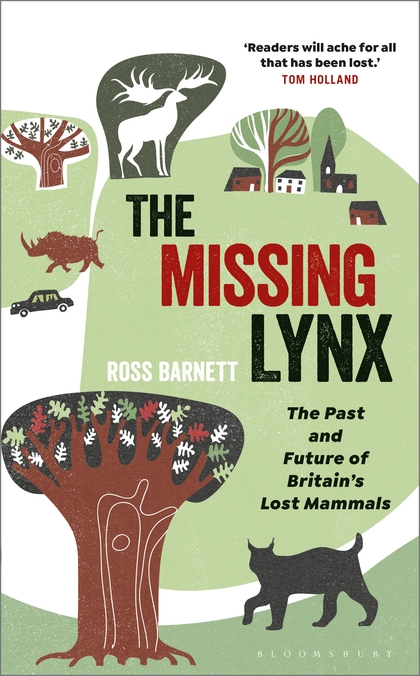
The Missing Lynx: The Past and Future of Britain’s Lost Mammals

Written by Jack Ashby, Manager of the University Museum of Zoology, Cambridge, and author of Animal Kingdom: A Natural History in 100 Objects.

A good title goes a long way, and based on that alone I was excited to receive a review copy of Ross Barnett’s new book through the post. I knew of Ross from Twitter – and I can heartily recommend following him for a whole host of natural history-related wonders, particularly around climate change, ancient mammal DNA and palaeontology. As a result, I was slightly surprised that he had written a book that I assumed – from the clever title – was about reintroducing the lynx to Britain.

That is, in fact, not what the book is about. Instead, it takes us species-by-species, chapter-by-chapter, through the incredible range of beasts that have disappeared from the British Isles in recent millennia (I should have paid more attention to the subtitle). We learn about the woolly mammoths and rhinos, the huge cave bears and their slightly smaller relatives, cave lions and cave hyenas, sabretooth cats, massive species of cattle and deer, as well as wolves, beavers and, yes, lynx. All of these stories are told in the voice of a person clearly fascinated and excited by the things he has been studying all his life, and with a dry sense of humour.

Continue reading →