Mo Koundje: How Gorilla Histories Can Help Decolonise Our Collections

Presented by Rebecca Machin, Leeds Museums and Galleries.

Abstract

Mo Koundje (‘Mok’) is a Western Lowland Gorilla in the collections of Leeds Museums and Galleries (LMG). His taxidermied skin is displayed at Leeds City Museum, while his skeleton is in the store at Leeds Discovery Centre. At present, his remains are used as an example of ‘gorilla’ in the Life on Earth gallery, but they have the potential to tell us so much more. Using archives from the Zoological Society of London, the Natural History Museum, and the Archives Nationales d’Outre Mer, as well as French and British press archives, I have found out more about Mok’s life. His story touches on domestic life in French colonies, the interaction between colonists and colonised communities, and the illegal hunting and trade in gorillas, which continues today. The remains of animals from once colonised countries have the potential to reveal stories not only of their own experiences, but of the people whose lives were affected by colonisation. By entering colonial homes, gorillas enable us to look at racial and gendered hierarchies imposed by European colonisers from a new perspective. We can, and should, use these stories to engage our audiences with a range of political and environmental issues still relevant today.

This presentation contains distressing images.

Continue reading →

Decolonising Manchester Museum’s Mineral Collection – A Call To Action

Presented by David Gelsthorpe, Manchester Museum.

Abstract

The history of Black people, people from indigenous cultures and the role of empire in museum natural history collections is largely ignored. This talk uses Manchester Museum’s mineral collection to take the first steps to uncover these stories, analyse the role of empire and expose racism. For the first time, archive photographs from the early 1900s are used in a new display, to tell the story of the people who mined the Museum’s South African gold ore specimens. Recent research and the Museum’s Sierra Leone diamond are used to tell the story of ‘Blood Diamonds’. Data analysis of the mineral collection reveals that 24% of the collection comes from colonial countries. 50% of the Museum’s minerals from the British Empire are Australian, of which 33% came from the Imperial Institute. This research has shown that Manchester Museum’s mineral collection is intimately connected to empire, but the history of Black and indigenous people is ignored or unknown. This is institutional racism and museums need to be proactive in addressing this. There are enormous opportunities to develop this research through fostering partnerships with source communities around the world. This paper is a call to action.

Continue reading →

Nature Read in Black and White: An Update

Presented by Miranda Lowe, Natural History Museum and Subhadra Das, University College
London.

Abstract

There has been an enthusiastic uptake of ideas and practices around decolonising the natural history museum in the wake of the publication of our paper ‘Nature Read in Black and White: Decolonial Approaches to Natural History Collections’ in the NatSCA Journal in 2018. People have written blogs, there have been exhibitions relating to the topic and even the Daily Mail scare quoted cancel culture fears when they heard the Natural History Museum in London was reviewing the colonial histories of its collections. A highlight moment was when Sadiq Khan, the Mayor of London, complimented one of the co-authors of the
paper, saying he had read all sixteen pages and how it was accessible and easy to read. We are gladdened by the national and international impact of our words and research, and this has encouraged us to reflect on this success and raise some other related issues that we would like to share with you in this keynote presentation. In addition to listing recent successes within our own organisations and some plans for future work, we also plan to talk about two further topics about decolonising natural history museums. The first will consider the colonial roots and context of the environmentalist movement, while the second will examine the question of representation in the natural history museum workforce. We will consider the current state of the discourse around decolonising museums, and discuss what continues to be required in the interests of long-term, equitable change.

Continue reading →

Telling the Truth About Who Really Collected the “Hero Collections”.

Written by Jack Ashby, Assistant Director of the University Museum of Zoology, Cambridge.

One way that museums can decolonise their collections is to celebrate the true diversity of all the people that were ultimately responsible for making them. We often say things like, “This specimen was collected by Darwin”, or whichever famous name put a collection together, when in reality we know that often they weren’t actually the ones who found and caught the animal.

Museums can be rightly proud of their “hero collections” and the famous discoveries represented by them. Acknowledging that they did not work alone does nothing to diminish their accomplishments. We just need to make clear that other people made enormous contributions to their successes, and celebrate them too.

Undeniably, natural history museums have overwhelmingly celebrated dead white men. A major strand of decolonisation work is to show that a greater diversity of people are, in fact, represented in the history of our collections. But in reality, their contributions are rarely documented.

The Malay Teenagers Who Collected Wallace’s Birds

Lately, I’ve been looking at the collection of birds here at the University Museum of Zoology, Cambridge, that Alfred Russel Wallace brought back from his eight-year voyage to the Malay Archipelago. Any museum with Wallace material considers it among their treasures. He co-discovered evolution by natural selection, added mountains of invaluable specimens to museums worldwide, and founded entire scientific disciplines based on his interpretations of what he saw. And he gives a lot of credit to the people of colour who collected much of his material.

Continue reading →

CryoArks – Discover The UK’s First Zoological Biobank

Written by Andrew Kitchener, Principal Curator of Vertebrates, National Museums Scotland.

Many of us have probably been approached by eager PhD students and other researchers who want to snip a bit off those specimens or drill a few holes in others. As curators we start to feel somewhat uncomfortable about seeing our precious collections sliced and diced, and yet we are also keen to discover more about the genetic content of our specimens for their own sake. This is partly because collectively we can contribute to studies that benefit wild populations of species, including the conservation biology of many endangered species and the possibility of rewilding extirpated species. You may also have a chest freezer bursting with grip-seal bags or plastic tubes filled with tissue samples collected from specimens you have acquired, but you’ve no idea what to do with them, but you know they will be useful one day. Or maybe you have a freezer full of specimens you want to get rid of. CryoArks is a new initiative that just might help you to solve all these problems.

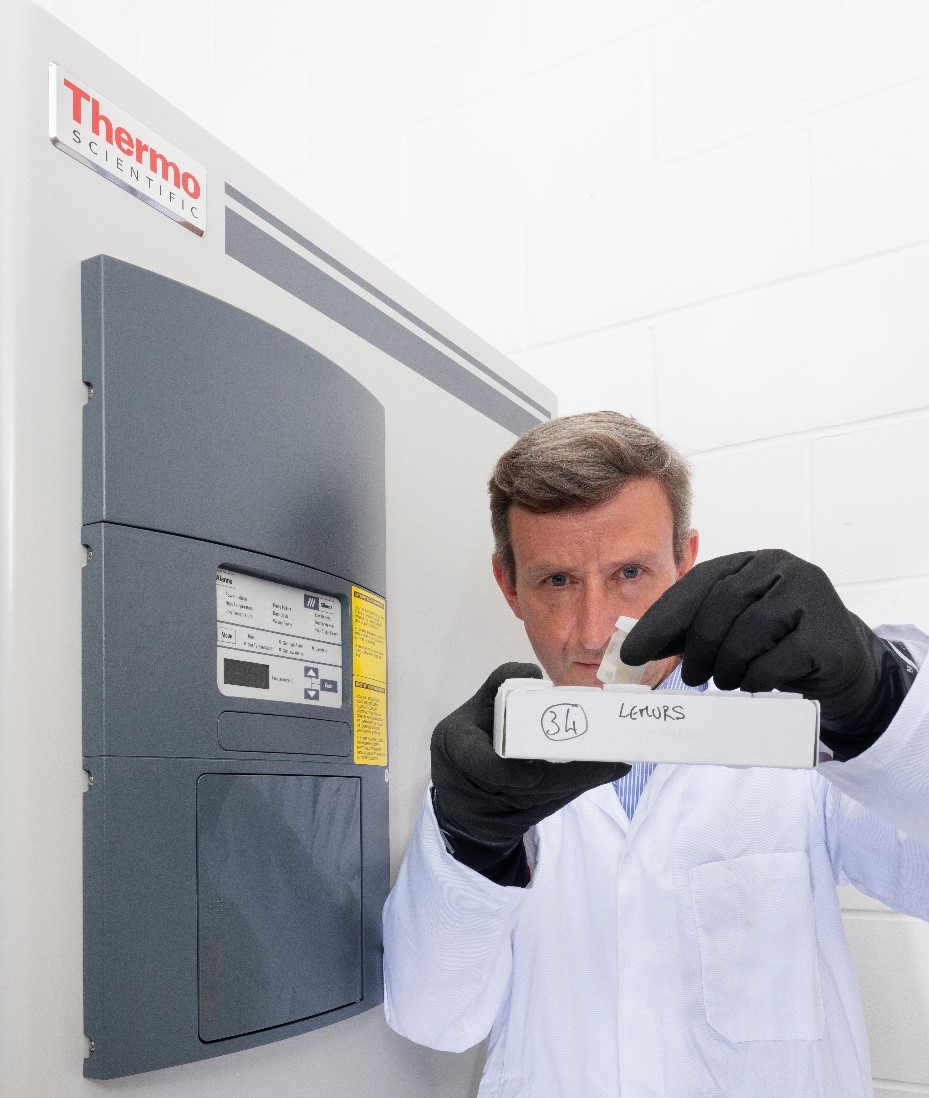
Sorting through lemur muscle samples at National Museums Scotland © National Museums Scotland

CryoArks is a BBSRC-funded project led by Professor Mike Bruford at Cardiff University, which has established the UK’s first comprehensive zoological biobank for research and conservation. CryoArks is a consortium of museums, zoos, academic institutions and biobanks, which is working together to establish common standards and working practices to store tissue and DNA samples and make them available on a common web portal, so that researchers and conservation biologists will be able to find out what is available for their research. This will help cut down on the sampling of our permanent collections by giving researchers something else to sink their scalpels into. CryoArks has two main sample storage hubs – at the Natural History Museum in London and at National Museums Scotland in Edinburgh – that currently house more than 65,000 samples, but we have room for almost a quarter of a million. The Royal Zoological Society of Scotland is also a joint CryoArks and European Association of Zoos and Aquaria biobank storage hub, bringing the zoo and non-zoo biobank communities together.

Continue reading →