Displays of Power: A Natural History Of Empire

Presented by Hannan Cornish, Luanne Meehitiya, Tannis Davidson, Subhadra Das, Grant Museum of Zoology, UCL Culture.

Abstract

The Displays of Power exhibition explores the zoology collections of the Grant Museum, motivated by the conviction that, “there are stories of empire in any natural history collection – if you know how to look”.

Research found that empire played a key role in the development of the Grant Museum. The map of the British Empire was reflected in where the specimens were collected and empire helped to turn animals into objects for worldwide trade. Teaching specimens were used to promote racism and colonialism. Specimens hunted to extinction by colonists evidenced how empire affected the natural world. Hunting trophies demonstrated imperial attitudes towards animals that persist.

Displays of Power was inspired by a paper co-authored by Subhadra Das, one of our curatorial team, and Miranda Lowe, a Principal Curator at the Natural History Museum, which argues that natural history museums perpetuate racism and alienate BAME visitors by ignoring colonial histories. To remedy this erasure, Displays of Power foregrounds the legacy of empire throughout the museum display.

The exhibition takes the unusual approach of reframing and reinterpreting objects that are already on display. In this way, we turned a lack of temporary exhibition space into an opportunity to show that stories of empire are ubiquitous but untold throughout collections. Displays of Power was created as a means to open up the conversation around empire in as many different ways as possible. This includes a collaboration with poet Yomi Sode, visitor conversations with trained front of house staff and family and school activities and resources. Associated events include a community take over day and evenings exploring privilege through comedy and a giant immersive game of snakes and ladders. Visitor feedback highlights the deep personal impact of the exhibition. Visitors are sending a strong message that we (and other museums) need to continue decolonising our collections and that is what we intend to do.

Continue reading

The Political Platypus And The Colonial Koala – How To Decolonise The Way We Talk About Australian Animals

Presented by Jack Ashby, University Museum of Zoology, Cambridge.

Abstract

Decolonisation is about breaking down systemic hierarchies, where European narratives have been considered superior to any others. In this talk, I will be asking whether this can be applied to the way we talk about Australian mammals.

My argument is that the ways in which museums and other sources represent Australian animals today are often fundamentally pejorative, and reflect an ongoing subconscious colonial bias. This attitude begins with the colonists and explorers of the 17th and 18th centuries, but remains detectable in the ways that Australian wildlife is interpreted today, in museums, TV programmes and in the popular zeitgeist. This may sound extreme, but I will be asking whether the zoological and socio-historical stories of marsupials, platypuses and echidnas may intertwine to have severe impact on global politics.

I will explore some common tropes for how Australia’s wildlife appears in our museums, and propose language and narratives to avoid perpetuating colonial narratives in museum interpretation.

Continue reading

Telling the Truth About Who Really Collected the “Hero Collections”.

Written by Jack Ashby, Assistant Director of the University Museum of Zoology, Cambridge.

One way that museums can decolonise their collections is to celebrate the true diversity of all the people that were ultimately responsible for making them. We often say things like, “This specimen was collected by Darwin”, or whichever famous name put a collection together, when in reality we know that often they weren’t actually the ones who found and caught the animal.

Museums can be rightly proud of their “hero collections” and the famous discoveries represented by them. Acknowledging that they did not work alone does nothing to diminish their accomplishments. We just need to make clear that other people made enormous contributions to their successes, and celebrate them too.

Undeniably, natural history museums have overwhelmingly celebrated dead white men. A major strand of decolonisation work is to show that a greater diversity of people are, in fact, represented in the history of our collections. But in reality, their contributions are rarely documented.

The Malay Teenagers Who Collected Wallace’s Birds

Lately, I’ve been looking at the collection of birds here at the University Museum of Zoology, Cambridge, that Alfred Russel Wallace brought back from his eight-year voyage to the Malay Archipelago. Any museum with Wallace material considers it among their treasures. He co-discovered evolution by natural selection, added mountains of invaluable specimens to museums worldwide, and founded entire scientific disciplines based on his interpretations of what he saw. And he gives a lot of credit to the people of colour who collected much of his material.

Continue reading

CryoArks – Discover The UK’s First Zoological Biobank

Written by Andrew Kitchener, Principal Curator of Vertebrates, National Museums Scotland.

Many of us have probably been approached by eager PhD students and other researchers who want to snip a bit off those specimens or drill a few holes in others. As curators we start to feel somewhat uncomfortable about seeing our precious collections sliced and diced, and yet we are also keen to discover more about the genetic content of our specimens for their own sake. This is partly because collectively we can contribute to studies that benefit wild populations of species, including the conservation biology of many endangered species and the possibility of rewilding extirpated species. You may also have a chest freezer bursting with grip-seal bags or plastic tubes filled with tissue samples collected from specimens you have acquired, but you’ve no idea what to do with them, but you know they will be useful one day. Or maybe you have a freezer full of specimens you want to get rid of. CryoArks is a new initiative that just might help you to solve all these problems.

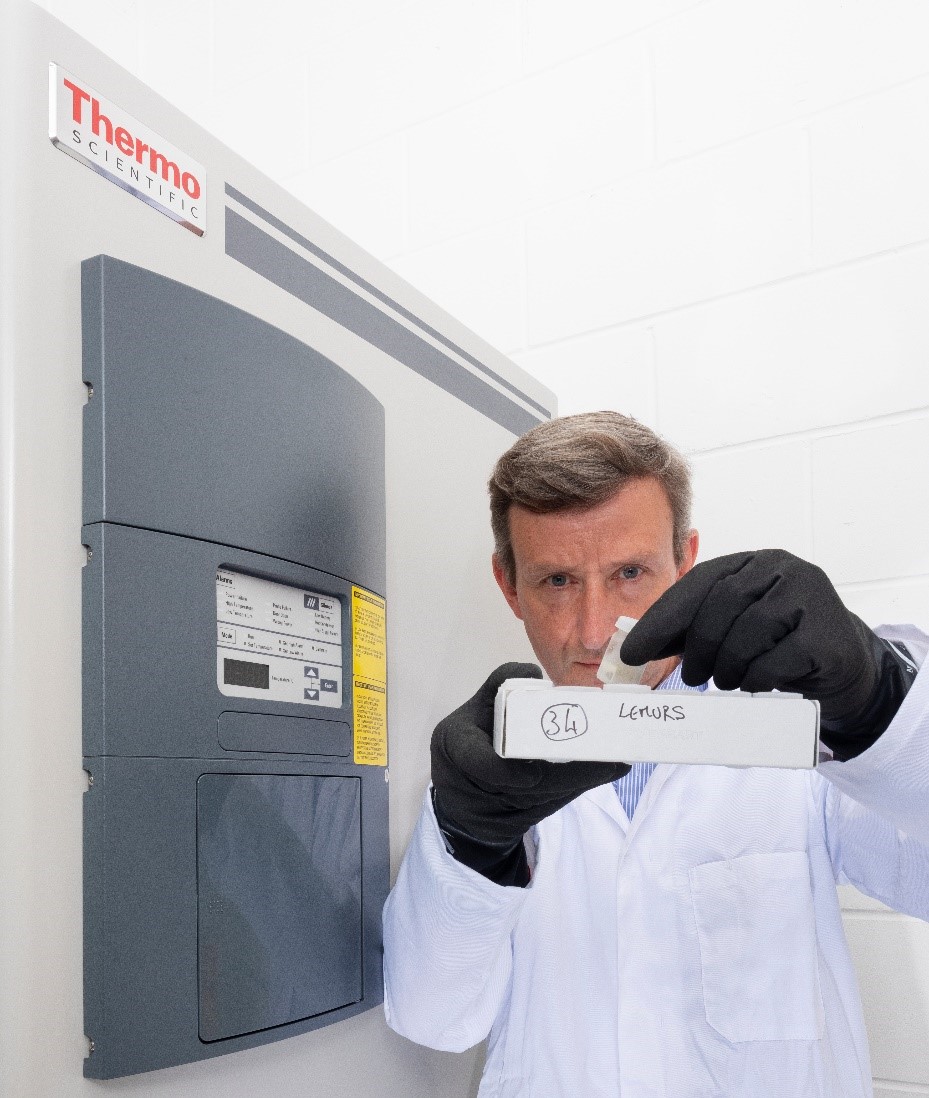
Sorting through lemur muscle samples at National Museums Scotland © National Museums Scotland

CryoArks is a BBSRC-funded project led by Professor Mike Bruford at Cardiff University, which has established the UK’s first comprehensive zoological biobank for research and conservation. CryoArks is a consortium of museums, zoos, academic institutions and biobanks, which is working together to establish common standards and working practices to store tissue and DNA samples and make them available on a common web portal, so that researchers and conservation biologists will be able to find out what is available for their research. This will help cut down on the sampling of our permanent collections by giving researchers something else to sink their scalpels into. CryoArks has two main sample storage hubs – at the Natural History Museum in London and at National Museums Scotland in Edinburgh – that currently house more than 65,000 samples, but we have room for almost a quarter of a million. The Royal Zoological Society of Scotland is also a joint CryoArks and European Association of Zoos and Aquaria biobank storage hub, bringing the zoo and non-zoo biobank communities together.

Continue reading

Natural Connections

This is a modified version of two articles originally published on the Gallery Oldham webpage by Patricia Francis, Natural History Curator, Gallery Oldham. May & June 2020.

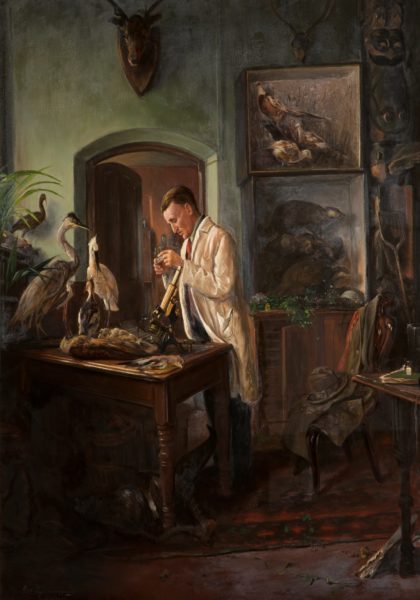
Fred Stubbs shown in The Naturalist by George Henry Wimpenny

This painting reveals a hidden Oldham story. It dates from the 1920s and has always been a great favourite with our visitors. Several years ago it inspired me to look more deeply and investigate, the person, the place and the specimens.

The person is Fredrick J. Stubbs

Fred was born in Liverpool in 1878 and moved with his family to Oldham where he became apprenticed to an upholsterer. He joined the Oldham Microscopical and Natural History Society, his first love being birds. Fred volunteered at the Oldham Municipal Library, Art Gallery and Museum which was long connected with the Natural History Society. When a vacancy arose at Stepney Museum’s Nature Study Centre, he was successful in getting the job and in 1909 left Oldham for London. Completing the booklet, ‘The Birds of Oldham’ in 1910.

Returning to Oldham in April 1919 he became the Deputy Librarian and Curator at the Library and Museum. He became president of the Yorkshire Natural History Society; was a member of the Beautiful Oldham Society and help found the Oldham Society of Artists. He worked at the Library and Museum until his death caused by pneumonia in 1932.

Continue reading