Derby Museums Need You

Thanks to Jonathan Wallis for bringing this to our attention.

In 2015 Derby City Council will be cutting funding for Derby Museums by 26%. Would that it were an isolated incident for Derby, or indeed the country at large. This is not the first time that the plight of the East Midlands has been brought to NatSCA’s attention, nor the first time they’ve been discussed by the members.

There is much that needs to be done but something we can all do is sign the no Cuts to Derby Museums petition.

The financial value of museum objects

In the museum sector there’s a bit of unwillingness to discuss the financial value of objects. After all, museums are not run as salerooms and their focus is on the other sorts of value that collections hold.

Of course, for some artworks it can be hard to ignore the massive price tags that they sometimes carry and there are some good arguments that in our materialistic society, which has become increasingly focussed on economics, there are sound reasons for including financial value in considerations about collections. An interesting discussion about this between two NatSCA stalwarts, Jan Freedman and Mark Carnall, was recently published by the Museums Association.

Worth £175 million today. Card Players (5th version ca.1894-1895) by Paul Cezanne is the most expensive painting in the world. For now... (image from Musée d'Orsay)

Worth £175 million today. Card Players (5th version ca.1894-1895) by Paul Cezanne is the most expensive painting in the world. For now… (image from Musée d’Orsay)

For those of us who work in museums, we normally only consider a specimen’s price-tag when acquiring new material, deaccessioning material or dealing with insurance valuations for exhibitions and loans.

When acquiring specimens, the consideration is about whether an asking price is fair and an appropriate amount to spend in the context of institutional priorities and budget. When deaccessioning, the consideration is rather more complex and is linked to appropriate methods of disposal and the motivations for disposal. Deaccessioning shouldn’t be done in order to make money, but disposal by sale may be an option as long as the processes involved in the decision meet professional standards.

The controversial disposal by sale of the statue of Sekhemka has caused problems for Northampton Museum & Art Gallery. (Image of the statue on display c.1950s - uploaded by Bibilovski, 2012)

The controversial disposal by sale of the statue of Sekhemka has caused problems for Northampton Museum & Art Gallery. (Image of the statue on display c.1950s – uploaded by Bibilovski, 2012)

When assessing these sorts of values it can be very useful to look to private auctions for a guide, which take place every so often at a variety of auction houses. For natural history it can be worth checking Sotheby’sBonhams and Summers Place. However, auctions tend to deal with the more showy objects, rather than the scientific specimens that museum staff often have to deal with, especially for research loans.

Insurance valuations are slightly different, since these may not simply relate to the market value of an object, but could take into consideration the cost of conservation if the object is damaged, or the cost of going into the field to collect a similar specimen to replace it if it’s the sort of specimen that doesn’t come up for sale. Either of these possibilities may be far more expensive than a likely sale value.

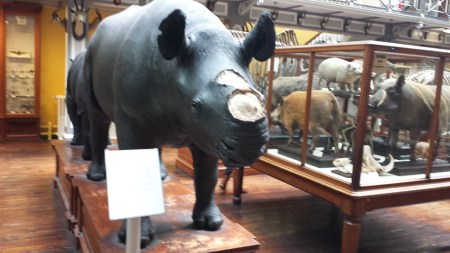
One of the issues with putting a price on objects is that it may make them more obviously attractive to criminals. For instance, a sudden spike in the street value of illegal rhino horn in parts of Asia around 2009 led to a massive increase in the prices of antique rhino trophies at auction, until special measures were introduced to stop this loophole in trade. In addition it has led to the targeted thefts of hundreds of specimens from collections around the world.

Taxidermy rhino with the horn removed and sign explaining the problem of thefts from museum specimens. (Image by Dr John Hutchinson, 2013)

Taxidermy rhino with the horn removed and sign explaining the problem of thefts from museum specimens. (Image by Dr John Hutchinson, 2013)

Of course, by being aware of the changing value of specimens and therefore the changing risk of theft, museums are able to take steps to ensure that appropriate security measures are put in place to properly care for their objects. So although the financial value of objects can be complex to address, it is clear that there is a need for museums to know how much their collections are worth, since other people may be only too aware.

State of the Union! Natural History Museums 2014

Author Mark Carnall, Curator, Grant Museum of Zoology, UCL
#NatureData Coordinating Committee
All views are the opinion of the author. August 2014.

‘After visiting the recent natural history museum community conference in July: SPNCH 2014, Cardiff, Mark Carnall reflects on what the sector internationally is thinking and doing – in particular what’s happening digitally and what people’s thoughts are on a UK natural science database’.

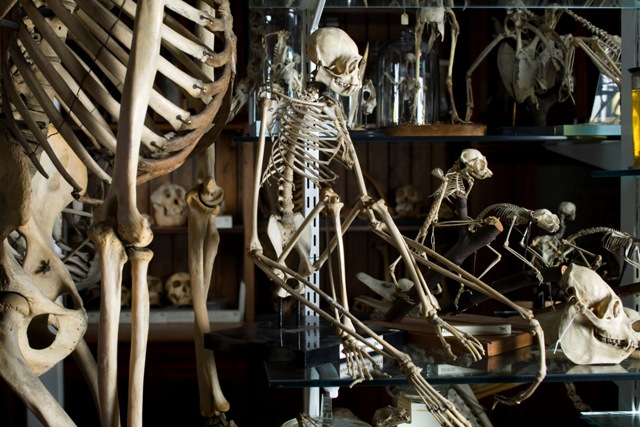
Primate skeletons in the Grant Museum of Zoology, UCL ©UCL, Grant Museum of Zoology and Matt Clayton

Primate skeletons in the Grant Museum of Zoology, UCL ©UCL, Grant Museum of Zoology and Matt Clayton

At the end of June was a rather special event; the coming together of three subject specialist networks (SSN), the Society for the Preservation of Natural History Collections (SPNHC), the Natural Sciences Collections Association (NatSCA) and the Geological Curators’ Group (GCG) hosted by Amgueddfa Cymru National Museum Wales. Between them, these three networks represent a sizeable chunk of curators, conservators, directors and educators who work in and with natural history museums and collections. Each SSN has yearly meetings but a syzygy rarely happens.

The full conference was a six day affair packed with field trips, stores tours, talks, workshops, demos, poster sessions and discussions attended by over 250 delegates from almost as many natural history institutions. This provided a great opportunity to catch up and meet friends, facilitated the catharsis in sharing frustrations unique to natural history museums and offered a rare chance to establish a sense of ‘the state of the union’ in natural history museums across Europe, North America and elsewhere.


The broad theme of the conference was historic collections and future resources and many of the presentations were about off-label uses of collections, advocacy and digitisation. Inspiringly, the conference was kicked off with a series of keynotes which carried the resounding message of “get over it” when it comes to the communities’ existential crisis in demonstrating value and worth with a rousing series of presentations from Professor Paul Smith and Dr Chris Norris setting the tone for the rest of the conference.

Off-label use of collections, a term borrowed from accidental discoveries of secondary beneficial side effects in the pharmaceutical industry, came up time and time again. Cynically, as the curator of a small museum it’s nice to finally be joined by colleagues from some bigger museums who, without having to face the “use it or lose it” challenge to keep a museum in existence, have cottoned on to the notion that perhaps collections have uses beyond the 10% of material that has a function in alpha taxonomy and (often low impact) taxonomic research. Colleagues presented example after example of natural history collections being used for research into environmental change. One question that wasn’t satisfactorily answered was about how this use of collections can be procedurally built into research. Many of the examples were incidental discoveries (hence off-label) rather than arising from researchers deliberately thinking of uses of collections in the first instance. However, advocates for the importance of natural history collections now have a new suite of examples to convince decision and policy makers about unique insights into the natural world which can only be gleaned from scrutinising collections.

When it came to advocacy, unfortunately the community fell into the trap of talking about scientific research use of collections almost to the exclusion of all other audiences. I’ve written before about how natural history museums need to celebrate and contribute more to being a part of the cultural sector, especially for museums which don’t hold scientifically important collections and specimens. Myopia aside, the community seems to have come on to some degree, telling each other how important natural history collections are, which came out in a panel discussion on advocacy. There are still a lot of stereotypes about what museums are and what they do that need to be pulled down, but there’s a danger in evangelising which can be quite divisive. Another general theme that came out across the series of talk days is that we need to get more sophisticated and generally get better at demonstrating what we do well. The finding of the NatSCA and Arts Council England study into the popularity of different kinds of museum galleries was presented, demonstrating that natural history collections are the most popular, but put some audiences off if they don’t appear to be well maintained or invested in. Natural History Near You was also presented, finally making headway into ascertaining exactly where all the natural history collections are, a fundamental piece of information that has eluded several generations of natural history collections workers. Interestingly, one of the contrasts between the UK delegates and those from the rest of Europe and North America was that with a handful of exceptions, the majority of the social media generated around the conference came from UK colleagues. It seems that social media is yet to take off as a promotional, professional networking and advocacy tool for museum professionals elsewhere.

Lastly, there was a cornucopia of presentations on digitising collections. It’s uncontroversial to say that museums in general are far from being digital – let alone post digital – and that natural history museums and collections as a group are lagging behind the rest of the museum sector. It seems that colleagues in North America and from the rest of Europe are making huge advances in all aspects of digitisation from technical advances, standards in digitisation, data capturing pipelines and networks, and databases linking specimen information. Embarrassingly, UK museums are somewhat left in the dust, contributing little to the 20 or so European and International data repositories and the data that does exist is incomplete, hard to export, manipulate or in many cases even locate – let alone scrutinise. This is in part what the #naturedata project hopes to solve, with “one portal to rule them all” in the UK at least. The need for this is even more pressing thanks to worryingly vague requirements for databases required for compliance with the Nagoya Protocol on Access and Benefit-sharing. Three conference sessions on the Nagoya Protocol valiantly tried to deconstruct the bureaucratic layers represented by this legislation but it looks like the practicalities of compliance will be causing headaches for generations of museum professionals yet.

Overall, the conference was an excellent set of days. Networking and socialising with enthusiastic, passionate and brilliant colleagues really is the best way to recharge the batteries and reinvigorate the soul. Throughout the presentations the niggling thought I kept returning to was that all the innovative, experimental and inspiring ways we use to get the most of our collections are still hamstrung by our fundamental issue of getting a handle on what we have in our collections. The curse and gift of natural history collections is their vast size, but it’s no longer good enough to use the size of our collections as an excuse for not getting to grips with every single specimen we have and making them available to the people for whom we keep them in trust.


Collecting biological specimens essential to science and conservation

A letter signed by more than 100 biologists and biodiversity researchers,  published online in Science today (Science 23 May 2014: Vol. 344 no. 6186 pp. 814-815 DOI:10.1126/science.344.6186.814), states why collecting plant and animal specimens is essential for scientific studies and conservation and does not, as some critics of the practice have suggested, play a significant role in species extinctions.

Beetle collection. Image by Paolo Viscardi

The letter is a response to an April 18 Perspectives article in Science arguing that alternative methods of documentation—such as high-resolution photography, audio recordings and nonlethal tissue sampling for DNA analysis—make the field collection of animal and plant specimens unnecessary. As most natural sciences collections professionals are fully aware, this is simply not the case.

“None of the suggested alternatives to collecting specimens can be used to reliably identify or describe animals and plants,” said Cody Thompson, mammal collections manager and assistant research scientist at the U-M Museum of Zoology.

“Moreover, identification often is not the most important reason to collect specimens. Studies that look at the evolution of animal and plant forms through time are impossible without whole specimens. Preserved specimens also provide verifiable data points for monitoring long-term changes in species health and distribution.”

In addition, specimens from museum collections and their associated data are essential for making informed decisions about species management and conservation now and in the future, the authors state.

“Photographs and audio recordings can’t tell you anything about such things as a species’ diet, how and where it breeds, how quickly it grows, or its lifespan—information that’s critical to assessing extinction risk,” said Luiz Rocha of the California Academy of Sciences, who organized the response to the Science article.

And contrary to statements made in the April 18 Science article titled “Avoiding (Re)extinction,” collecting biological specimens does not play a significant role in species extinctions, according to the rebuttal authors.

In the April article, Arizona State University’s Ben Minteer and three co-authors cite several examples of species extinctions and suggest that the events were linked to overzealous museum collectors.

Not so, according to authors of the rebuttal letter, who reviewed the evidence and found that none of the cited extinctions—including the disappearance of flightless great auks in Iceland and Mexican elf owls on Socorro Island, Mexico—can be attributed to scientific collecting.

Millions of great auks were harvested for food, oil and feathers over the millennia, and only about 102 exist in scientific collections. Mexican elf owls were common when specimens were collected between 1896 and 1932, and the most likely reasons for extinction around 1970 were habitat degradation and predation by invasive species.

At the same time, Minteer and his colleagues failed to point out any of the valuable services that museum biological collections have provided over the decades, according to the rebuttal authors.

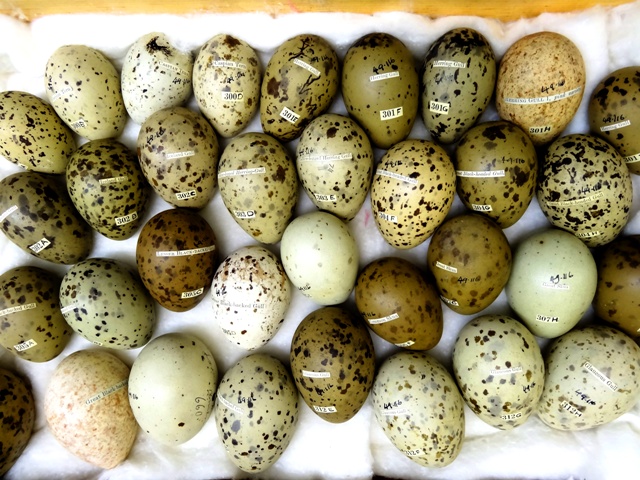
Both historical and new collections played a key role in understanding the spread of the chytrid fungus infection, one of the greatest current global threats to amphibians. The decision to ban DDT and other environmental pollutants was based on the discovery of thinning bird eggshells collected over an extended period. And the declining body size of animals, one of the negative effects of climate change, was discovered using body-size data from museum specimens.
Egg collections like this helped identify the harm done by DDT. Image by Paolo Viscardi

In other cases, genetic data from decades-old scientific specimens has even been used to “de-extinct” species. One of these, the Vegas Valley leopard frog, was thought to have gone extinct in the wake of Las Vegas development. However, a study published in 2011 compared the genetics of specimens from the extinct population to individuals from surviving populations of similar-looking frogs elsewhere in the Southwest and found them to be the same species.

These types of discoveries are “the hallmark of biological collections: They are often used in ways that the original collector never imagined.” And with the continuing emergence of new technologies, this potential only grows.

That potential, combined with the increasing number of threats species face and the need to understand them, suggests that the need to collect specimens—and to share the information they hold—has never been greater.

In their April article, Minteer and his colleagues erroneously portray scientific collecting in a negative light that distracts from the primary causes of modern extinctions: habitat degradation and loss, unsustainable harvesting and invasive species.

“Halting collection of animal and plant specimens by scientists would be detrimental not only to our understanding of Earth’s diverse biota and its biological processes, but also for conservation and management efforts,” said Diarmaid O’Foighil, director of the U-M Museum of Zoology and a co-author of the rebuttal letter.

“That detriment in understanding would only increase with time because having museum specimens available for future generations of scientists will allow their study using research methodologies that have yet to be invented.”

A pre-publication pdf version of the letter can be read here.


Do you want to train to be Natural Science Curator?

Heritage Lottery Fund ‘Skills for the Future’

Natural History & Social History Training Opportunities

Support from the Heritage Lottery Fund ‘Skills for the Future’ programme and Natural Sciences Collections Association (NatSCA) has created opportunities for four individuals to train in curatorial skills with a partnership of regional museums and heritage sites.

We are looking for people who are passionate and enthusiastic about Natural History/Sciences or Social History. These traineeships are available to anyone who might not have qualifications in the subject area, or are not from museum background, or are wanting a career change.

  • ·         One Natural History traineeship based at The Manchester Museum The University of Manchester
  • ·         One Natural History traineeship based at Leeds Museum Discovery Centre
  • ·         One Natural Science  traineeship based at Thinktank Science Museum, Birmingham Museum Trust
  • ·         One Social History traineeship based at The Herbert Art Gallery & Museum, Coventry

Full information and application forms can be found within the job packs

Please follow link   www.bmag.org.uk/about/vacancies

Closing date is: 20 March 2013 at 10.00 AM   Proposed dates for interviews: W/C 14 April 2014
If you have any enquiries about these traineeship opportunities, please contact Paulette Francis-Green Project Manager by email projmangctrainee@aol.co.uk