Compiled by Olivia Beavers, Assistant Curator of Vertebrate Zoology at World Museum, National Museums Liverpool.
Welcome to the September edition of NatSCA Digital Digest.
A monthly blog series featuring the latest on where to go, what to see and do in the natural history sector including jobs, exhibitions, conferences, and training opportunities. We are keen to hear from you if you have any top tips and recommendations for our next Digest, please drop an email to blog@natsca.org.
Sector News
GCG 51st Winter Seminar and AGM –Call for Abstracts Now Open
The Geological Curators Group have announced the details for their Winter Seminar Reciprocal Relationships: how can partnerships help us and our collections develop? and AGM taking place at Oxford University Museum of Natural History 11 – 13th November 2024. The dates include an evening icebreaker, presentations, workshops, AGM, conference dinner and a field trip.
Compiled by Olivia Beavers, Assistant Curator of Vertebrate Zoology at World Museum, National Museums Liverpool.
Welcome to the June edition of NatSCA Digital Digest.
A monthly blog series featuring the latest on where to go, what to see and do in the natural history sector including jobs, exhibitions, conferences, and training opportunities. We are keen to hear from you if you have any top tips and recommendations for our next Digest, please drop an email to blog@natsca.org.
Sector News
From Collections to Connections, May – November 2024
This Changing Chalk commission/ Natural Trust funded project is a collaborative archival art and environment initiative. Artist Pauline Rutter invites Black and minoritised young people, their families and communities to explore the rich history of flora and fauna across several locations of the Changing Chalk area within the South Downs National Park.
‘From Collections to Connections’ offers opportunities for learning and sharing about collections held at the Booth Museum which relate to the Sussex locations of Mill Hill, Truleigh Hill and Devils Dyke. Through walks, talks and creative interventions, opportunities are provided for exploring the museum collections and their related histories. Individuals will be invited to find their own connections between these elements and their experiences within the natural and museum environments. To find out more, follow this link to the summary outline: https://drive.google.com/file/d/1cJQh4UYMTeRB_HqsM7EydOmNBLGKYQpb/view
Compiled by Olivia Beavers, Assistant Curator of Vertebrate Zoology at World Museum, National Museums Liverpool.
Welcome to the March edition of NatSCA Digital Digest.
A monthly blog series featuring the latest on where to go, what to see and do in the natural history sector including jobs, exhibitions, conferences, and training opportunities. We are keen to hear from you if you have any top tips and recommendations for our next Digest, please drop an email to blog@natsca.org.
Sector News
NatSCA Annual Conference & AGM 2024
Registration is open for the 2024 Annual Conference & AGM of the Natural Sciences Collections Association. Trials and Triumphs: sharing practice across the museum sector will be held on Thursday 18th and Friday 19th April 2024 in the Oxford University Museum of Natural History. This practical conference aims to celebrate triumphs and amplify successes in museums, but also highlights pitfalls and lessons learned from situations that didn’t go as planned. Members – please remember to contact membership@natsca.org for your promotional code to release discounted tickets.
The event will be physical/digital hybrid, with attendees able to attend in person or online via Zoom. Follow the link for more details and to register.
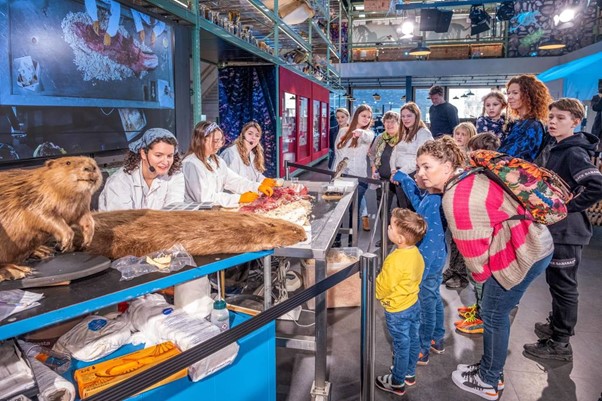
The day we prepared the largest beaver ever found dead in the Netherlands.
It is a Wednesday afternoon in Naturalis’ Live Science Hall. An older woman walks by, holding her nose, but watching us intently. Shortly after, teenagers on a school trip yell “eeeewww gross!” but then come in closer to check it out. A young girl says loudly “I think this is sad” while she drags her mom by the hand up to our silver lab table. On the table is a large Eurasian eagle-owl, now in two pieces. I am removing muscle from the detached wing, and my co-worker Liselotte is busy pulling the skin from the body. This owl, found dead by the side of the road, is being prepared as a study skin for the museum’s collection. But instead of in the lab, we are doing it live in front of the public in a hall that has free entry.
We prepare vertebrates, mostly mammals and birds (though we have worked on a giant ocean sunfish here too) live twice a week, all the while talking to visitors who stop by. On a quiet day, visitors can come right up to the table (they are kept at a bit of a distance by a stanchion) and on a busy day, people sit on the risers in the hall and interact with us via a science educator who walks around with a microphone taking visitor questions. We have a camera mounted in the ceiling zoomed in on the table. This is shown on the screen behind us so that even the smallest visitors can see what we are doing.
Every year, 10th December is commemorated as International Human Rights Day, the date when the Universal Declaration of Human Rights was adopted by the members of the United Nations. This year is particularly momentous, as it is the 75th anniversary of the Declaration’s adoption. What has this got to do with museums? The original Declaration includes a number of commitments (set out in 30 Articles) that are obviously related to the work of museums: the right to education, the right to information and freedom of expression, the right to take part in public affairs, among others. Museums often focus on one (article 27) that gets summarized as being ‘the right to participate in cultural life’, but that isn’t it’s full or proper title or scope: more correctly, it is that “Everyone has the right freely to participate in the cultural life of the community, to enjoy the arts and to share in scientific advancement and its benefits.” Note especially the part about sharing in scientific advancement and its benefits: we will come back to this.
Now, the Universal Declaration is not perfect, it is 75 years old after all, and it reflected a world rather different than our world today. Hundreds of millions of people were still under colonial rule. The environment didn’t feature in the Declaration, as human impacts on the environment were not as massive, and not as obvious. Nevertheless, the Declaration has been supplemented by many additional agreements, many of which have a legal standing. However, the necessity of a decent quality environment has been recognized for decades. Indeed, it has been argued that most or possibly all of the 30 rights in the original Universal Declaration rely on a decent quality environment. Sustainable development really got going in the early 1970s, with the Stockholm Conference on the Human Environment, that recognized that people have a right to a decent quality environment. Fast forward 50 years, to 2022, and that right was finally formally recognized by the United Nations. More recently, the inherent rights of nature have been the subject of court cases and in some cases natural features have been granted rights, which helps protect them and to take polluters to court for environmental damage.




 NatSCA