Taxidermy Koala – The Language of Natural History

This article has been re-posted from the Grant Museum of Zoology blog, with permission of the author Jack Ashby.

With generic terms like mankind and Homo sapiens (“wise man”), people of all genders are well aware that it is the masculine that has dominated the vocabulary of humanity. Not so in the animal kingdom.

Across UCL Culture we are celebrating the centenary of some women first getting the vote in the UK in a number of different ways. In the run up to International Women’s Day, here on the blog our Specimens of the Week will be exploring themes like women in natural history, female specimens, and – in this case – the language of natural history. This week’s Specimen of the Week is…
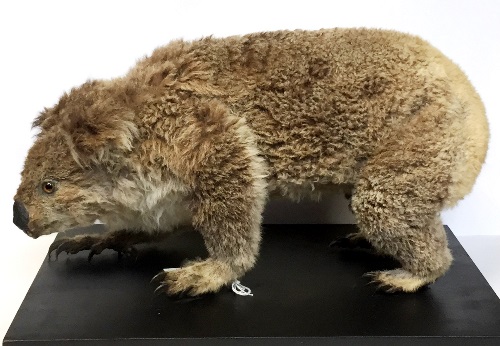
Koalas are one of many Australian mammals that are named after a characteristic that only females have. Their scientific name Phascolarctos means “pouched bear”. LDUCZ-Z65. (C) UCL Grant Museum of Zoology

***The Taxidermy Koala***

I find it interesting to think about animals that are named after features that only one sex has. How would you feel if your species was defined by a characteristic that you yourself didn’t possess?* My own passion is the mammals of Australia. Unlike many other groups (for example there are entire groups of insects that can only be identified by studying male genitalia), for those animals which are named for sex-specific features, Australian mammals are almost** universally named after things that only appear in females.

Continue reading

Meet the Committee – Donna Young

What is your role on the NatSCA committee?

My main role over for the last four years has been organising our annual conferences at York, Bristol, Derby and Cambridge museums.

There’s a lot of work involved in putting the programme together and it’s a great team effort, along with our fantastic treasurer and the staff based at the various venues. I have found it very rewarding to see us expand our audience and develop our programme themes.

I am currently a member of the of the journal editorial board and NatSCA bursaries/grants sub-committee.

Job Title & Institution

Curator of the Herbarium: World Museum, National Museums Liverpool.

Twitter Username

@HerbariumDonna

Donna Young, hard at work on the herbarium. (C) National Museums Liverpool.

Continue reading

Willows in the Wind: Digitisation of the Tullie House Herbarium

Excited (botanical) chatter, the inexorable flashing of camera equipment, intrigued visitors gathering around our new gallery space; this was our Virtual Flora of Tullie Herbarium Project, funded by the Bill Pettit Memorial Award at the start of 2017.

The scope of the project, between 30th of May to 26th of September 2017, was to use a team of volunteers to begin photographing and cataloguing our (“ex”) University of Lancaster herbarium. This significant acquisition of 35,000 vascular plant sheets is a highly data rich and well-provenanced collection with invaluable information on the historical and contemporary distribution of species across the UK and beyond. Almost a third of the specimens were collected from Cumbria, much of it collected during a major 30 year survey of the flora of Cumbria; an exemplar model of field surveying which is aspired to by Botanical Society of Britain and Ireland (BSBI) recorders today. The survey work culminated in the team leader’s (Geoffrey Halliday) highly comprehensive publication of A Flora of Cumbria. No other herbarium has a comparable recent (1968+) collection of Cumbrian material.  But despite the importance of this recent acquisition, none of these specimens were digitised.

Thanks to the Bill Pettit Memorial Award funding this was all about to change.

Continue reading

NatSCA Digital Digest – February

What’s New?

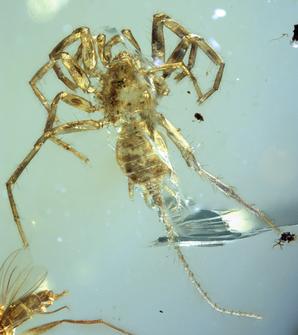
If you haven’t heard about the exciting discovery of a “spider-like” ancient creature from 100 million years ago, now is the time to check it out! Named Chimerarachne yingi, this little beauty has eight legs and a tail, and is exquisitely preserved. I only wish H. R. Giger had been around to see it. You can read more about the discovery here.

Chimerarachne (Image in public domain)

It’s day three of Operation Move Sue the T. rex over at the Field Museum. To follow this story, follow #SueOnTheMove.

What Shall I Attend?

The big item on everyone’s calendar is of course the NatSCA Conference 2018 – this year hosted in Leeds. Keep the dates 26th and 27th April free. I’m hoping people bring their live-tweeting A-game this year because I’m not able to go, so I need to live vicariously through you wonderful people. You can find more information on our website. Paper and poster submissions are now closed but you can still contribute; continue reading to the next section for more information.

Continue reading

NatSCA Journal Evolution

NatSCA’s Journal of Natural Science Collections is a place for those working with these collections to share projects and practices that will benefit the museum community. The Journal represents all areas of work with natural science collections, and includes articles on best practice and latest research across disciplines, including conservation, curation, learning, and exhibitions. All submissions are peer reviewed, resulting in high quality articles.

The Journal was founded in 2013, replacing NatSCA News. It has continued to evolve, and 2017/18 has brought some exciting new developments:

Going paperless

Following a recent survey of our members, the committee has decided to offer a paperless option for the Journal. From 2018, when you join NatSCA or renew your membership, you will be given a choice to receive either printed or electronic-only access to the Journal. This will make NatSCA a more environmentally-friendly and sustainable organisation, and save money that can be used in other areas to benefit our membership.

Volume 5 of the Journal will be sent out to all members as normal. It is being finalised at the moment, and will be arriving through your doors very soon!

Continue reading