How to Reimagine a 117-year-old Diorama of Seabirds for a 2021 Gallery.

Written by Patricia Francis, Natural History Curator, Gallery Oldham. 

An account of ‘how to’ reuse an old, forgotten about diorama and turn it into a display highlighting a widespread and major environmental problem of today.

I first found this large sea stack diorama in a corner of a museum storeroom. The storeroom being in a basement of a building without lift access, so the display obviously had had a bit of a rough arrival to its resting place. It had been left uncovered for many years and was in a bit of a sorry state. There were a few birds left in position covered by plastic bags, sad remnants of a previous splendid display. It is a four-sided diorama and on one side at the base of the display is a ‘rock pool’ where a large sea worn pebble bears the following: Fred Stubbs, Oldham 1905.
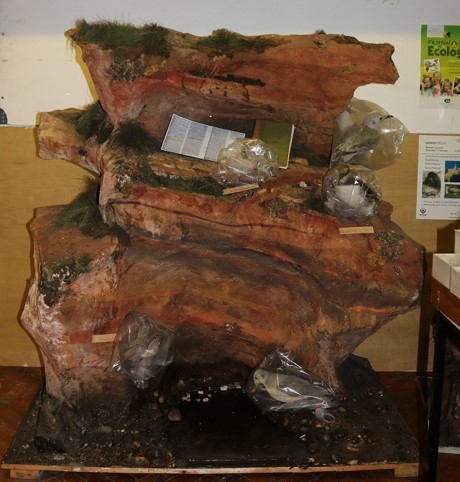
After a bit of background research, I found this exhibit had four periods when it has been displayed. Firstly, in Oldham’s first Museum which opened in 1883 and where it was made – one of four original dioramas mentioned in a notebook and in the local newspaper the ‘Oldham Chronicle’ in an article of 1909 when it was described as: ‘A splendidly conceived stack, an isolated sandstone rock in the sea…provides accommodation on its ledges for a number of seabirds…makes up a beautiful picture at once artistic and scientific’. At this time a young Fred Stubbs was a leading light in the Oldham Natural History Society. Although the Museum was overseen by the Borough Council, the Society had been charged with the day to day running and creating natural history displays.

Very strangely three of these dioramas were coastal – sea stack, salt marsh and seashore, the fourth was woodland. Quite odd for a town museum like Oldham, far from the sea and where the largest local habitat is the Pennine and Peak District moorland! The maker, Fred, was born in Liverpool – so I wondered if his continued family connections with the coast had influenced this?

Continue reading

NatSCA Digital Digest – October 2023

Compiled by Milo Phillips, Assistant Curator of Entomology for National Museums Scotland.

Welcome to the October edition of NatSCA Digital Digest.

A monthly blog series featuring the latest on where to go, what to see and do in the natural history sector including jobs, exhibitions, conferences, and training opportunities. We are keen to hear from you if you have any top tips and recommendations for our next Digest, please drop an email to blog@natsca.org.

Sector News

Museum Association Conference 2023: The Power of Museums

There’s still time to register for this years’ Museum Association Conference, being held in Gateshead on 7th-9th November. The conference will explore how we can help our communities flourish by having a positive impact on health and wellbeing, placemaking, economic regeneration and by providing space to reflect on the pressing issues that we face. The cost of living crisis, discrimination and climate change are all having an impact on our communities. What do people need from us in times of upheaval and change? Follow the link to find out about the registration fees and to book your place: https://www.museumsassociation.org/events/conference-2023/

NatSCA Lunchtime Chats

The new lunchtime chats are for members only and run on the last Thursday of every month. This series is supposed to be informal; no fancy equipment is needed; it will be put out over the NatSCA Zoom platform and there is no fixed format. All members will have received a link to join via Zoom (the same link works for all sessions) – if you haven’t, get in touch with membership@natsca.org. Bring your sandwiches and a cuppa and we hope to see you on the day!

Continue reading

NatSCA Digital Digest – September 2023

Compiled by Olivia Beavers, Assistant Curator of Vertebrate Zoology at World Museum, National Museums Liverpool.

Welcome to the September edition of NatSCA Digital Digest.

A monthly blog series featuring the latest on where to go, what to see and do in the natural history sector including jobs, exhibitions, conferences, and training opportunities. We are keen to hear from you if you have any top tips and recommendations for our next Digest, please drop an email to blog@natsca.org.

Sector News

Museum Association Conference 2023: The Power of Museums

This years’ Museum Association Conference is being held in Gateshead on 7th-9th November. The conference will explore how we can help our communities flourish by having a positive impact on health and wellbeing, placemaking, economic regeneration and by providing space to reflect on the pressing issues that we face. The cost of living crisis, discrimination and climate change are all having an impact on our communities. What do people need from us in times of upheaval and change? Follow the link to find out about the registration fees and to book your place: https://www.museumsassociation.org/events/conference-2023/

#BlackInNHMs – Black in Natural History Week – Registration is now open!

The 3rd Annual Black in Natural History Museums (#BlackInNHMs) Week runs from Sunday 15th – Saturday 21st October. Anyone can join in: non-black and black colleagues are invited to a series of online events planned for the week. Follow this link to register and find out more: https://www.blackinnhms.org/2023-binhms-week

Continue reading

What is Taxidermy? An Intimate Relationship between Death and Maker.  

Written by Jazmine Miles Long, Taxidermist. https://www.jazminemileslong.com, Twitter: @TaxidermyLondon; Instagram: @Jazmine_miles_long

For taxidermy to exist an animal must have died. This brutal truth creates unease and leaves the viewer to ponder how the death occurred. And secondly how the death and the body is managed. A fluffy rabbit, cute and cuddly in life, suddenly becomes hideous and untouchable in death. Due to my profession, I am raising a child who has been exposed to dead animals and the concept of death his whole life. This has not made him desensitised to death, I’d say the opposite. He is deeply hurt by the death of any animal; he is a self-proclaimed vegetarian and last week at the age of 4 he asked me if his job when he grows up could be to stop people eating animals. He shouts at cars to slow down in case they hit anything and one of my favourite things he asks me when we meet new people is if they are a vegetarian or a carnivore eyeing them up suspiciously. Does a good understanding of death at a young age give a person greater empathy for animals and take us closer to not seeing them as ‘other’? 

When my son is asked what a taxidermist does, he says they look after animals when they die. I get at least one phone call a week from someone mourning their dead pet, I give advice on what to do next, ideas for memorials and how to store the body in the freezer while they decide what to do. I didn’t expect as a taxidermist to be a councillor, a listening ear, someone who is qualified to talk about death. 

Continue reading

Preparing Collections for a Big Move

Written by Ellie Clark (Collections Move Team Lead) and Lizzy Devenish (Collections Move Team Lead Digitisation), Natural History Museum, London.

Introduction

The Natural History Museum is in the process of preparing 38 million specimens to be moved, 28 million of which will be rehoused to a new Science and Digitisation Centre at Thames Valley Science Park (TVSP) in Reading – the largest move of natural history specimens globally. Part of NHM Unlocked, this is an ambitious programme to secure the future of our irreplaceable collections, accelerate scientific research and enhance the Museum’s public offer. 

As part of this process, new workflows are being developed to ensure the safety of specimens before, during and after the move. Below, Team Leads Ellie Clark and Lizzy Devenish discuss a couple of ways this is currently being accomplished.

Physical Interventions Survey

It is important to gain a good understanding of the condition and housing needs of specimens before they move to TVSP. To do this, the NHM Unlocked Moves Team are currently undertaking a Physical Interventions Survey across the Palaeontology Collections to better understand these needs. The level of preparation needed varies from specimen to specimen depending on several factors including current storage, specimen condition, size of specimen and collection type. The ultimate aim of the survey is to provide an initial assessment for the time and resources needed for specimen preparation by curatorial and conservation teams to facilitate the safe movement of specimens to the new site.

Continue reading