A Refresher Course on Fluid Specimen Conservation at the Natural History Museum of Denmark

Written by Anastasia van Gaver (Conservator) & Bethany Palumbo (Head of Conservation) Natural History Museum Denmark).

Workshop participants and Julian Carter

As conservators, it’s essential we keep up to date with developments in the techniques used in specimen treatments. With hundreds of fluid-preserved specimens to make and conserve for the new exhibitions at the Natural History Museum of Denmark, we sought the best in the field to give us a refresher course. Esteemed expert Julian Carter arrived fresh off the plane from Cardiff and over 3 days we explored different techniques for preserving and mounting specimens and well as discussing the unique challenges we face when conserving these invaluable scientific resources.

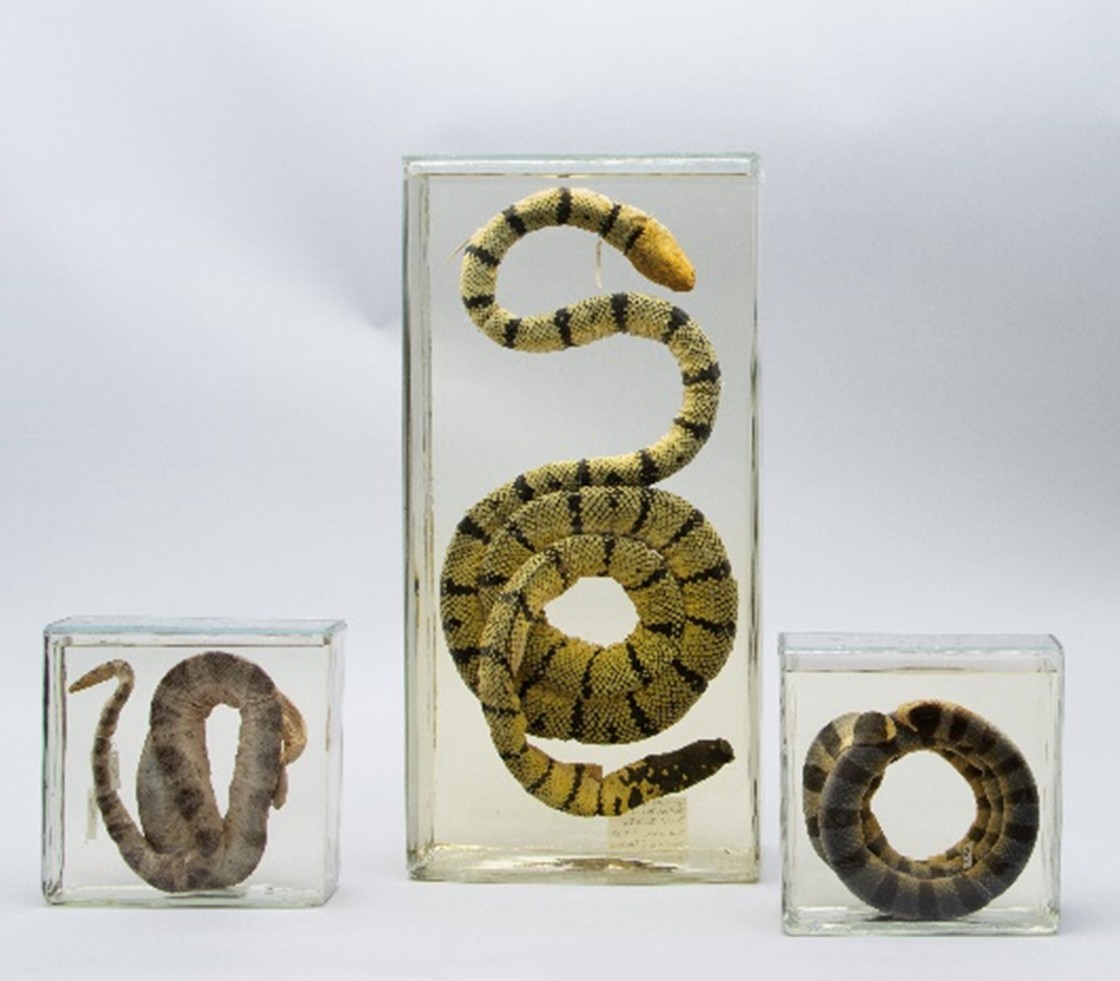
Example of three fluid specimens prepared by the conservation team for the new Natural History Museum of Denmark

Continue reading

Bark Tanning Skins into Leather for Taxidermy – A Sustainable, Natural and Non-harmful Alternative to Commercial Tanning Products?

Written by Jazmine Miles Long, Taxidermist.

When a taxidermy mount is made, the skin of the mammal (and in some cases reptiles and birds) is usually tanned. Tanning is the process of turning a raw skin into leather using chemistry. By turning the skin into leather, we are changing a fragile perusable material into something durable that can be sculpted into taxidermy and be more resistant to insect attack. Tanning the skin involves removing proteins in the skin and loosening the collagen fibres and then attaching tannins to these structures. Leather can be made with either the hair on or off the skin. When we are making taxidermy, we want the fur to stay attached to the skin and so the process is different to when the fur is to be removed. With hair on tanning, we want the pH to stay low to prevent the fur from falling out. The skin starts by going into a pickle solution of around pH 2 and after it has been through the tanning process it ends up at about pH 4.5 -5.

Continue reading

NatSCA Digital Digest – June 2025

Compiled by Olivia Beavers, Assistant Curator of Vertebrate Zoology at World Museum, National Museums Liverpool.

Welcome to the June edition of NatSCA Digital Digest.

A monthly blog series featuring the latest on where to go, what to see and do in the natural history sector including jobs, exhibitions, conferences, and training opportunities. We are keen to hear from you if you have any top tips and recommendations for our next Digest, please drop an email to blog@natsca.org.

Sector News

NatSCA Annual Conference & AGM 2025 Recording 

On May 8th and 9th 2025, NatSCA hosted ‘Making a Difference: Showing the Positive Impact of Natural History Collections’, the 2025 NatSCA Conference at the Manchester Museum. This conference was recorded and can now be viewed online on our YouTube channel here.

Society for the History of Natural History Summer Meeting 2025 – online registration open

The SHNH are offering an online attendance option for this year’s summer meeting, ‘A Sense of Nature’ on 19th and 20th June 2025. Registration for in-person attendance has now closed.

The conference will explore the intersections of the senses – including sight (vision), sound (hearing), smell (olfaction), taste (gustation) and touch (tactile perception) – with the history of natural history. The programme will feature 12 papers across six sessions.

Continue reading

A Hundred Feet Through the Door – A Chance Encounter with some Centipedes set me on a Curatorial Path…

Written by Dan Gordon, Keeper of Biology, The Great North Museum: Hancock.

So, how did I get started in museums? Like perhaps many people, it began with a stroke of luck.

I’d decided to study Biology at university—I suppose I’d vaguely pictured myself at some point in the future, white-coated in the lab, pouring over spectrophotometer readings or agar plates. But by the end of the first year, I found myself staring out of the window during practicals. Nineteen-year-old me was slowly becoming disillusioned: Botany was biochemistry; Zoology was elegant mathematics; even Ecology was really an intricate forest of statistics, not trees. There was beauty in the numbers, but it was all a long way from my childhood passion for birdwatching, rock pooling and reading travel books. One day, peering at smudges on a petri dish and trying to work out if I’d just induced gene expression, I realised I might not be cut out for that imagined future. I was fascinated by the soul of the subject, but the finer points of its language were losing their magic.

Continue reading

NatSCA Digital Digest – March 2025

Compiled by Olivia Beavers, Assistant Curator of Vertebrate Zoology at World Museum, National Museums Liverpool.

Welcome to the March edition of NatSCA Digital Digest.

A monthly blog series featuring the latest on where to go, what to see and do in the natural history sector including jobs, exhibitions, conferences, and training opportunities. We are keen to hear from you if you have any top tips and recommendations for our next Digest, please drop an email to blog@natsca.org.

Sector News

NatSCA Annual Conference & AGM 2025: Registration Now OPEN!

Booking is open for the 2025 Natural Sciences Collections Association (NatSCA) conference. This year’s theme is: Making a Difference: Showing the Positive Impact of Natural History Collections, and it will be hosted by the University of Manchester: Manchester Museum, UK.

Due to the size of the venue there are only a limited number of spaces, so please book promptly to avoid disappointment. Visit the webpage to find out more: https://www.natsca.org/event/2881

This year’s conference meal is at Zouk and we would love to see you there. Please make sure to add the separate ticket to your basket.

Don’t hesitate to get in touch if you any questions. If you would like to become a member, which would qualify you for the conference discount or bursaries, please see our website NatSCA.org for details. 

30th Symposium on Palaeontological Preparation and Conservation: Call for abstracts

Please send abstracts of up to 250 words plus an image to sppc@geocurator.org by 10th April. Abstracts will be considered on any topic of earth science excavation, conservation, preparation mount-making and exhibition. Please state if the abstract is for a poster or platform presentation.

The 30th Symposium on Palaeontological Preparation and Conservation will be held in the Netherlands this year on 26 – 27th June.

The theme will be ‘From Excavation to Exhibition’ and they hope to broaden their usual remit to include more aspects of the story of how geological collections end up on display in our museums, as well as their conservation and preparation. Examples of previous years’ abstracts can be found online at https://www.geocurator.org/events/97-sppc

Continue reading