Creating the River Otter Beaver

Written by Jazmine Miles Long, Ethical Taxidermist, Artist, Educator and Natural History Restorer, https://www.jazminemileslong.com, Twitter: @TaxidermyLondon; Instagram: @Jazmine_miles_long

Jazmine with the River Otter Beaver in process

In April 2019 Holly Morgenroth (Collections Officer at The Royal Albert Memorial Museum) gave me a call to say she had acquired a dead beaver that was in good condition for taxidermy. This was significant because this beaver was part of the River Otter Beaver Trial. All deceased beavers should now be sent to the Zoological Society of London for medical autopsies, which means they are usually not in good enough condition for taxidermy after the procedure. This particular beaver, originally from a population of beavers in Scotland, had been introduced to the River Otter in April 2019 to expand the gene pool of the population. Sadly she was found dead – it is possible she drowned in salt water as there were no visible injuries from conflict or a road traffic accident. Devon Wildlife Trust decided she did not need a post mortem and very kindly handed her over to Holly at the museum. Holly jumped at the opportunity and expertly packed her into a large plastic tub and placed her in the museum’s chest freezer and got to work obtaining funding to have her processed into taxidermy and a full skeleton.

Continue reading

A Very Important Beaver

Written by Holly Morgenroth, Collections Officer / Natural Sciences Curator, RAMM.

A New Acquisition for RAMM

This blog post tells the story of a new and very important acquisition for the Royal Albert Memorial Museum & Art Gallery (RAMM) in Exeter. I grew up in a small Devon village called Otterton and spent many happy hours wandering the banks of the River Otter observing the rich wildlife it had to offer. So when in 2013 news broke that a family of beavers (a species extinct in the wild in Britain for over 400 years) had made the river their home I watched with great interest.

Their arrival divided opinions. The Government planned to remove them from the river. But the beavers captured the hearts of the public and Devon Wildlife Trust (DWT) saw a unique opportunity for research. The beavers became part of a five year scientific trial run by DWT to assess their impact on local geography, ecology and people. The results of the trial were overwhelmingly positive.

Continue reading

Size Matters: Pesticides in Large Mounted Vertebrate Specimens

Written by Becky Desjardins (Senior Museum Preparator & Conservator), Georgia Kay & Kim König (MSc students Museums & Collections – Leiden University; Naturalis Interns), Naturalis Biodiversity Center.

Back in 2013, Naturalis conducted a research project about arsenic in the museums’ specimens. The goal was to determine if arsenic was spreading from the collection areas into staff and or public areas of the museum. We tested many specimens with an XRF but also tested the elevators, door handles, floors, shelves, keyboards, etc. From this testing we developed protocols about handling specimens and how we use the spaces in the collection. You can read all about that project over here.

What didn’t get tested were the large mounted vertebrates. Back in 2013 the Naturalis collections were spread over a number of warehouses around Leiden. Because these external buildings were considered depots only (meaning no offices/canteens in these spaces) there was less concern about arsenic contamination in non-collection areas. The large vertebrates were considered to be high risk specimens (so very toxic), and were handled as such, they never had their moment with the XRF.

Continue reading

Behind The Heads: Natural History, Empire and The Abel Chapman Collection. Part 2.

Written by Dan Gordon, Keeper of Biology, The Great North Museum: Hancock.

Abel Chapman’s time in southern Africa was only the first of many visits to the continent. His next trip, in 1904, was to a very different place – British East Africa. This was a colonial protectorate roughly equivalent to today’s Republic of Kenya. It had grown out of land leased by the British East Africa Company but was now firmly under British imperial control.

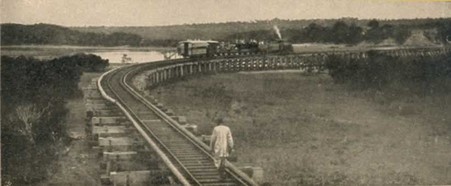
The Uganda railway, a huge feat of engineering, had been completed just three years before Chapman’s visit. This now allowed trains to travel the 800km (500 miles) between Mombasa on the east coast and the African Great Lakes. The British now had the means to extend their influence right across East Africa, disrupting the slave routes and simultaneously opening up the land to the missionaries, settlers, tourists and game hunters that were now pouring in. It was in this rapidly changing environment that Chapman strove to find the longed for wilderness that had eluded him in Transvaal, and test his skills as a sportsman, before that land too vanished under the settler’s plough.

Figure 1. An undated photo of the Uganda Railway near Mombasa (http:/www.jaduland.de, Public domain via Wikimedia Commons)
Continue reading

Behind The Heads: Natural History, Empire and The Abel Chapman Collection. Part 1.

Written by Dan Gordon, Keeper of Biology, The Great North Museum: Hancock.

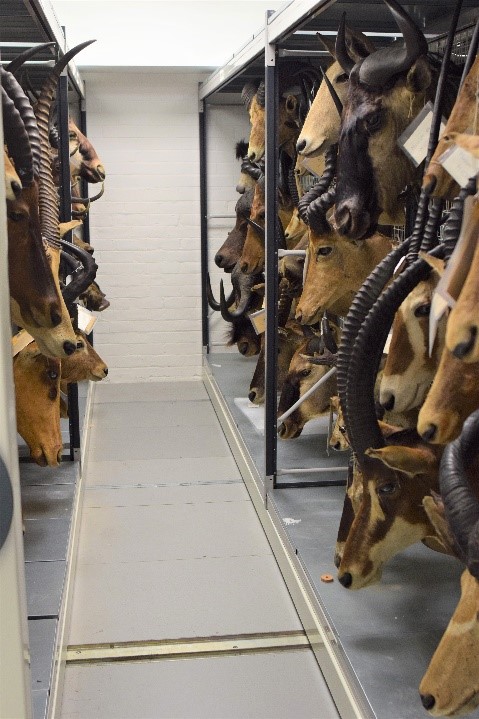
In the museum’s basement is a room filled with heads. Row after row of them stare out from metal racks, glassy eyed and bristling with every kind of horn and antler. Visitors to this room are sometimes awestruck at the breadth of species on display. The Kudu, its head crowned by spiralling horns like giant corkscrews. A tiny Klipspringer with horns like shiny black thorns. The huge Eland, its vast head armed with massive horns like tank shells. A parliament of Africa’s fantastic beasts, all in this small storeroom. These are hunting trophies from the Abel Chapman collection. When he died in 1929 they were taken down from the walls of his Northumberland home, and gifted to the museum.


Figure 1. A rack of game trophies from the Chapman collection in the Great North Museum resource centre (Copyright Tyne and Wear Archives and Museums.

In light of the current conversation about museums and colonialism, and the insightful work of Lowe and Das on the subject of Natural History collections in this context, I thought I’d try to learn more about the history of the great North Museum’s African collections, and my attention was caught on the horns of Chapman’s trophies. The more I’ve learned about their story, the more I’ve come to feel that trophy heads, some of the most recognisable Natural History objects, are great examples of the way that colonialism has both helped to shape naturalism, museum collections and even our ideas about wildlife conservation.

The story of our collection begins in 1851 when Abel Chapman was born into a wealthy Sunderland brewing family. Educated at the elite Rugby School, he joined the family firm as a young man and embarked on a successful business career. Chapman was intelligent and adventurous, making expeditions to places like Canada, Scandinavia and the Arctic. In detailed notebooks filled with deft pencil sketches he documented the things he heard, saw and shot, and used these to write a whole series of books. He built a reputation as a ‘hunter naturalist’ passionate about combining field sports with game preservation, and as well as amassing a horde of trophies, he became an influential figure in the emerging field of wildlife conservation.

Continue reading