The Manx Museum, part of Manx National Heritage, is both the national museum and part of the National Trust of the Isle of Man, which is technically not a part of the UK, it is a Crown Dependency. Its collecting focus is to represent the Island and its history, similar to county museums in the UK. No other museum represents our Island better and that is our strength. When accessing our material, researchers are looking for something relating to the Island itself or how it sits in context to a wider geographical area. We are an Accredited museum and, like many others, we have a collections development forum, made up of curatorial and collections management staff, through which any new proposed acquisitions have to be assessed – but this has not always the case. We still have objects within the collection which would not pass our collections development policy today.
Written by John-James Wilson, Lead Curator of Zoology at World Museum, National Museums Liverpool & Jing Jing Khoo, Postdoctoral Research Associate at Institute of Infection, Veterinary & Ecological Sciences, University of Liverpool.
Selangor Museum was established in Kuala Lumpur by British colonial officials in 1887. A purpose-built museum building, opened in 1907, was designed by Liverpool-born architect Arthur Hubback, but there is a stronger link between Selangor Museum and Liverpool.
Selangor Museum’s early director Herbert Robinson was also born in Liverpool and had worked as an assistant at the Liverpool Museums, now known as World Museum. Selangor Museum wasn’t a large institution, with just three British curators and three museum hunters from Sarawak, one being Charles Ulok. But through the museum’s work, a European knowledge system was imposed onto the local wildlife.
The museum’s work included extensive hunting on the hill and mountains and islands of Malaysia, Thailand and Indonesia. The museum soon ran out of storage space in Kuala Lumpur and specimens were routinely sent to England. Hundreds of specimens were sent to Robinson’s former workplace, World Museum, in 1914.
Click link above for3-minute video about Selangor Museum and its connection to Liverpool made for the Green Representatives Network at Monash University in Selangor.
For taxidermy to exist an animal must have died. This brutal truth creates unease and leaves the viewer to ponder how the death occurred. And secondly how the death and the body is managed. A fluffy rabbit, cute and cuddly in life, suddenly becomes hideous and untouchable in death. Due to my profession, I am raising a child who has been exposed to dead animals and the concept of death his whole life. This has not made him desensitised to death, I’d say the opposite. He is deeply hurt by the death of any animal; he is a self-proclaimed vegetarian and last week at the age of 4 he asked me if his job when he grows up could be to stop people eating animals. He shouts at cars to slow down in case they hit anything and one of my favourite things he asks me when we meet new people is if they are a vegetarian or a carnivore eyeing them up suspiciously. Does a good understanding of death at a young age give a person greater empathy for animals and take us closer to not seeing them as ‘other’?
When my son is asked what a taxidermist does, he says they look after animals when they die. I get at least one phone call a week from someone mourning their dead pet, I give advice on what to do next, ideas for memorials and how to store the body in the freezer while they decide what to do. I didn’t expect as a taxidermist to be a councillor, a listening ear, someone who is qualified to talk about death.
Written by Louise Gibson, ZSL biobank manager at the Institute of Zoology, Zoological Society of London (ZSL).
Lurking in the depths of the Zoological Society of London (almost 200 years old), are vast collections of frozen, wet, and dry biological specimens. Amassed over several decades, procurement of these items has come via scientific fieldwork researching wildlife conservation, standard pathological investigation of captive animal mortality, contributions from Border Force and police wildlife crime investigations, and from the occasional public donations, dropped off on our doorstep.
Although the collections are extensive, knowledge of their contents is limited to those who have collected samples or managed them, many of which have long since left ZSL. Potential was seen to create a biobanking programme with the objective of preserving the collections and the knowledge that comes with them and in turn creating an accessible biological archive open to the scientific community and beyond. As a not-for-profit charity with minimal resources, we are aiming to achieve this on a shoestring budget.
Written by Fiona Roberts (Collaborative ESRC PhD student, Cardiff University & Amgueddfa Cymru-National Museum Wales) and Violet Nicholls (Assistant Curator in Herbarium, Portsmouth Museums).
This post is dedicated to Dr Dagoberto Lima Azevedo (1979-2023), Tukano researcher, translator, scholar, author and a voice for the Indigenous peoples of the Rio Negro in the northwestern Amazon.
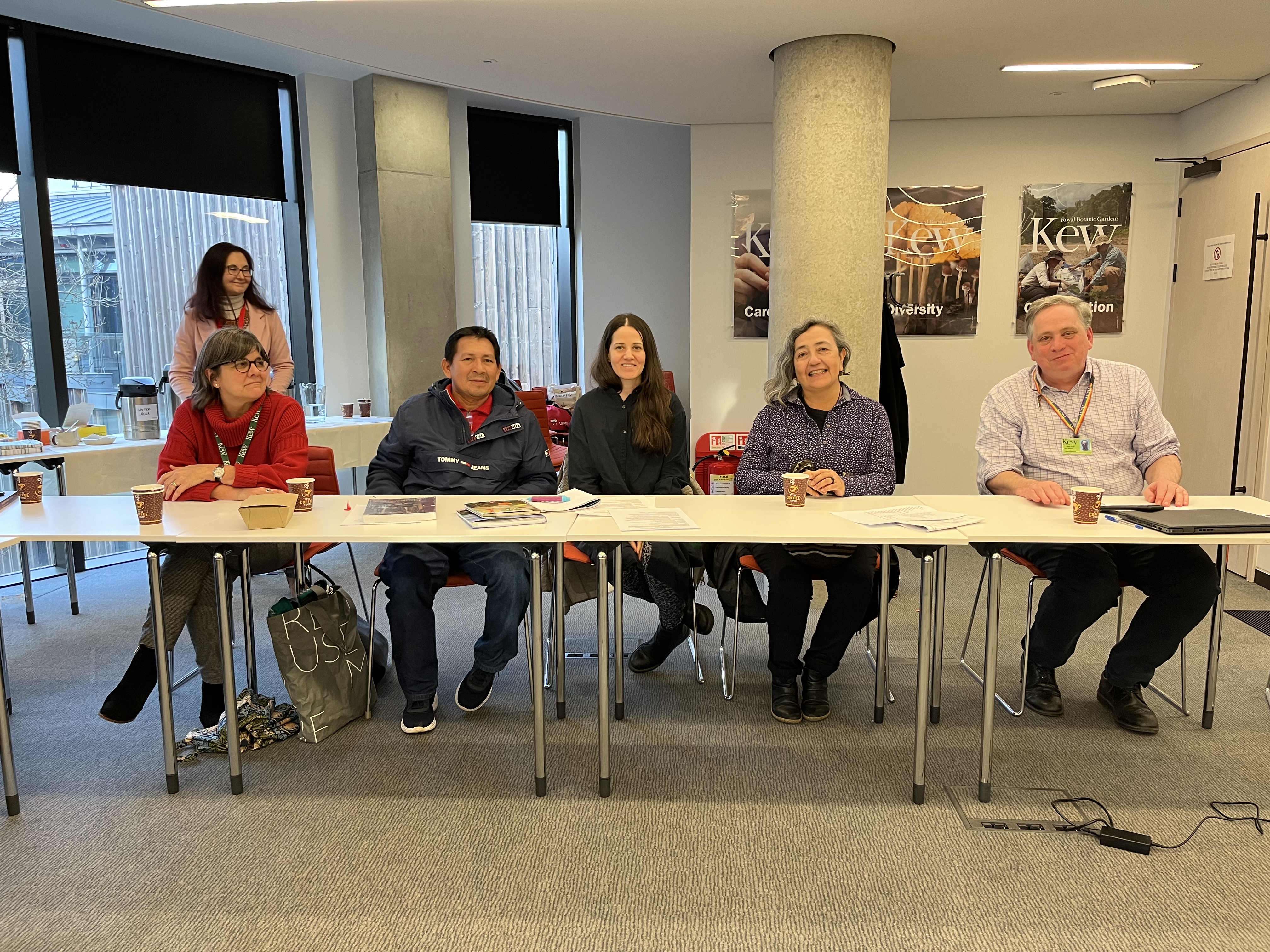
The workshop ran in partnership with Museu Goeldi, Brazil and the Department of Cultures and Languages, Birkbeck, University of London. It addressed the question, ‘how ethnobotanical collections in museums can best be used to support Indigenous communities?’. Dr Dagoberto Lima Azevedo, from the Federação das Organizações Indígenas do Rio Negro, and Claudia Leonor López Garcés (Museu Paraense Emílio Goeldi) travelled from the Brazilian Amazon for the event. They met with fellow panellists Professor Mark Nesbitt (Royal Botanic Gardens, Kew), Professor Luciana Martins (Birkbeck, University of London), Cinthya Lana (University of Gothenburg) and Dr William Milliken (Royal Botanic Gardens, Kew).
Fig. 1. Some members of the panel at the workshop with, from left to right, Cynthia Sothers, Luciana Martins, Dagoberto Lima Azevedo, Cinthya Lana, Claudia Leonor López Garcés and Mark Nesbitt. Photo by Gayathri Anand.
The Richard Spruce collection (1849-1864) was used as a case study. Spruce collected plants and recorded their uses in South America, and is considered to be an early ethnographer, as he also recorded the traditions and customs of the different communities that he met on his travels.1 He collected over 14,000 herbarium specimens in the Andes and Amazon regions, and 350 items are in his ethnobotanical collections.2