Dropping a Pin on the Salter Collection

Written by George Seddon-Roberts, PhD Student, John Innes Centre, work completed whilst on placement as a Curatorial Intern at Amgueddfa Cymru – Museum Wales.

When accessing an entomology collection, there are a few things that a researcher can expect to find. Each specimen should be pinned with labels describing its species and information about where it was collected – two valuable pieces of information which can help researchers to trace the specimen’s origin geographically and in time. Knowing where and when a specimen was collected can help researchers better understand the historical landscape and ecology and make predictions into the future. However, when collections receive specimens from private collectors, this standard of labelling might not be met. As part of a 3-month internship at Amgueddfa Cymru – Museum Wales, I aimed to transform one such collection.

The collection in context 

John Henry Salter (1862-1942) was an academic and naturalist, who spent much of his life as a lecturer at University College of Wales in Aberystwyth, where he would later be appointed as the first Professor of Botany. Outside of academia, Salter was a prolific collector of insects across several groups, most notably including coleoptera (beetles) and lepidoptera (butterflies and moths). Salter’s collection contains specimens from across Wales, as well as England, Tenerife and south-east France; regions where he spent time during his retirement. The specimens, which amount to over 15,000 individuals, were meticulously recorded in field logs by Salter, which were also donated to the museum with the collection.  

Continue reading

NatSCA Digital Digest – August

Compiled by Ellie Clark, Collections Move Team Leader at the Natural History Museum

Welcome to the August edition of NatSCA Digital Digest.

A monthly blog series featuring the latest on where to go, what to see and do in the natural history sector including jobs, exhibitions, conferences, and training opportunities. We are keen to hear from you if you have any top tips and recommendations for our next Digest, please drop an email to blog@natsca.org.

Sector News

Registration is now open for the 13th European Bird Curators Meeting, October 2024, in Liverpool.

The European Bird Curators Meetings aim to promote cooperation, dissemination of best practices and new techniques in the curation, management, and use of bird collections. Presenters in the scientific programme often include curators, collection managers, museum historians and ornithological researchers. These are friendly meetings and anyone with an interest is welcome to join us.

The meeting will include plenary and submitted presentations, discussion sessions, collections tour, conference dinner (optional – Tuesday 29th October) and field excursion (optional – Thursday 31st October). 

Please follow the ‘Tickets available here’ link from the event webpage to register. They have single day registration options and have kept costs as low as possible to encourage attendance by local natural history curators. 

If you have any questions, please email vertebratezoology@liverpoolmuseums.org.uk.

Continue reading

NatSCA Digital Digest – May 2024

Compiled by Ellie Clark, Collections Moves Team Leader at the Natural History Museum.

Welcome to the May edition of NatSCA Digital Digest.

A monthly blog series featuring the latest on where to go, what to see and do in the natural history sector including jobs, exhibitions, conferences, and training opportunities. We are keen to hear from you if you have any top tips and recommendations for our next Digest, please drop an email to blog@natsca.org.

Sector News

Registration is now open for the 13th European Bird Curators Meeting, October 2024, in Liverpool.

The European Bird Curators Meetings aim to promote cooperation, dissemination of best practices and new techniques in the curation, management, and use of bird collections. Presenters in the scientific programme often include curators, collection managers, museum historians and ornithological researchers. These are friendly meetings and anyone with an interest is welcome to join us.

The meeting will include plenary and submitted presentations, discussion sessions, collections tour, conference dinner (optional – Tuesday 29th October) and field excursion (optional – Thursday 31st October). 

Please follow the ‘Tickets available here’ link from the event webpage to register. They have single day registration options and have kept costs as low as possible to encourage attendance by local natural history curators. 

If you have any questions, please email vertebratezoology@liverpoolmuseums.org.uk.

Continue reading

Mainstreaming Biodiversity in Museums

Written by Henry McGhie, Curating Tomorrow henrymcghie@curatingtomorrow.co.uk.

Link to the guide: https://curatingtomorrow236646048.files.wordpress.com/2023/11/mainstreaming-biodiversity-in-museums_2023.pdf

‘Mainstreaming’ is a policy and planning approach that means that we don’t just create a new programme or strand of work, but that we embed it across all activities. We can embed support for biodiversity and environmental concerns across museum activities. Why is this important? Well, for a few reasons. Firstly, biodiversity is not yet fully mainstreamed into museum thinking – in terms of their goals, actions, or evaluation. Second, museums present a massive potential to support biodiversity in different ways, notably through education, research, public awareness and partnerships. Third, museums make big negative impacts on biodiversity and the environment, through their contributions to climate change (from use of energy, waste, and visitor emissions), and their involvement in environmentally damaging activities (e.g. how their investments are used). Fourth, because biodiversity is in deep crisis: species continue to decline, major challenges are getting worse, and there is no clear prospect of a change for the better. Lastly, fifth, because people and nature are interdependent: if the environment suffers, people and communities suffer.

Continue reading

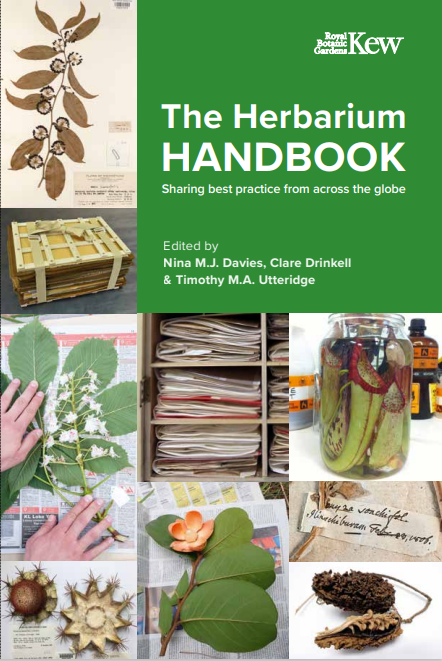
The Herbarium Handbook – Sharing Best Practice from Across the Globe.

Submitted by Clare Drinkell, Senior Curator Botanist at the Royal Botanic Gardens, Kew.

Editors: Nina Davies, Clare Drinkell, Timothy Utteridge. 290 pp, 234 x 156 mm. Over 700 colour photographs. Paperback, ISBN 9781842467695. Kew Publishing, TW9 3AE, UK 2023. £25.00. https://shop.kew.org/kew-herbarium-handbook

Cover page of The Herbarium Handbook

The new Herbarium Handbook is a key new addition to Kew Publishing’s series of handbooks, including The Plant Glossary and The Temperate Plant Families Identification Handbook. Unlike the other books in the series the Herbarium Handbook is a new version of a book first compiled and edited by Kew botanists some thirty-four years ago. The initial Herbarium Handbook came about following an extremely popular International Diploma Course in Herbarium Techniques at Kew. The demand to attend the course was so high that the number of applicants far exceeded places on the course. In view of the interest, the main information imparted during the course was published as a manual, widely recognised as an important reference for fundamental aspects of herbarium care and management.

Continue reading