Stirring the hornet’s nest – are natural science collections even legal?

I was wrapping up a particularly difficult male peacock with a helper a few weeks ago and we were discussing natural science collections. “Do you think one day they’ll just be made illegal?” she asked, straight-faced and sincere. I was miffed – this was someone saying to a natural science curator that really, it shouldn’t be allowed. I sighed and spent the rest of the wrapping session (porcupine was also tricky) explaining how wonderful – and legal – natural science collections are.

Continue reading

Confessions of an Amateur Aquarist: Having an Aquarium in a Museum Exhibition

Sea Life: Glimpses of the Wonderful‘ is the Royal Albert Memorial Museum & Art Gallery’s (RAMM) 2017 summer exhibition. It takes inspiration from the works of PH Gosse. Gosse was a Victorian naturalist who lived near Torquay and spent his time exploring the coast. He wrote many popular books and RAMM is fortunate to have over 100 of his original artworks.

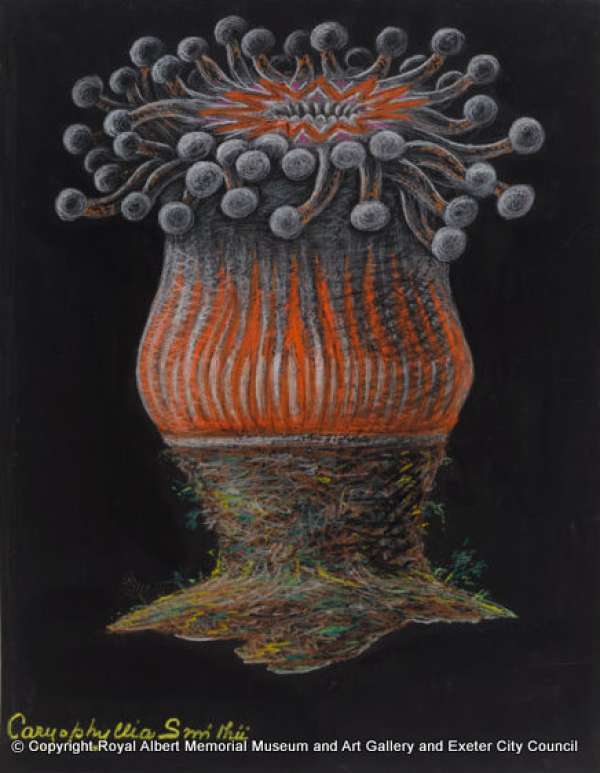
Devonshire cup coral. Teaching aid drawn in coloured chalk by PH Gosse. (Image courtesy of Royal Albert Memorial Museum and Art Gallery).

Gosse is well known for his interest in aquariums. He invented the word aquarium and was among the first to keep animals alive successfully. In 1856 he published a book; ‘The aquarium: an unveiling of the wonders of the deep sea’, and was also partly responsible for the aquarium craze that gripped Victorian England.

The exhibition team decided that no exhibition on rock pooling and aquariums was complete without a real one set up in the gallery.  Kids keep fish as pets – can’t be that hard … or so we thought. I’d like to share a few things we have learnt over the past few months: Continue reading

NatSCA Digital Digest – May

nddLogo2017-05-04

What a month we’ve had! The Conference at Cambridge on the 20th to 21st April was a roaring success. Over 100 museum delegates gathered together beneath the mantle of a Finback whale skeleton, to swap notes and revive old connections. Many heated exchanges were had over issues ranging from fungi to frocked wolves. No museum-based conference is complete without a tour of the stores – big thanks once again to the Zoology Museum for having us. We got a sneak-preview of the new gallery space too and, while I can’t post pictures of that, I can tell you that you have to go and see it when they open. Highlights for me included an elephant from Sri Lanka with links to Stanley Kubrik, and a Diorama of a beach with added surprises for future conservators. Continue reading

Cold Case Curation

Museums have many curious objects behind closed doors. Recently, volunteers discovered some ‘cold ones’ at Tullie House Museum and Art Gallery Trust.

Behind Closed Doors

If museums are icebergs, then museum exhibits are just the tip; and the remaining 90% or so of specimens are tucked away safely behind closed doors. Many people, lucky enough to have visited these museum storage areas (‘behind-the-scenes’), will be familiar with almost endless rows of racks and shelves packed with all sorts of different objects, ranging from Chinese vases to taxidermy monitor lizards. But few non-curators would be familiar with the idea of freezers full of dead animals!

We have two large freezers, at our off-site storage facility, packed full of animals; we needed to know exactly how many animals were in there and where they were from, hence this project- Cold Case Curation. The specimens also have excellent provenance; labels with location details including specific grid references and dates. Therefore this Cold Case Curation project was as much a biological survey (albeit indoors) as a detailed museum inventory.

Cold Case Curation in action; the team of five volunteers “surveying” the “fauna” of our freezers

Cold Case Curation in action; the team of five volunteers surveying the ‘Fauna of our Freezers’.

Volunteer-Power

Enter our team of volunteers. They were specially recruited for a day for this Cold Case Curation task; to survey the frozen fauna, matching specimens against existing inventory records. This was a joint initiative with our Cumbria Biodiversity Data Centre (hosted at the Museum), to capture biological records. Most of our volunteers are long-term with the Museum and the Centre, and are current university students.

As our team of five volunteers eagerly crowded around the two huge freezers, they were fascinated with the idea of freezing animals to preserve them before they are stuffed and prepared as taxidermy specimens (but don’t worry, they all died naturally!).

In teams, the volunteers enthusiastically worked their way through documenting the freezer contents. 241 individual specimens later, we had documented 11 species of mammal and 48 species of bird. Interesting discoveries included a bittern, a little grebe chick, 10 waxwings and a white-tailed tropic bird (with stomach contents). Volunteers delighted in handling iconic British species including 54 red squirrels and 24 barn owls.

Volunteer, Jessica Mitchell proudly wielding a polecat from the freezer “faunal assemblage"

Volunteer, Jessica Mitchell proudly wielding a polecat from the freezer faunal assemblage.

Their experiences are best summarised in their own words;

“After helping out at Tullie House with their cold case curation, recording everything they had in the freezers, we found some amazing specimens from polecats to owls, your typical garden birds to brown hares, but I have to say my favourite by far was the river otter. This otter was fantastic and it was brilliant to see it so upclose as it is a creature I have only seen from afar in the wild. This event was extremely educational and rewarding to myself as I’m studying zoology here in Carlisle”.  Volunteer, Laura Carter.

Volunteer, Laura Carter with River Otter discovery from freezer

Volunteer, Laura Carter with a River Otter discovery from the freezer.

Another volunteer, Donna Salter was also drawn to the otter:

“It’s a bit obvious to go for the big, furry, cute mammal, but my favourite has to be the otter. I was somewhat of an otter obsessed child: other girls wrote fan letters to Mark Owen or Ronan Keating while I wrote to Philip Wayre, founder of the Otter Trust (he sent back a signed visitors guide – I still have it). So for me, getting to hold and see the details of an otter can’t really be beaten!”

Cold Case Reflections; Learning from the Model

The Museum has greatly benefited from this exercise with our detailed inventories and biological records which will go into our database and ultimately end up on the Global Biodiversity Network Gateway for public access (and we also have the data we need to make more informed decisions over which specimens we decide to formally accession). However, this project proved to be a particularly successful public engagement event. It was a combination of the fact that volunteers were seeing and handling a variety of animals and that they were ‘discovering specimens’, whilst working together as a team, which is vastly more enjoyable than lone working. The event was enhanced with use of Twitter  (#coldcasecuration), which captured some of the magical moments of discovery.

This exercise illustrates how a relatively routine (inventory) collections management exercise can be turned into an exciting public engagement project, capturing critical data for the museum and inspiring a future generation of potential young scientists and curators.

By Simon Jackson, Curator, Tullie House Museum and Art Gallery Trust

NatSCA Digital Digest

Chameleon

Jobs and Traineeships

Norfolk Museums Service is offering six 12-month paid traineeships, including one post in natural history. The closing date for applications is 3 January 2016. See here for details.

Curatorial Assistant, Anthropology Audit: Natural History Museum (NHM), London. Six-month collections-based role. Applications close 7 December 2015.

Documentation Officer (job share): Horniman Museum & Gardens, London. 19 hours/week. Applications close 14 December 2015.

Events and Exhibitions

Introduction to Diptera Families. Oxford University Museum of Natural History. A two-day workshop on the ecology and identification of flies.

Gifts for the Gods: Animal Mummies Revealed. Manchester Museum. An exhibition showing how modern science can help explain the ancient practice of animal mummification. Open now until 17 April 2016.

Wildlife Photographer of the Year 2015. Natural History Museum, London. As always, this is a stunningly beautiful exhibition, and well worth seeing. If you can’t make it to London, you can also see it on tour at other museums around the UK.

Collected and Possessed. Horniman Museum & Gardens, London. An exhibition by artist Mark Fairnington, inspired by the collections of the Horniman, NHM, and Wellcome Collection. Open now, until 24 January 2016.

Around the Web

A WNPR podcast looking behind the glass of the taxidermy dioramas the the Peabody Museum.

Who’s digitising what? The New York Times guide to online natural science collections.

In pursuit of plants: The Marianne North Gallery at Kew.