Taxidermy and the Country House: Where Natural History Meets Social History – a review 

Written by Jack Ashby, Assistant Director of the University Museum of Zoology, Cambridge.

Pat Morris is the authority on the history of British taxidermy, and there is arguably no-one better to write an exploration of the specific context of taxidermy collected for and displayed in private country houses. Although their materiality is identical, by their nature, these collections are often conceptually very different – the antithesis, even – to those in public museum. These differences are not the focus of the book, nonetheless this perspective offers great potential to help us consider more roundly the story of taxidermy and those that made and collected it.

The similarities museum and country house collections do share include their origin-stories, and of course the practicalities of preserving specimens. Like museums, these private collections trace their histories back to cabinets of curiosities. Preservability was fundamental to what could be kept, and Morris begins by explaining that early cabinets of curiosities in country houses were mainly items that required no preservation – dry materials like shells and bone. The only skins that were widely kept were those that could be simply dried without being prone to insect attack, which is why durable specimens like taxidermy crocodiles, hollowed-out armadillos and inflated pufferfish were commonplace in these early collections, rather than the birds and mammals which later became the norm.

Continue reading
A Prize Winning Brown Bear in Sofia.

Written by Richard Crawford, who has just completed a PhD thesis at the University of the Arts London, entitled ‘Re-presenting taxidermy; Contemporary Art interventions in Natural History Museums’.

I am used to seeing trophy specimens in mainstream natural history museum collections – for example, the crouching tiger shot by King George V in 1911 that is on display in the natural history galleries at the Royal Albert Museum in Exeter – but I was surprised to see a taxidermy specimen of a big Brown Bear at the National Museum of Natural History, Sofia, holding a medal that it had been awarded at the Berlin International Hunting Exhibition in 1937.

The prize winning brown bear in Sofia Natural History Museum

The 1937 Berlin International Hunting Exhibition showcased all manner of hunting trophies including mounted antlers, boar heads, bear skins and various taxidermy animals. It also featured demonstrations with live animals, including hunting eagles and a pack of beagles. The event was given official approval by the then prime minister, Hermann Goering, who opened the exhibition amid fluttering Nazi flags and rows of hunters dressed in smart grey uniforms. In his opening remarks, Goering stated his view, that hunting could promote international peace:

Continue reading

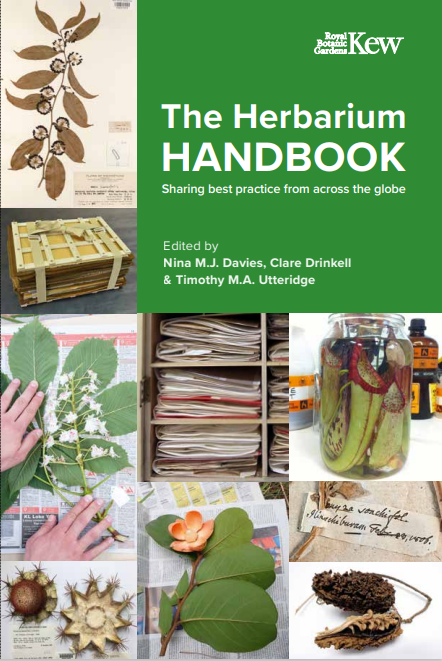
The Herbarium Handbook – Sharing Best Practice from Across the Globe.

Submitted by Clare Drinkell, Senior Curator Botanist at the Royal Botanic Gardens, Kew.

Editors: Nina Davies, Clare Drinkell, Timothy Utteridge. 290 pp, 234 x 156 mm. Over 700 colour photographs. Paperback, ISBN 9781842467695. Kew Publishing, TW9 3AE, UK 2023. £25.00. https://shop.kew.org/kew-herbarium-handbook

Cover page of The Herbarium Handbook

The new Herbarium Handbook is a key new addition to Kew Publishing’s series of handbooks, including The Plant Glossary and The Temperate Plant Families Identification Handbook. Unlike the other books in the series the Herbarium Handbook is a new version of a book first compiled and edited by Kew botanists some thirty-four years ago. The initial Herbarium Handbook came about following an extremely popular International Diploma Course in Herbarium Techniques at Kew. The demand to attend the course was so high that the number of applicants far exceeded places on the course. In view of the interest, the main information imparted during the course was published as a manual, widely recognised as an important reference for fundamental aspects of herbarium care and management.

Continue reading

Top NatSCA Blogs of 2023

Compiled by Jen Gallichan, NatSCA Blog Editor.

To celebrate all of your wonderful contributions to the blog in 2023, here is a round up of the top ten most read blogs of the year. I want to take this opportunity to thank everyone who contributed an article. And what a bumper year it has been with articles covering decolonisation work, collections moves, exhibitions, workshops, collections research and management. The NatSCA blog is driven solely by your contributions and it is stands as a testament to the hard work you are all in doing despite challenging times.

I am pleased to say that the 2024 blog calendar is open for business, so drop me a line if you would like to contribute.

In descending order…

10. William Thomas March, a Jamaican Collector, Naturalist and Early Pioneer of Biological Data Recording in Jamaica. Written by Olivia Beavers, Assistant Curator of Vertebrate Zoology at World Museum, National Museums Liverpool. We kick of with a great blog looking at the work Olivia Beavers has been up to in Liverpool to highlight the work of a collector whose contributions to understanding Jamaican biodiversity are not yet fully recognised.

9. People and Plants Workshop Three: Sharing Knowledge in the Amazon. Written by Fiona Roberts (Collaborative ESRC PhD student, Cardiff University & Amgueddfa Cymru-National Museum Wales) and Violet Nicholls (Assistant Curator in Herbarium, Portsmouth Museums). The People & Plants workshops were an interesting series of training events focusing on decolonising collections. This article reviews the last of these events which addressed the question of how ethnobotanical collections in museums can best be used to support Indigenous communities.

Continue reading

Paddy the Pangolin: Conservation of a Taxidermy Museum Specimen

This article is re-posted from a piece that appeared on the Amgueddfa Cymru blog page, 3 August 2023 with permission from the author.

Written by Madalyne Epperson, MA Conservation Practice student, Durham University – when on placement at Amgueddfa Genedlaethol Caerdydd – National Museum Cardiff.

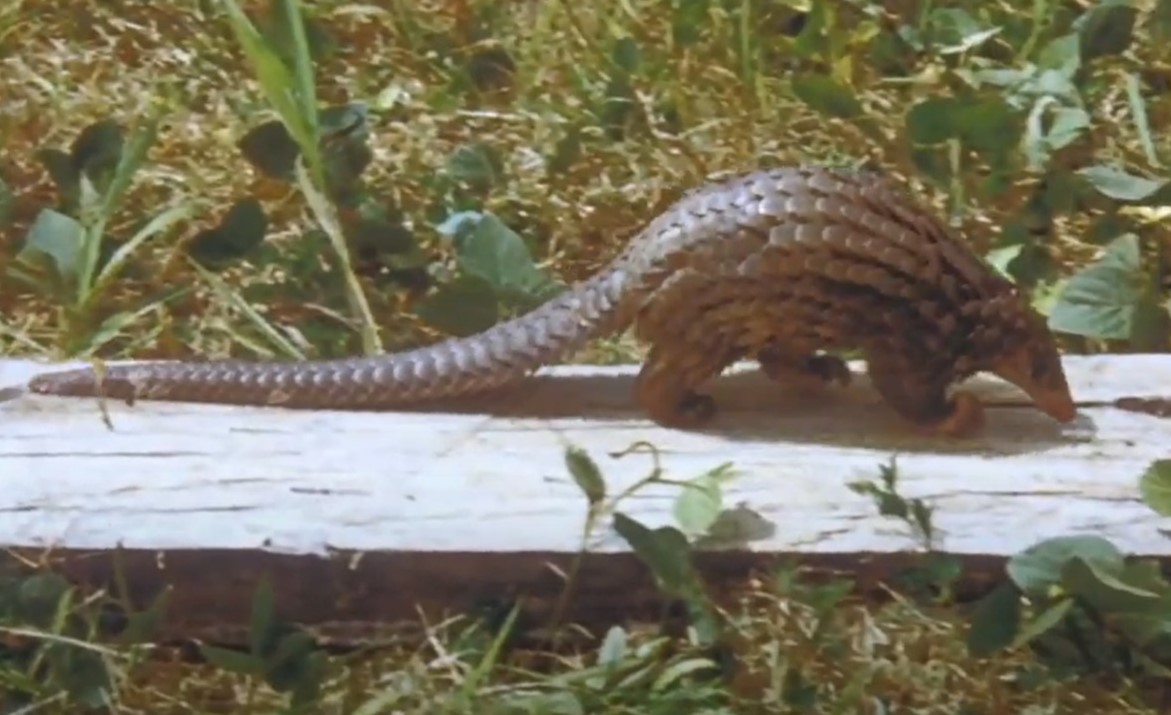
Paddy in the Wild During the Cambridge French West Africa Expedition 1957 (Pan Golin 2018)

Natural history collections are often central to our understanding of evolution, population genetics, biodiversity, and the environmental impacts of pesticide use and climate change, among other things. For this reason, caring for these collections is of great importance. A taxidermy tree pangolin – named Paddy by the conservation team – was brought to Amgueddfa Cymru – Museum Wales in 2017 in need of attention. Paddy was collected on August 4th, 1957, by researchers during Cambridge University’s French West Africa Expedition. According to the expedition diary, Amgueddfa Cymru had asked the researchers to retrieve a pangolin to make a museum specimen, as was common practice at that time. The mounted pangolin was feared lost after the expedition’s drying tent went up in flames on August 25th, 1957. Paddy was terribly singed by the fire, which greatly disheartened the expedition team. It is perhaps for this reason that Paddy never made it to the museum when the expedition concluded. It was not until 2016/2017 that Paddy was found in Staffordshire in the home of one of the expeditions members and sent over to the museum.

Continue reading