Giant Sequoia at the Natural History Museum

Written by Lu Allington-Jones, Senior Conservator & Chelsea McKibbin, Conservator, at the Natural History Museum, London.

In 2016 a team undertook conservation of the slice of giant sequoia tree which is on display in Hintze Hall of the Natural History Museum in London. Following condition mapping, the treatment involved dry cleaning, removal of the old varnish with solvent gel and applying a fresh coat of varnish. A time-lapse video was taken of the whole process, which spanned 12 weeks, and can be viewed at the end of this post.
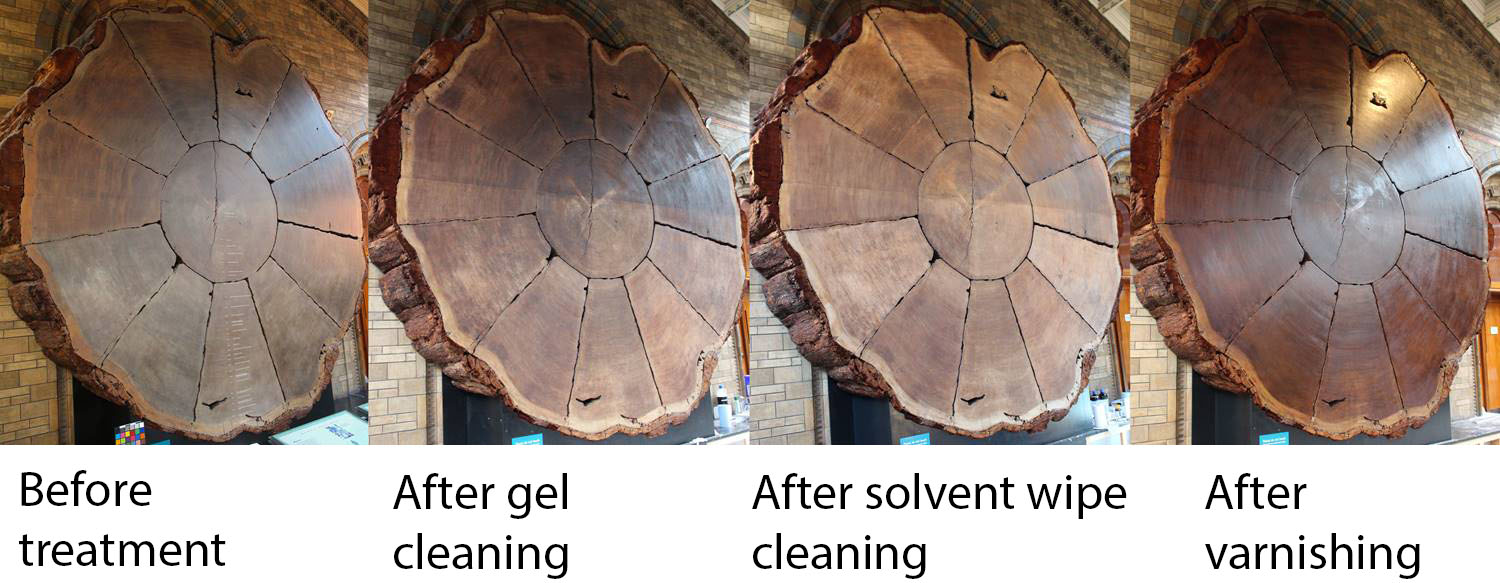
Figure 1. The stages of treatment

The Specimen

The giant sequoia (from Kings Canyon National Park, California, USA) was felled in 1891 at the age of 1,341 years. It had been 101 m tall and just over 5 m in diameter. Two sections were cut for display. The bottom and slightly larger one was sent to the AMNH while the top section was split into 12 pieces: one central disc and 11 radial segments to enable shipping to the UK. They arrived at the South Kensington site in April 1893.
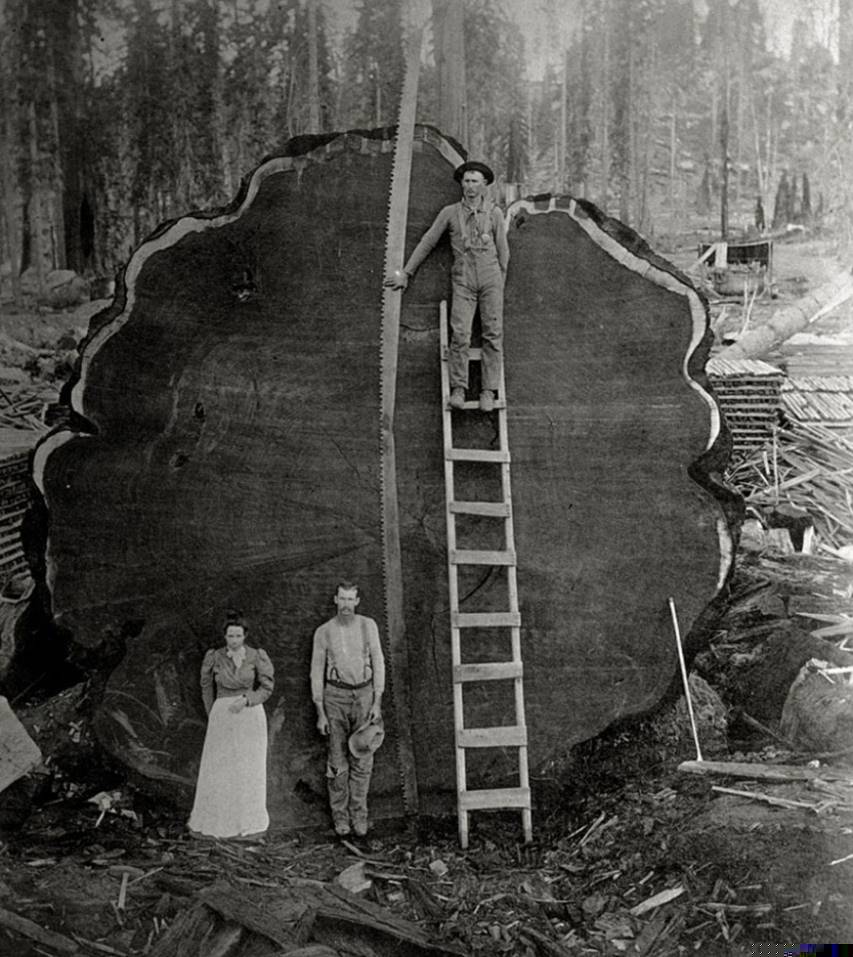
Figure 2. The tree when it was felled

The giant sequoia section went on display the following year, in one of the bays of the central hall. It was moved in 1902 to stand against the wall dividing the north and central halls, and again in 1971 to its current location on the second-floor balcony.

Continue reading →

Resurrection 101

Written by Paolo Viscardi, Curator of Zoology, National Museum of Ireland – Natural History

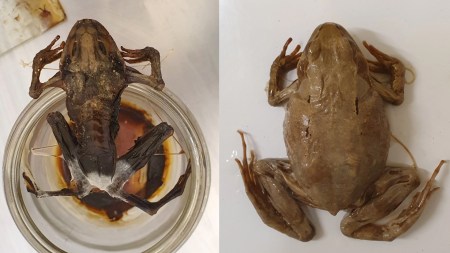
Anyone who has to deal with fluid collections, without the support of a natural history conservator, probably has nightmares about cracked jar lids and desiccated specimens. But would you sleep more easily if I told you that it’s possible to get a transformation like this using a straightforward and inexpensive method?

Frog_before-after

Here’s my account of how I resurrected this dehydrated specimen using stuff you probably have sitting in your museum cupboards or that you can buy for less than £20. It’s worth noting that the technique will not always work and if you plan to use it on a specimen that may have useful DNA to contribute, you should take a sample before rehydrating, since it is likely to reduce the quantity and quality of DNA you can extract.

Continue reading →

Exeter Shell Collection Designated by Arts Council England

Written by Holly Morgenroth, Collections Officer, Royal Albert Memorial Museum & Art Gallery (RAMM).

On 30 January 2020 Arts Council England’s (ACE) awarded Designated status to the George Montagu collection of Molluscs at the Royal Albert Memorial Museum & Art Gallery (RAMM). Just 152 collections in the country hold the coveted Designation award, and only a few of these collections are Natural History. Tullie House’s natural science collection recently received this accolade. The Designation scheme is a mark of distinction awarded to the finest cultural collections housed in non-national museums, libraries and archives across England.

Pioneering naturalist George Montagu (1753-1815)

George Montagu was the first person to collect and name British molluscs in a truly scientific manner. The shells were not just attractive curios. His work revolutionised the study of molluscs and his collection at RAMM is Britain’s most intact and taxonomically-important, early 19th-century collection of British shells (1800-1816). Today it is an essential resource for taxonomic research.

Continue reading →

Diminished Scales – The Plight of The Pangolin and The Role of Museums

Written by Dan Gordon, Keeper of Biology, The Great North Museum: Hancock.

‘To explain grace requires a curious hand’ wrote Marianne Moore, in her 1938 poem, The Pangolin. Moore first learned about pangolins at college in biology class and remained fascinated by them for the rest of her life. Curiosity was what first drew me to pangolins, too. Not just about their curious, clawed hands – when I first encountered a stuffed pangolin at the Great North Museum, its whole appearance was like nothing I’d ever seen. A small quadruped, clad in precisely overlapping rows of jagged scales, like steel plating welded onto a badger. A huge tail at one end, a tapering snout at the other. It was an animal that suggested a host of comparisons – a pinecone, an artichoke, a dinosaur. What on earth was it? I decided to investigate.

I soon learned it was a Ground Pangolin (Smutsia temnickii), one of eight species of pangolin that make up the family Manidae. Pangolins are the only scaled mammals and are found in tropical Africa and Asia. Most species live nocturnal, solitary lives. They’re notable for all sorts of reasons. The Ground Pangolin can walk on its back legs, like a tiny T-rex in a suit of armour. The Black-bellied Pangolin has a tail so long it has more bones than any other mammal.

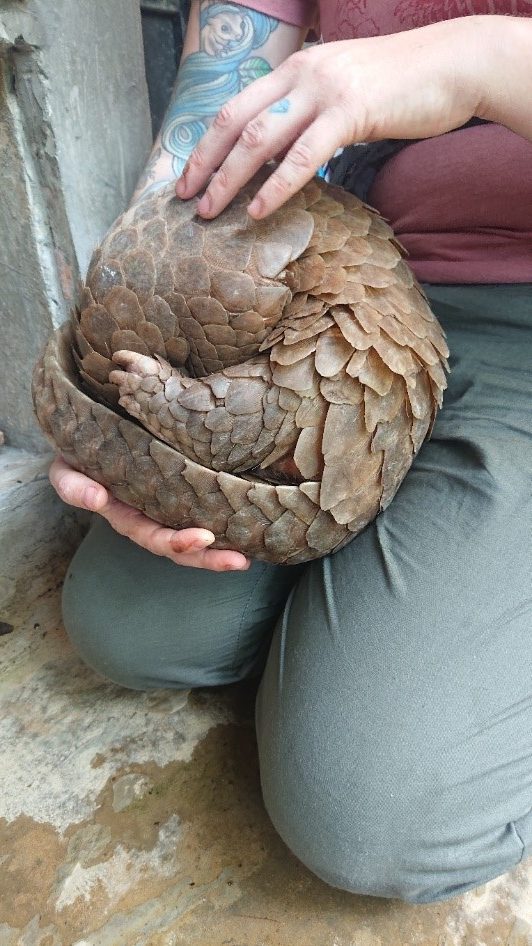
Sunda Pangolin (Manis javanica) at SVW Rescue Centre, Vietnam. When threatened pangolins curl into a defensive ball. This animal was found wedged beneath a seat on a bus travelling from Laos to Hanoi and rescued by SVW staff (© Dan Gordon)

Continue reading →

Provenance, Provenance, Provenance

Written by Yvette Harvey, Keeper of the Herbarium, Royal Horticultural Society, RHS Garden Wisley, Surrey.

When all is quiet, the crowds have long-gone home and the lights have been dimmed, the back rooms come alive for the curators who have long finished their official hours. For it is the time for tracking down rogue specimens, delving into the past or anticipating the future. What I am trying to say is that it is the time for research and the inevitable Miss Marple style adventures to be discovered when finding details to add to the current knowledge of a historic specimen. I say current because invariably details will have been lost or not even deemed worthy to have been recorded on labels, or written in a language so obscure as to not be recognised by the modern eye.

Perhaps lost details are just a phenomenon of the botanical world, but I suspect not, and I will explain what I am alluding to above using just a couple of examples of specimens made by a single collector, John Forbes, who undertook a voyage from 1822 until his death in 1823, almost 200 years ago.

John Forbes was one of the Horticultural Society of London’s (now the Royal Horticultural Society) early plant collectors. Head-hunted from the Liverpool Botanical Garden for his horticultural skills, he was employed to travel to Southern Africa to bring back plants to introduce to British gardens. He sailed with Captain Owen on the HMS Leven, a voyage tasked with making a survey of the east coast of Africa, visiting (in the following order): Madeira, Tenerife, Santa Cruz, Cape Verde Islands, Brazil, South Africa, Mozambique (Forbes is noted as the second botanist to collect there (Exell & Hayes: 130)), Madagascar, Comoros, Mozambique, South Africa and finally Mozambique (where Forbes died, 16th August 1823).

Continue reading →