Colonial Critters: Decolonising The Powell-Cotton Museum

Presented by Rachel Jennings, Powell-Cotton Museum.

Abstract

The Powell-Cotton Museum’s dioramas are visual spectacles that delight audiences, but they aren’t representations of ‘real life’. Starting in September 2020, we are undertaking a project called ‘Colonial Critters’, which will look critically at the context in which these displays were created. In this project we will delve into the history of the Museum and uncover the ‘hidden’ stories in our extensive archive,
including those of the communities with whom Percy Powell-Cotton worked across the African continent, in India, and in Kent to make this place. We will engage our staff and audiences in the process to find out what stories they would like the Museum to tell, giving the opportunity for some uncomfortable – but ultimately more rounded – histories to be displayed. The aim of decolonisation is not to re-write history, but to be more open and transparent about the origins of our collections.

This presentation will outline the Colonial Critters project, and discuss what decolonisation means to us at the Powell-Cotton Museum.

Continue reading

Diving into a Coral Reef with Cambridge Communities

Written by Sara Steele, Museum Education Assistant, Museum of Zoology and Roz Wade, Learning Officer, Museum of Zoology.

This article was first published as a blog for University of Cambridge Museums, 1st June 2020.

Our audiences are full of creativity, something we see in bucketfuls at our events and workshops. We wanted to go further, and showcase audience creations and collaborations in our programming and displays.

As a Museum celebrating the wonders of the natural world, we have an innate desire to protect it. We have committed to embedding sustainability into our public programme : tackling the materials we use and considering the impacts of activity outputs. Not all craft day creations end up on the fridge, let alone as an item cherished for life. Could we bear the thought of our logo sitting atop a landfill?

With this focus on collaboration and sustainability in mind, and with the help of the artistic mind of volunteer Fanny Bara Moreau, we designed a summer activity with longevity at its core.

Every summer, the University of Cambridge Museums box up their wares and head out into the weather with themed activities to communities across the city with Cambridge City Council’s Big Weekend and Children and Young People’s Participation Service (ChYpPs). Summer 2019 had a tropical oceans theme at the Museum of Zoology, with the goal of inspiring conversations around the conservation of our coral reefs. We wanted to use this as an opportunity to bring audiences together through shared making and showcase their creations in our programmes and displays.

Continue reading

NatSCA Digital Digest – November

Compiled by Glenn Roadley, Curator (Natural Science), The Potteries Museum & Art Gallery.

Welcome to the November edition of NatSCA Digital Digest.

A monthly blog series featuring the latest on where to go, what to see and do in the natural history sector including jobs, exhibitions, conferences and training opportunities. We are really keen to hear more about museum re-openings, exhibition launches, virtual conferences and webinars, and new and interesting online content. If you have any top tips and recommendations for our next Digest please drop an email to blog@natsca.org.

News from the Sector 

Upcoming Conference: Decolonising Natural Science Collections
November 19th 2020
NatSCA will be holding a one-day online conference on November 19th 2020, 9:50am – 4.15pm GMT. Continue reading

NatSCA Digital Digest – October

Compiled by Lily Nadine Wilkes. NatSCA Volunteer.

Welcome to the October edition of NatSCA Digital Digest.What can I read?

There are some wonderful posts on our blog. Patricia Francis, the natural history curator of Gallery Oldham, wrote Natural Connections an investigation of the person, place and specimens of a painting that reveals a hidden Oldham story. There is also Andrew Kitchener’s post on CryoArks, the UK’s first zoological biobank.

As we are in Black History Month, there is a lovely collection of research from the Natural History Museum into how the museums history and collections are connected to the transatlantic slave trade in Slavery and the Natural World.

Continue reading

Museums Beyond Covid

Written by Jan Freedman, Curator of Natural History, The Box, Plymouth.

The sun was hot on my neck as I walked up the stone steps of the largest museum in America. The Smithsonian National Museum of Natural History is on every natural curators museums to visit list, and I was full of youthful excitement!

Inside was cool, and I was met with a grand hall, with a beautiful taxidermy elephant in the centre. The space buzzes with the echoing chatter and the scuttling of excited little feet. I walk on to the stairs, past the large mass of people queuing for the lift, and head up the stairs, patiently waiting for people to pass, so I can meet my ancestors. Here in the Human Origins gallery, there are wonderful displays and interactives all about the evolution of our species. Children run from case to case. Prams block display panels. Interactives are bashed.

I move along to the mammal gallery, where it seems like twenty different schools have chosen to visit at the same time. The cases are two deep with visitors peering at mammals from continents away: children squashed at the front, adults squeezing and pushing to get a glimpse. Reminiscent of a Friday night at our student bar. The air is stale and dry. The noise of a thousand different conversations ring loud in my head. There’s a feeling of being moved along by an invisible force of hunger: not for food, but to ‘see’ the next thing.

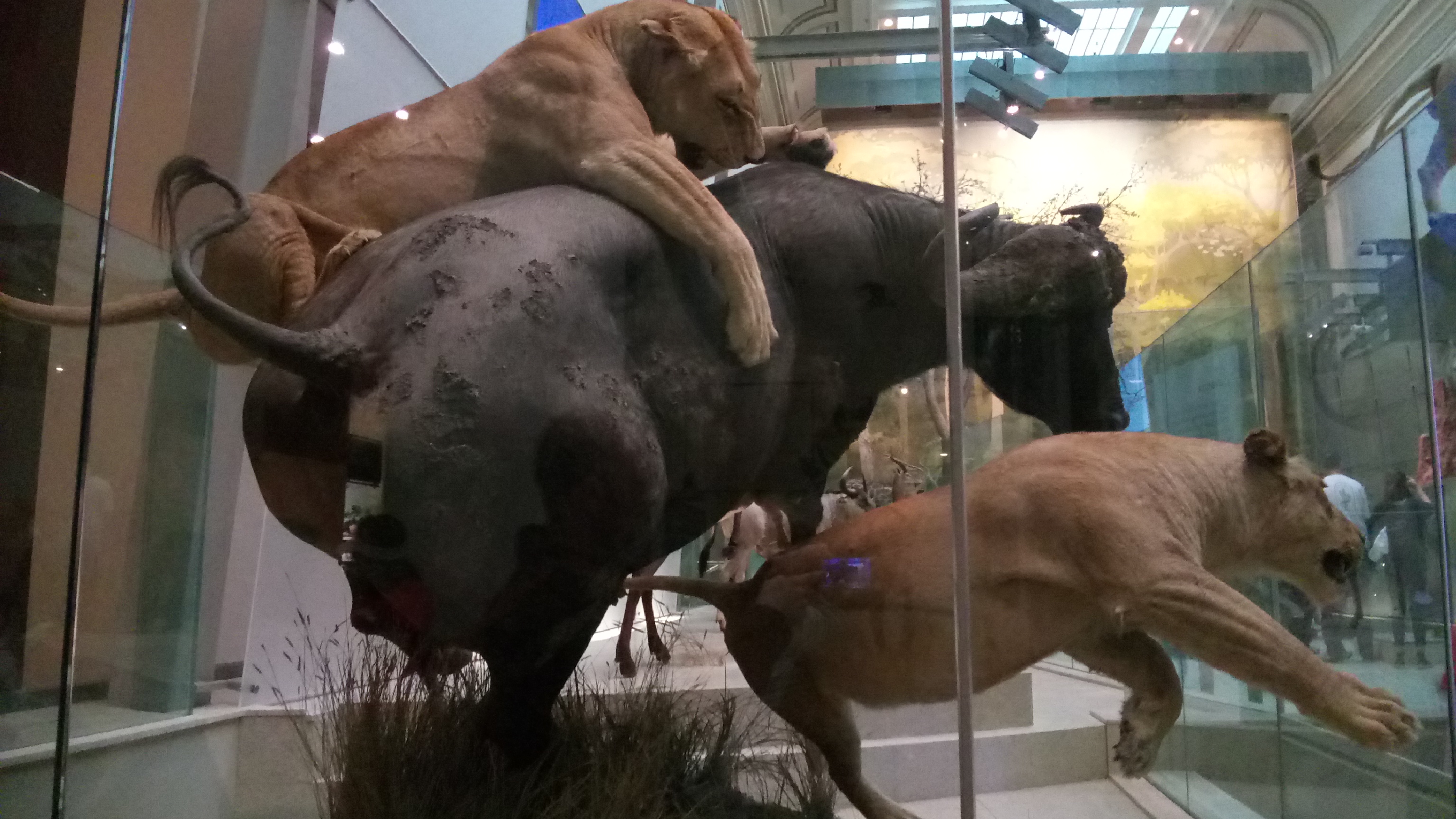
Beautiful taxidermy work of lions attacking a buffalo. I patiently waited 15 minutes until the case was clear of visitors for this photo. Photo by Jan Freedman.

Continue reading