Giant Sequoia at the Natural History Museum

Written by Lu Allington-Jones, Senior Conservator & Chelsea McKibbin, Conservator, at the Natural History Museum, London.

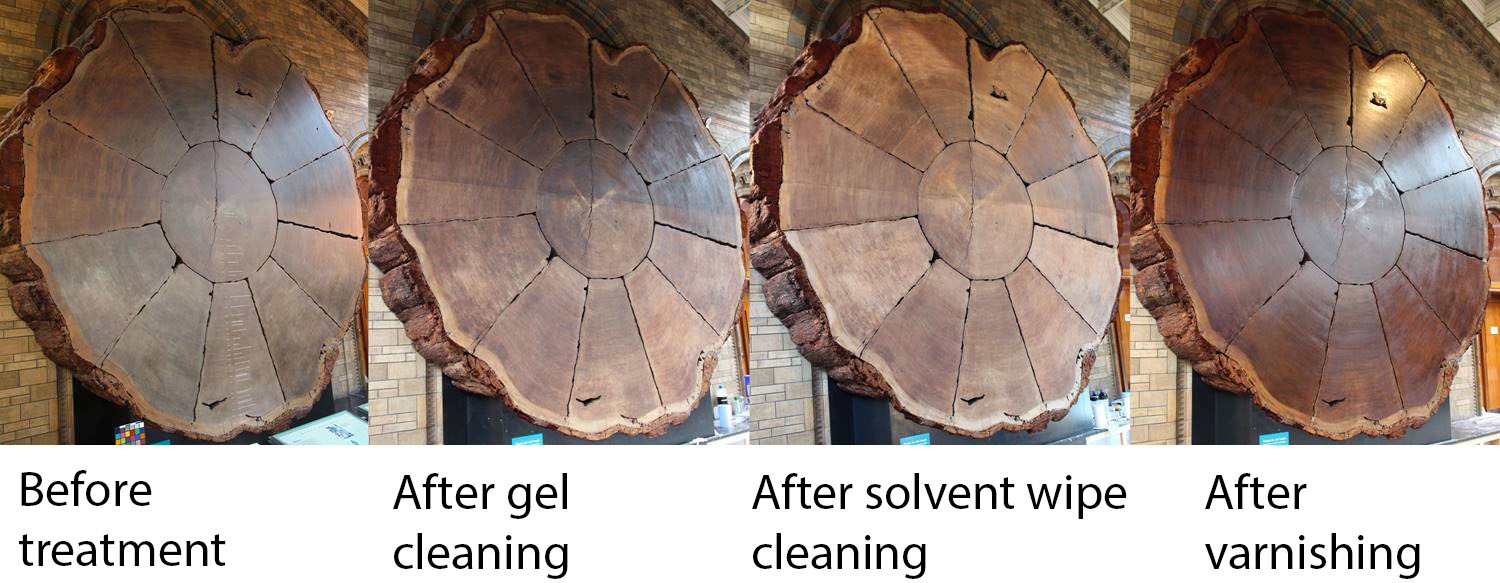
In 2016 a team undertook conservation of the slice of giant sequoia tree which is on display in Hintze Hall of the Natural History Museum in London. Following condition mapping, the treatment involved dry cleaning, removal of the old varnish with solvent gel and applying a fresh coat of varnish. A time-lapse video was taken of the whole process, which spanned 12 weeks, and can be viewed at the end of this post.

Figure 1. The stages of treatment

The Specimen

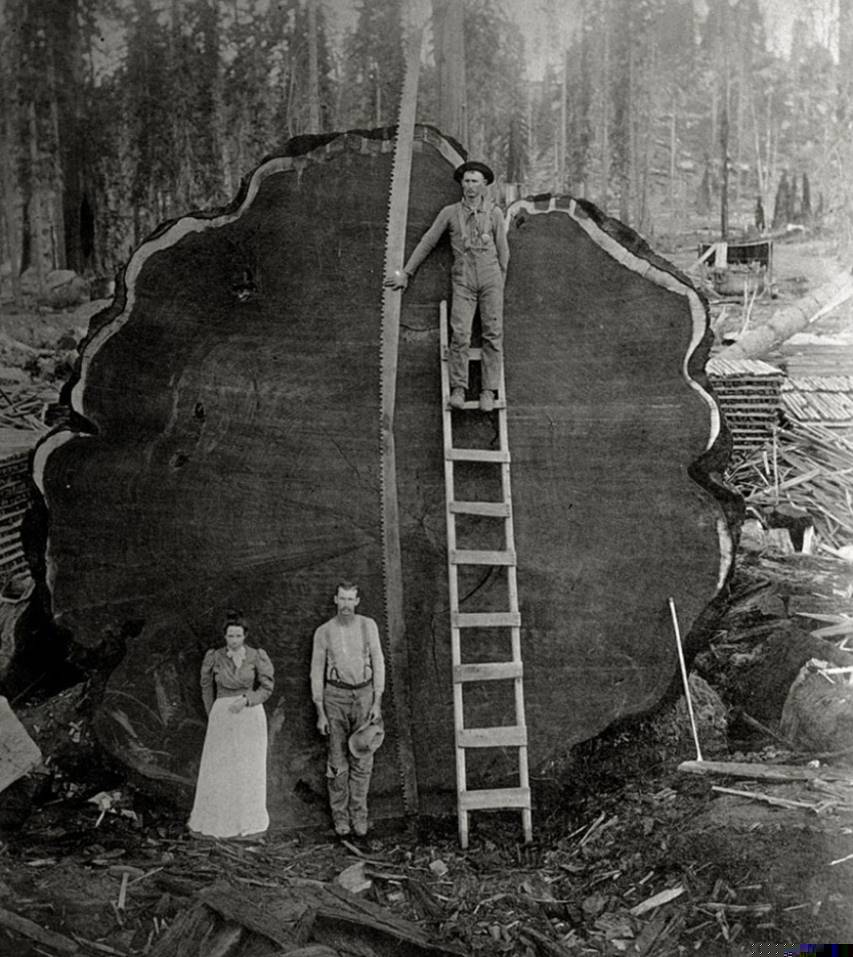
The giant sequoia (from Kings Canyon National Park, California, USA) was felled in 1891 at the age of 1,341 years. It had been 101 m tall and just over 5 m in diameter. Two sections were cut for display. The bottom and slightly larger one was sent to the AMNH while the top section was split into 12 pieces: one central disc and 11 radial segments to enable shipping to the UK. They arrived at the South Kensington site in April 1893.

Figure 2. The tree when it was felled

The giant sequoia section went on display the following year, in one of the bays of the central hall. It was moved in 1902 to stand against the wall dividing the north and central halls, and again in 1971 to its current location on the second-floor balcony.

Continue reading

NatSCA Digital Digest – April

Compiled by Lily Nadine Wilks, Intern at Museum Development Yorkshire.
Welcome to the April edition of NatSCA Digital Digest!

A note from the Blog editor:

As you know, Digital Digest is our monthly blog series featuring the latest on what’s new in the natural history sector. We normally feature the latest on where to go, what to see and do in the natural history sector including jobs, exhibitions, conferences and training opportunities. With the onset of the lockdown, we can’t go anywhere physically, but perhaps now more than ever, there is still heaps of stuff out there to keep you entertained. I would like to welcome Lily to the Digital Digest team, who had the tough job of compiling her first ever Digest in our first month of lockdown! Many thanks and well done for all of your suggestions.

In this strange and unusual time more and more of us are looking online for fun things to do, read and watch. I have compiled some of my favourites:

Where Can I ‘Visit’?

If you are like me and are missing going out to museums and seeing physical exhibitions, the Smithsonian – National Museum of Natural History have the next best thing with a range of virtual tours through their permanent, current and past exhibits. There are plenty to choose from to keep you entertained.

Chester Zoo did two wonderful live virtual tours of some of their animals throughout the day on their Facebook page and YouTube channel. They are still up and if you didn’t catch them first time round they are definitely worth watching. My favourites are the adorable Red Pandas and the curious Meerkats. Find them all on YouTube here.

What Can I do?

The Natural History Society of Northumbria have issued the North East Bee Hunt to get help recording bee species across the North East. It comes with a handy identification guide, this is something I will be trying in my garden and on my daily outdoor exercise.

If you don’t have time to watch but are able to listen, I have enjoyed the Ologies series with Alie Ward, a comedic science podcast on all things ‘Ology’. I enjoyed Plumology (feathers) featuring Dr. Alison Shultz, the Ornithology curator at the Natural History Museum of LA.

I enjoy a good bit of competition and the University of Cambridge Museum of Zoology have created Open Your Window Bingo! You can get points for looking out your window and spotting Butterflies, Birds, Plants and Extras.

Good Reads?

I enjoyed reading the Late bloomer: the exquisite craft of Mary Delany blog from the British Museum, beautiful visuals accompany a story about Mary Delany who at 72 began producing floral collages. It is mind-blowing that the images are not painted but are paper collages.

April Fools came around once more and I thought the National Trust is definitely my favourite this year. Rangers on Brownsea Island are helping squirrels find their nuts.

As another bit of light relief, Laura Bailey has been sharing the adventures of Moley on Twitter. Moley is a stone seal. I have to agree with Moley on this one.

Before You Go…

If you have any top tips and recommendations for our next Digest please drop an email to blog@natsca.org.

Similarly, if you have something to say about a current topic, or perhaps you want to tell us what you’ve been working on, we welcome new blog articles so please drop Jen an email if you have anything you would like to submit.

Stay safe and keep well.

NatSCA Digital Digest – March

Compiled by Jennifer Gallichan, Curator of Molluscs & Vertebrates at National Museum Cardiff.

Welcome to the March edition of NatSCA Digital Digest!

A monthly blog series featuring the latest on where to go, what to see and do in the natural history sector including jobs, exhibitions, conferences and training opportunities. If you have visited an exhibition/museum, have something to say about a current topic, or perhaps you want to tell us what you’ve been working on, please drop an email to blog@natsca.org.

Where Should I Visit?

Monsters Of The Deep opens on 20th March at the National Maritime Museum, Cornwall. Really curious to know what people think of this exhibition exploring centuries old myths of Krackens and Giant Sharks. I have also heard that there will be a Coelocanth on display for the first time in Cornwall!

Design For Life at Surgeons’ Hall Museums, Edinburgh explores the fascinating history of Comparative Anatomy and how integral it was to the beginnings of Surgeons’ Hall Museums. The exhibition will run until Easter 2020.

Continue reading

NatSCA Digital Digest – February

Compiled by Glenn Roadley, Curator (Natural Science), The Potteries Museum & Art Gallery.

Welcome to the February edition of NatSCA Digital Digest!

A monthly blog series featuring the latest on where to go, what to see and do in the natural history sector including jobs, exhibitions, conferences and training opportunities. If you have visited an exhibition/museum, have something to say about a current topic, or perhaps you want to tell us what you’ve been working on, please drop an email to blog@natsca.org.

Where Should I Visit?

Plenty of events and exhibitions to keep you busy this month. The Royal Academy of Arts (London) exhibition ‘Eco-Visionaries: Confronting a planet in a state of emergency’ runs until Sunday 23rd February. Through film, installation, architectural models and photography, the works in this exhibition interrogate how architecture, art and design are reacting to a rapidly changing world, From climate change to species extinction and resource depletion.

Exploration: From Deep Time to Outer Space’ continues at The Hunterian, Glasgow. The Hunterian is home to many important historical and modern natural history specimens and the associated materials related to them. Many of the most interesting and scientifically valuable are the product of fascinating field investigations and expeditions. This exhibition explores the scientific discoveries of the University of Glasgow’s staff, students and associates since the 18th century. Open until 15th March.

Continue reading

NatSCA Digital Digest – October

Compiled by Jennifer Gallichan, Curator: Vertebrates/Mollusca, Amgueddfa Cymru – National Museum Wales

Welcome to the October edition of NatSCA Digital Digest!

A monthly blog series featuring the latest on where to go, what to see and do in the natural history sector including jobs, exhibitions, conferences and training opportunities. If you have visited an exhibition/museum, have something to say about a current topic, or perhaps you want to tell us what you’ve been working on, please drop an email to blog@natsca.org.

Where Should I Visit?

It is definitely worth visiting Beavers to Weavers: The Wonderful World of Animal Makers exhibition at Leeds City Museum as they have just won a Museums Change Lives award in the category of environmental sustainability. More than 48,000 people visited this exhibition last year, so if you’ve not yet been, it’s worth checking out. The exhibition has an environmental focus displaying beautiful objects made by animals. Discover how animals build homes, make armour or camouflage, craft tools and traps to catch food or change their appearances to attract each other. If you want to know more there is also a great blog about it.

After its recent stay in Great North Museum: Hancock, Dippy On Tour finally comes to National Museum Cardiff this month! This will be Dippy’s only sojourn in Wales, and so is a fantastic opportunity for many to see this iconic specimen. Croeso Dippy i Gymru! There are tonnes of related events programmed, you can dance around Dippy at our Silent disco, or find your inner calm at Dippy about Yoga, so well worth a visit.

Continue reading