NatSCA Digital Digest – February 2023

Compiled by Glenn Roadley, NatSCA Committee Member, Curator of Natural Science at The Potteries Museum & Art Gallery.

Welcome to the February edition of NatSCA Digital Digest.

A monthly blog series featuring the latest on where to go, what to see and do in the natural history sector including jobs, exhibitions, conferences, and training opportunities. We are keen to hear from you if you have any top tips and recommendations for our next Digest, please drop an email to blog@natsca.org.
Sector News

NatSCA Conference

The NatSCA annual conference and AGM will be held at The Potteries Museum & Art Gallery on Thursday 27th and Friday 28th April 2023. The focus this year is:

So how do we actually do all this? Hopeful futures and turning theory into practice for big issues in natural history collections.

This is the “How To…” conference for people working with natural history collections. The last few years have seen unprecedented changes in the expectations for what the museum sector can deliver. Global and local social and environmental issues have coincided to reinforce the needs of museums to consider their reinvention and relevance. Booking will open shortly, so keep an eye on our website and social media channels for updates.

SPNHC Conference

The 38th Annual Meeting of The Society for the Preservation of Natural History Collections is being held in San Francisco, California 28 May – 2 June 2023. Full details here.

DiSSCo UK Community Event

The next DiSSCo UK event will be held on March 3rd, 14:30-16:30 via Microsoft Teams. Please save this date in your calendars! A general update on DiSSCo UK activities and future plans will be provided, and we will hear from our colleagues at Kew regarding their digitisation project, and will discuss the affiliation between natural science collections and the humanities sector. For details, contact Tara Wainwright (tara.wainwright@nhm.ac.uk)

Bursaries for People and Plants workshop 2 at Royal Botanic Gardens, Kew (Friday March 10th 2023)

Applications are now open for 4 funded spaces at workshop 2 of the AHRC funded project ‘People and Plants: reactivating ethnobotanical collections as material archives of Indigenous ecological knowledge’.

Four bursaries of up to £225 each are available. This sum may be set against your travel costs or accommodation costs.

Conditions:

  • Only members of the Natural Science Collections Association and the Museum Ethnographers Group can apply for a bursary.
  • All successful applicants must provide a write up for the NatSCA or MEG blog.
  • Due the funds available, applications are limited to UK residents only.
  • Bursaries are only open to individual members.

To apply for a bursary please write no more than 500 words on how the workshop would be useful for your own personal or professional development, how this fits with your interests and what you might bring to the discussion.

Preference will be given to those lacking institutional support to attend workshops, early career museum professionals and students.

All bursaries are given at the discretion of the project team and the NatSCA and MEG committee. Applicants will be notified by February 20th if they have been successful and travel and accommodation will be booked by the project.

Applications should be sent to: Ali Clark a.clark@nms.ac.uk by Friday February 17th at 5pm.

Details of the workshop: March 10th Royal Botanic Gardens, Kew

This workshop will be run in partnership with the Department of Cultures and Languages, Birkbeck, University of London and Museu Goeldi, Brazil. Discussions will be centred around the ecological value of ethnobotanical collections, including a focus on the interaction of western botanical nomenclature and traditional knowledge which forms the basis of an existing British Academy Knowledge Frontiers project. The Richard Spruce collection (1849-1864) will be the basis of a case study for how culture, plants and environment in the northwest Amazon have changed over the last 160 years.

Speakers include: Luciana Martins (Birkbeck), Dagoberto Lima Azevedo (Tukano Indigenous Researcher), Claudia-Leonor Lopez Garces (Museu Paraense Emilio Goeldi) and Cinthya Lana (University of Gothenburg)

Continue reading
Naturalis’ New Hall of Evolution

Written by Becky Desjardins, Senior Preparateur, Naturalis Biodiversity Center.

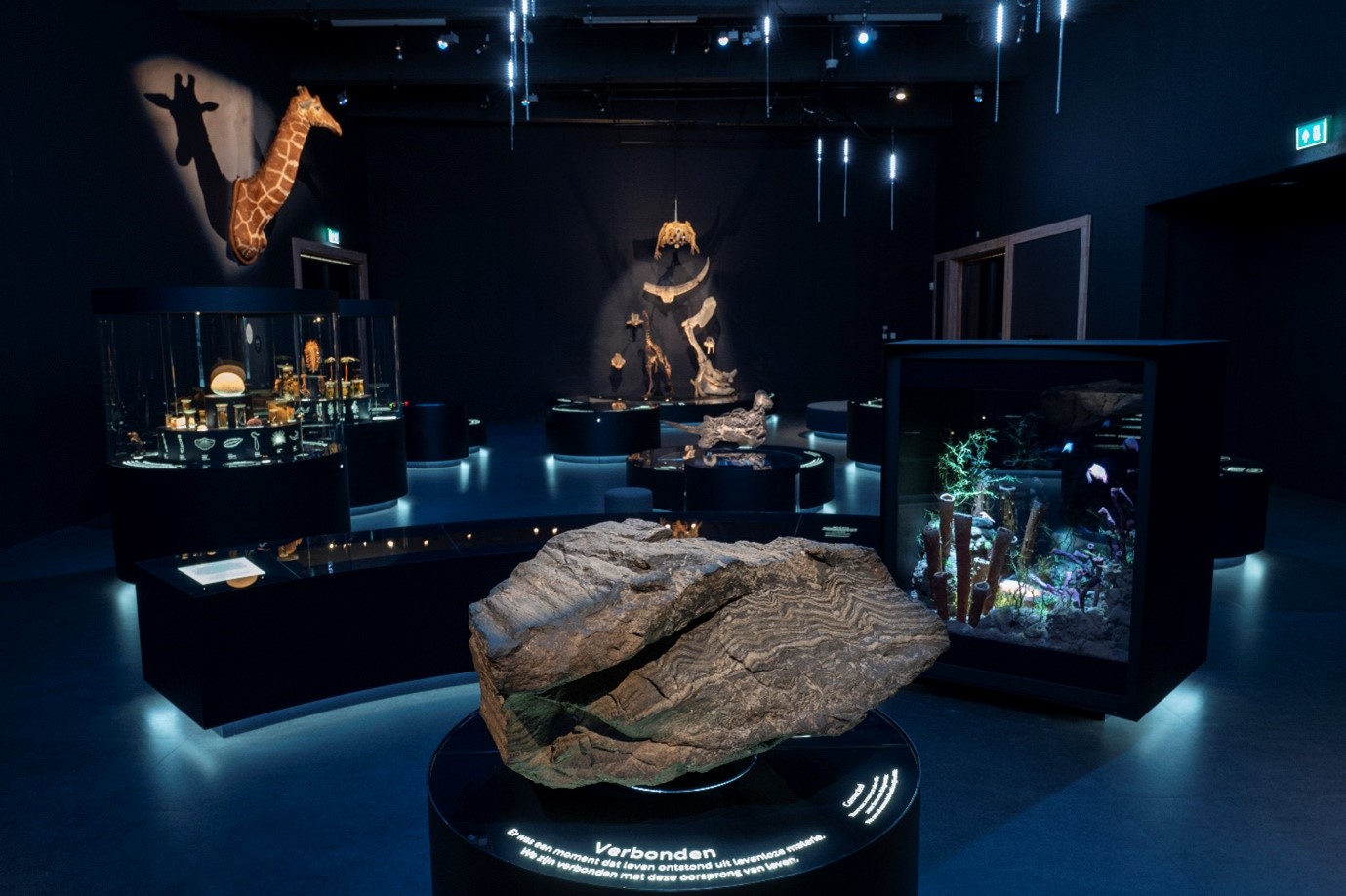
In 2019 Naturalis opened a new building with eight permanent exhibit halls. We are happy to announce that we have opened the ninth hall, Evolution. The exhibit designer, Marijke Besselink, told me that the concept for the hall was developed after she heard how visitors reacted to a stone that was in the former Naturalis prehistory exhibit. This stone came from Greenland and dates to 3.76 billion years ago. In this rock you can see layers that indicate the presence of oxygen that might have been produced by single celled organisms. It is one of the earliest signs of life on earth. One of the museum educators told Marijke how in the old exhibit, visitors were astonished that the rock was so old, and would touch it with awe. Now this centerpiece is in the front centre of the dark blue exhibit, and when a visitor touches the stone, it starts up a light and sound interaction which connects to other vitrines around the exhibit. This gives the visitor a feeling of connection, that everything on Earth is intertwined: we are all related.

© Henk Caspers

Around the stone we can find fossils from the Burgess Shale, a Canadian formation that includes more than 500-million-year-old ancestors of most modern animals. Marijke wanted to make it clear to the public what the animals preserved as fossils looked like as to the casual observer these small fossils sometimes look like a dark grey smudge! Projections help the fossil organisms manifest out of their slate beds and move across the vitrine and into an aquarium filled with creatures from the so-called Cambrian explosion. The aquarium, made with the Pepper’s Ghost technique, is one of the highlights of the hall. Besides being very cool looking, visitors see how these prehistoric animals moved, and see how similar they are to modern animals.

Continue reading

NatSCA Digital Digest – January 2023

Compiled by Claire Dean, Project Curator, Tullie House Museum & Art Gallery.

Welcome to the January edition of NatSCA Digital Digest.

A monthly blog series featuring the latest on where to go, what to see and do in the natural history sector including jobs, exhibitions, conferences, and training opportunities. We are keen to hear from you if you have any top tips and recommendations for our next Digest, please drop an email to blog@natsca.org.

Sector News

The NatSCA annual conference and AGM will be held at The Potteries Museum & Art Gallery on Thursday 27th and Friday 28th April 2023. The focus this year is So how do we actually do all this? Hopeful futures and turning theory into practice for big issues in natural history collections.

We are looking for 20-minute presentations, 5-minute lightning talks, and posters. Work can be presented in-person or digitally. All the details you need are here. The deadline for submission is 5pm GMT Monday 30th January.

Abstract submissions are also now open for SPNHC 2023. The 38th Annual Meeting of The Society for the Preservation of Natural History Collections is being held in San Francisco, California 28 May – 2 June 2023. Full details here.

Continue reading

Ostracod Odessey – Broadcasting the Brady Collection

Written by Dan Gordon, Keeper of Biology, The Great North Museum: Hancock.

The Great North Museum : Hancock is home to many remarkable collections, but one of the most important is perhaps one of the most unfamiliar to our visitors. The Brady collection of Ostracods.

Ostracods, sometimes called Seed Shrimp, are distinctive Class of crustaceans. A shell of two intricately textured valves almost entirely envelopes their shrimp-like bodies, with just a small opening for a cluster of rapidly moving legs to poke out. As their common name suggests, most species are very small, mostly invisible to human eye, but they’re ubiquitous, busily going about their lives wherever there is permanent or temporary water, from the poles to the tropics. Some swarm the world’s oceans in vast planktonic shoals, while others live in the still, dark pools of caves, in garden ponds or even puddles.

They’re poorly known outside of academic communities, which is a real shame, because despite being fascinating creatures in their own right, they have important roles in many aquatic ecosystems, and significantly, they’re commonly encountered in the fossil record, which means that they are particularly important indicator fossils. In addition, the chemical make-up of their distinctive shells tells us about ocean acidity and temperature, which can tell us about ocean warming and climate change.

The collection was the work of George Stewardson Brady, a local man, born in Gateshead in 1832, and one of the people who pioneered the study of these animals at a time when they were relatively poorly understood.  Housed in a row of cabinets, the Brady collection is made up of nearly 3000 microscope slides with up to 100 Ostracods on each. These specimens were collected all over the world, many of them by well-known expeditions such as the HMS Challenger expeditions in the 1870s. It contains many Types, and provides a valuable resource for the study of these animals today.

Continue reading

NatSCA Digital Digest – December 2022

Compiled by Milo Phillips, Assistant Curator of Entomology for National Museums Scotland.

Welcome to the December edition of NatSCA Digital Digest.

A monthly blog series featuring the latest on where to go, what to see and do in the natural history sector including jobs, exhibitions, conferences, and training opportunities. We are keen to hear from you if you have any top tips and recommendations for our next Digest, please drop an email to blog@natsca.org.

Sector News

Catch up: Museum Action for Climate Empowerment Webinars

The most recent webinar from the Network of European Museum Organisations (NEMO) is now available to watch online if you were unable to make it to the live webinar in November. Henry McGhie or Curating Tomorrow, and NEMO Policy Officer Elizabeth Wilde dig into sustainability insights for the sector, key ways that museums can meaningfully contribute to the United Nations Framework Convention on Climate Change (UNFCCC), and explores a new guide for how museums can measure and report greenhouse gas emissions. All previous webinars can also be found over on the NEMO YouTube channel.

Link to latest webinar: https://www.ne-mo.org/training/nemo-webinars.html

Link to NEMO YouTube channel: https://www.youtube.com/@nemo-networkofeuropeanmuse7452

Registration Open for Field Studied Council January Courses

You can now register for upcoming natural history courses hosted by the Field Studies Council. January workshops include: an introduction to bee conservation, an exploration of botanical folklore, and courses on marine mammal and marine invertebrate biology and ecology. Many are hosted online with FSC Virtual, and costs vary.

Link to upcoming courses: https://www.field-studies-council.org/courses-and-experiences/natural-history-courses/

Continue reading