Making a Green Gallery – A Leeds Story

By Sara Merritt, Audience Development Officer at Leeds Museums & Galleries.

Us: We want to retro-fit a permanent gallery! As sustainably as possible! With £40k! In two months! And we want to keep the space open to visitors!

Them: Umm, are you sure that’s a good…

Us: Great! We’ll get cracking.

2022 saw us undertake the retro-fit of our permanent Life on Earth gallery at Leeds City Museum, with the aim of making it as sustainable as possible. The gallery required an overhaul to meet current visitor expectations, with innovative design ideas and production methods to reflect our greater understanding of climate change, the biodiversity crisis, and Britain’s colonial history.

Our objectives were threefold and carefully considered:

  • To manage and deliver a sustainable retro-fit with the addition of creating a carbon calculator to measure our C02 output
  • To ensure the interpretation was relevant, and that we had a strong idea of our target audience to attract visitors who were already engaged in making climate-positive changes.
  • To identify robust materials and production methods which would stand up to visitors pulling, prodding, and everything in between.

We were used to working with greener materials for temporary exhibitions and knew the implications around material availability, longevity of eco materials, and higher associated costs. We therefore needed to keep the project resource light and put our efforts into the interpretation, rather than dramatic object moves. We took the bones of what we had, large cases and great objects, and retold the story with the emphasis on using our objects to inspire our visitors to live more sustainably.

Continue reading →

NatSCA Digital Digest – May 2024

Compiled by Ellie Clark, Collections Moves Team Leader at the Natural History Museum.

Welcome to the May edition of NatSCA Digital Digest.

A monthly blog series featuring the latest on where to go, what to see and do in the natural history sector including jobs, exhibitions, conferences, and training opportunities. We are keen to hear from you if you have any top tips and recommendations for our next Digest, please drop an email to blog@natsca.org.

Sector News

Registration is now open for the 13th European Bird Curators Meeting, October 2024, in Liverpool.

The European Bird Curators Meetings aim to promote cooperation, dissemination of best practices and new techniques in the curation, management, and use of bird collections. Presenters in the scientific programme often include curators, collection managers, museum historians and ornithological researchers. These are friendly meetings and anyone with an interest is welcome to join us.

The meeting will include plenary and submitted presentations, discussion sessions, collections tour, conference dinner (optional – Tuesday 29th October) and field excursion (optional – Thursday 31st October). 

Please follow the ‘Tickets available here’ link from the event webpage to register. They have single day registration options and have kept costs as low as possible to encourage attendance by local natural history curators. 

If you have any questions, please email vertebratezoology@liverpoolmuseums.org.uk.

Continue reading →

Divorced or Separated? Naming the Specimens on Display at the Zoologisches and Palaontologisches Museum, Zurich.

Written by Richard Crawford, who has just completed a PhD thesis at the University of the Arts London, entitled ‘Re-presenting taxidermy, Contemporary Art interventions in Natural History Museums’.

Do people read labels in museums? If they do, what do they learn about the object on view? It has been the custom to use labels to give factual names to the things on display in scientific museum displays, but Art curators have taken a different approach and put titles to works that suggest a particular reading of the artwork. These may be suggested by the artist. A good example of this style of labelling is Damien Hirst’s ‘Mother and Child divided’, an artwork that used preserved specimens.

For this work, Damien Hirst famously sawed a cow and a calf in half and exhibited the separate halves in tanks filled with formaldehyde, which he placed apart with sufficient space for a viewer to walk between the two halves of each animal carcass so that they could observe the internal organs of both cow and calf. When it was exhibited at the Tate Gallery in 1995, it helped win him the Turner Prize. The title was ironic. Hirst’s work critiques romantic depictions of the animal as part of harmonious natural order, a place in which mothers protect and nurture their young according to supposedly universal maternal instincts. In place of natural harmony, he presented the viewer with the disjuncture and division brought about by human intervention that brought early death to these two animals, destined for the meat market.

Continue reading →

NatSCA Digital Digest – March 2024

Compiled by Olivia Beavers, Assistant Curator of Vertebrate Zoology at World Museum, National Museums Liverpool.

Welcome to the March edition of NatSCA Digital Digest.

A monthly blog series featuring the latest on where to go, what to see and do in the natural history sector including jobs, exhibitions, conferences, and training opportunities. We are keen to hear from you if you have any top tips and recommendations for our next Digest, please drop an email to blog@natsca.org.

Sector News

NatSCA Annual Conference & AGM 2024

Registration is open for the 2024 Annual Conference & AGM of the Natural Sciences Collections Association. Trials and Triumphs: sharing practice across the museum sector will be held on Thursday 18th and Friday 19th April 2024 in the Oxford University Museum of Natural History. This practical conference aims to celebrate triumphs and amplify successes in museums, but also highlights pitfalls and lessons learned from situations that didn’t go as planned. Members – please remember to contact membership@natsca.org for your promotional code to release discounted tickets.

The event will be physical/digital hybrid, with attendees able to attend in person or online via Zoom. Follow the link for more details and to register.

Continue reading →

A Prize Winning Brown Bear in Sofia.

Written by Richard Crawford, who has just completed a PhD thesis at the University of the Arts London, entitled ‘Re-presenting taxidermy; Contemporary Art interventions in Natural History Museums’.

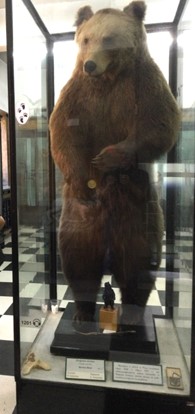
I am used to seeing trophy specimens in mainstream natural history museum collections – for example, the crouching tiger shot by King George V in 1911 that is on display in the natural history galleries at the Royal Albert Museum in Exeter – but I was surprised to see a taxidermy specimen of a big Brown Bear at the National Museum of Natural History, Sofia, holding a medal that it had been awarded at the Berlin International Hunting Exhibition in 1937.

The prize winning brown bear in Sofia Natural History Museum

The 1937 Berlin International Hunting Exhibition showcased all manner of hunting trophies including mounted antlers, boar heads, bear skins and various taxidermy animals. It also featured demonstrations with live animals, including hunting eagles and a pack of beagles. The event was given official approval by the then prime minister, Hermann Goering, who opened the exhibition amid fluttering Nazi flags and rows of hunters dressed in smart grey uniforms. In his opening remarks, Goering stated his view, that hunting could promote international peace:

Continue reading →