“Our Irish Natural History”: Increasing the Accessibility of Natural History Collections through Community-Driven Interpretation

Written by Adriana Ballinger, Yale University Charles P. Howland Postgraduate Research Fellow at the National Museum of Ireland, Natural History.

Natural history specimens are often inaccessible to the communities from which they were collected. As a result, source communities lack opportunities to connect with elements of their local heritage, and museums and their publics overlook the place-based expertise that many of these communities hold about the specimens we research and see on display. Scientists lead the knowledge creation process surrounding natural history specimens, but source communities can also contribute valuable information, especially regarding the meanings that flora, fauna, and geological features embody in their environments of origin. Although these cultural contexts are often intangible and unquantifiable, they are nevertheless important facets of specimens’ natural histories. For the past year, I have led “Our Irish Natural History,” a community-driven research and exhibition project at the National Museum of Ireland (NMI). I set out to increase the accessibility of the NMI’s natural history collections, explore innovative avenues for community-led interpretation, and create new opportunities for public engagement.

Continue reading →

Seeing With Their Eyes A Poetic Reflection on the 2025 ‘From Collections to Connections’ NatSCA Conference Presentation

Written by Pauline Rutter – Independent Archival Artist, Community and Organisation Poet.

These words look out from the page with eyes I have borrowed. Eyes not shaped for vision through the specific disciplinary scientific lens. Eyes that strain to see beyond past centuries of debate on what, of all origins, is knowable and what is not. With these original eyes, would ways of seeing allow the light to travel outwards resisting funnelled perspectives and interpretations descended from imperialistic systems of Enlightenment science, colonial ideologies and narratives? In this context my eyes had opened up unevolved or re-evolved with lepidopteran vision, though not removed from all that had been taught to be seen. New eyes with sight of intensified colour that amplified nature’s interconnecting patterns, only visible outside the spectrum of the everyday, the expected, the predetermined. 

What use is butterfly sight that transforms configured objects and living matter with or without full binominal species names, into fragments like those of the intertwined and metamorphosed elements in ritualistic rapture spreading out across a Wangechi Mutu collage? 

Continue reading →

How to Foster Empathy with Endangered Animals: Developing a Creative Writing and Drawing Workshop Toolkit

Written by Dr Christina Thatcher, Lecturer in Creative Writing & Dr Lisa El Refaie, Reader in Language and Communication, Cardiff University.

With biodiversity declining at an alarming rate, we need to find ways of encouraging people to care about all endangered animal species, not just the ones with the most obvious appeal, such as pandas and polar bears, for example. According to the International Union for Conservation of Nature’s ‘Red List of Threatened Species’, 27% of mammals are threatened with extinction, but so are 44% of reef corals, 41% of amphibians, 37% of sharks and rays, 21% of reptiles, and 12% of birds.

In 2023, we—Dr Christina Thatcher and Dr Lisa El Refaie from Cardiff University—met and discovered our shared interest in the expressive arts, metaphor, empathy and nature. We then designed a project which aimed to use the power of creativity to increase public awareness of, and empathy for, endangered animals, focusing on species that have few or no obvious human-like features. The project was funded by the Arts and Humanities Research Council (AHRC) Impact Acceleration Account and ran from November 2023 until the autumn 2024, in collaboration with Natural History curators at the National Museum Cardiff. Continue reading →

Feeling Older than Your Age? The Importance of Museum Collections for Radiocarbon Dating, and a Request for Collections containing Bivalves Collected Before 1950 from the UK

Written by Rachel Wood, Associate Professor, Oxford Radiocarbon Accelerator Unit, School of Archaeology, University of Oxford.

Radiocarbon dating is routinely used to work out the age of archaeological and palaeontological sites, and often pops up in news articles and TV dramas. But some substantial problems remain. One of these is the calibration process, which allows us to convert the ratio of 14C (“radiocarbon”) and 12C (the common stable form of carbon) to an age estimate. This is particularly challenging when we are trying to date marine shells or any animal that has eaten food from the marine system. This means that it can be difficult for us to get an accurate age for a sample that should be straightforward – for example, the skeleton of Medieval person or a Mesolithic dog.

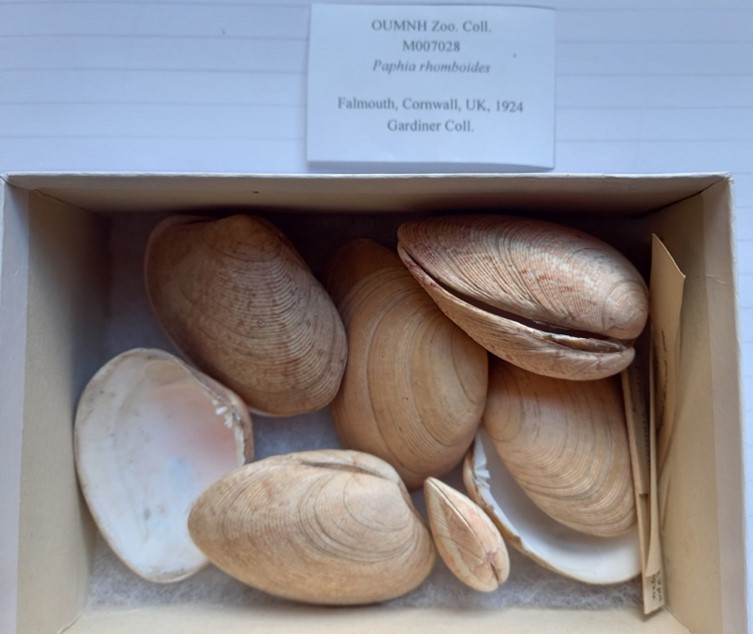
The Oxford Radiocarbon Accelerator Unit is starting a project looking for samples of marine shells to help resolve this problem (Fig. 1). Natural history collections in museums are key to its success, and we would be very grateful to hear if anyone has a collection of pre-1950 marine bivalve shells.

Figure 1. Marine bivalves, suitable for helping us to calibrate radiocarbon dates. Please let us know if you have similar material that can be analysed by sampling a small strip from the edge. (Photo Peter Ditchfield, Courtesy Oxford University Museum of Natural History)

The Problem

At school, we are taught that radiocarbon dating works because radiocarbon decays radioactively at a known rate. By comparing the amount of 14C to a stable form of carbon called 12C, we can work out the age of a sample (Fig. 2). This is true, but only partially so because the starting 14C:12C varies. To get around this problem, we need to calibrate radiocarbon dates. Most 14C is produced in the upper atmosphere, and is incorporated into plants by photosynthesis and then passed through the food chain. This means, that if someone is eating terrestrial food – they will have a similar 14C:12C ratio in their bodies as in the atmosphere.

Continue reading →

Behind The Heads: Natural History, Empire and The Abel Chapman Collection. Part 2.

Written by Dan Gordon, Keeper of Biology, The Great North Museum: Hancock.

Abel Chapman’s time in southern Africa was only the first of many visits to the continent. His next trip, in 1904, was to a very different place – British East Africa. This was a colonial protectorate roughly equivalent to today’s Republic of Kenya. It had grown out of land leased by the British East Africa Company but was now firmly under British imperial control.

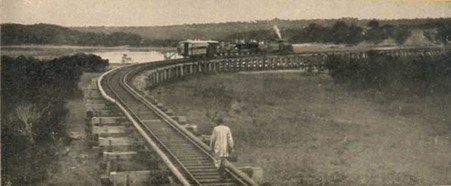
The Uganda railway, a huge feat of engineering, had been completed just three years before Chapman’s visit. This now allowed trains to travel the 800km (500 miles) between Mombasa on the east coast and the African Great Lakes. The British now had the means to extend their influence right across East Africa, disrupting the slave routes and simultaneously opening up the land to the missionaries, settlers, tourists and game hunters that were now pouring in. It was in this rapidly changing environment that Chapman strove to find the longed for wilderness that had eluded him in Transvaal, and test his skills as a sportsman, before that land too vanished under the settler’s plough.

Figure 1. An undated photo of the Uganda Railway near Mombasa (http:/www.jaduland.de, Public domain via Wikimedia Commons)
Continue reading →