Divorced or Separated? Naming the Specimens on Display at the Zoologisches and Palaontologisches Museum, Zurich.

Written by Richard Crawford, who has just completed a PhD thesis at the University of the Arts London, entitled ‘Re-presenting taxidermy, Contemporary Art interventions in Natural History Museums’.

Do people read labels in museums? If they do, what do they learn about the object on view? It has been the custom to use labels to give factual names to the things on display in scientific museum displays, but Art curators have taken a different approach and put titles to works that suggest a particular reading of the artwork. These may be suggested by the artist. A good example of this style of labelling is Damien Hirst’s ‘Mother and Child divided’, an artwork that used preserved specimens.

For this work, Damien Hirst famously sawed a cow and a calf in half and exhibited the separate halves in tanks filled with formaldehyde, which he placed apart with sufficient space for a viewer to walk between the two halves of each animal carcass so that they could observe the internal organs of both cow and calf. When it was exhibited at the Tate Gallery in 1995, it helped win him the Turner Prize. The title was ironic. Hirst’s work critiques romantic depictions of the animal as part of harmonious natural order, a place in which mothers protect and nurture their young according to supposedly universal maternal instincts. In place of natural harmony, he presented the viewer with the disjuncture and division brought about by human intervention that brought early death to these two animals, destined for the meat market.

Continue reading

Taxidermy and the Country House: Where Natural History Meets Social History – a review 

Written by Jack Ashby, Assistant Director of the University Museum of Zoology, Cambridge.

Pat Morris is the authority on the history of British taxidermy, and there is arguably no-one better to write an exploration of the specific context of taxidermy collected for and displayed in private country houses. Although their materiality is identical, by their nature, these collections are often conceptually very different – the antithesis, even – to those in public museum. These differences are not the focus of the book, nonetheless this perspective offers great potential to help us consider more roundly the story of taxidermy and those that made and collected it.

The similarities museum and country house collections do share include their origin-stories, and of course the practicalities of preserving specimens. Like museums, these private collections trace their histories back to cabinets of curiosities. Preservability was fundamental to what could be kept, and Morris begins by explaining that early cabinets of curiosities in country houses were mainly items that required no preservation – dry materials like shells and bone. The only skins that were widely kept were those that could be simply dried without being prone to insect attack, which is why durable specimens like taxidermy crocodiles, hollowed-out armadillos and inflated pufferfish were commonplace in these early collections, rather than the birds and mammals which later became the norm.

Continue reading

The Herbarium Handbook – Sharing Best Practice from Across the Globe.

Submitted by Clare Drinkell, Senior Curator Botanist at the Royal Botanic Gardens, Kew.

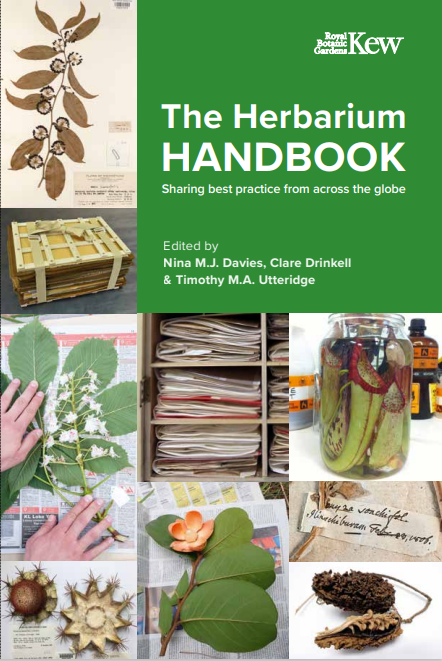
Editors: Nina Davies, Clare Drinkell, Timothy Utteridge. 290 pp, 234 x 156 mm. Over 700 colour photographs. Paperback, ISBN 9781842467695. Kew Publishing, TW9 3AE, UK 2023. £25.00. https://shop.kew.org/kew-herbarium-handbook

Cover page of The Herbarium Handbook

The new Herbarium Handbook is a key new addition to Kew Publishing’s series of handbooks, including The Plant Glossary and The Temperate Plant Families Identification Handbook. Unlike the other books in the series the Herbarium Handbook is a new version of a book first compiled and edited by Kew botanists some thirty-four years ago. The initial Herbarium Handbook came about following an extremely popular International Diploma Course in Herbarium Techniques at Kew. The demand to attend the course was so high that the number of applicants far exceeded places on the course. In view of the interest, the main information imparted during the course was published as a manual, widely recognised as an important reference for fundamental aspects of herbarium care and management.

Continue reading

NatSCA Digital Digest – November 2023

Compiled by Glenn Roadley, NatSCA Committee Member, Curator of Natural Science at The Potteries Museum & Art Gallery.

Welcome to the November edition of NatSCA Digital Digest.

A monthly blog series featuring the latest on where to go, what to see and do in the natural history sector including jobs, exhibitions, conferences and training opportunities. We are keen to hear from you if you have any top tips and recommendations for our next Digest, please drop an email to blog@natsca.org.

Sector News

GCG AGM and seminar – Building bridges between collectors and museums

The Geological Curators Group will be holding their annual AGM and seminar on November 28th – topics will include:

  • Many important specimens are held in private collections. How can museums gain an understanding of the scope of these collections and the needs of collectors?
  • How can museums gain the trust of collectors and start to find ways to work around the sometimes strict conditions imposed upon them?
  • How do collectors feel that museums can improve the way that they deal with such donations?
  • Lack of ‘proof of legal ownership’ or ‘documentation of permission to collect’ can be major sticking points for museums; however, such provenance was rarely required or given historically (or even more recently). How can we ensure that important historic specimens can be integrated into museum collections? Do we need a more flexible approach to the ‘ownership’ of geological specimens collected from casual sites that are not SSSI’s or other protected statuses?
  • What can we learn from previous experiences?
  • Can museums produce advice to help private collectors to document their collections and highlight or label specimens that might ideally end up in a museum in the future?

For more information and to register, see the GCG website: https://www.geocurator.org/events/162-50th-annual-general-meeting-and-winter-seminar

Continue reading