
Written by Ranee Prakash, Senior Curator (Flowering Plants), Algae, Fungi and Plants Division, Department of Life Sciences, Natural History Museum, London.
A survey of flowering plant material stored in various fluid preservatives across several European herbaria/institutions was carried out a few years ago. The feedback received from the survey is shared and shows that the majority of the herbaria use 70% IMS (industrial methylated spirit) to store their collections.
Introduction
The seed plant collections (stored in various liquids such as formalin, some have unknown liquids, and some mention poison) form a relatively small yet significant part of the botanical holdings at NHM (Natural History Museum). They include some important material dating back to the mid 1800’s and type collections such as the world’s largest flower Rafflesia arnoldii collected by Robert Brown. However, these wet collections have remained a somewhat underused asset and are in dire need of curatorial attention.
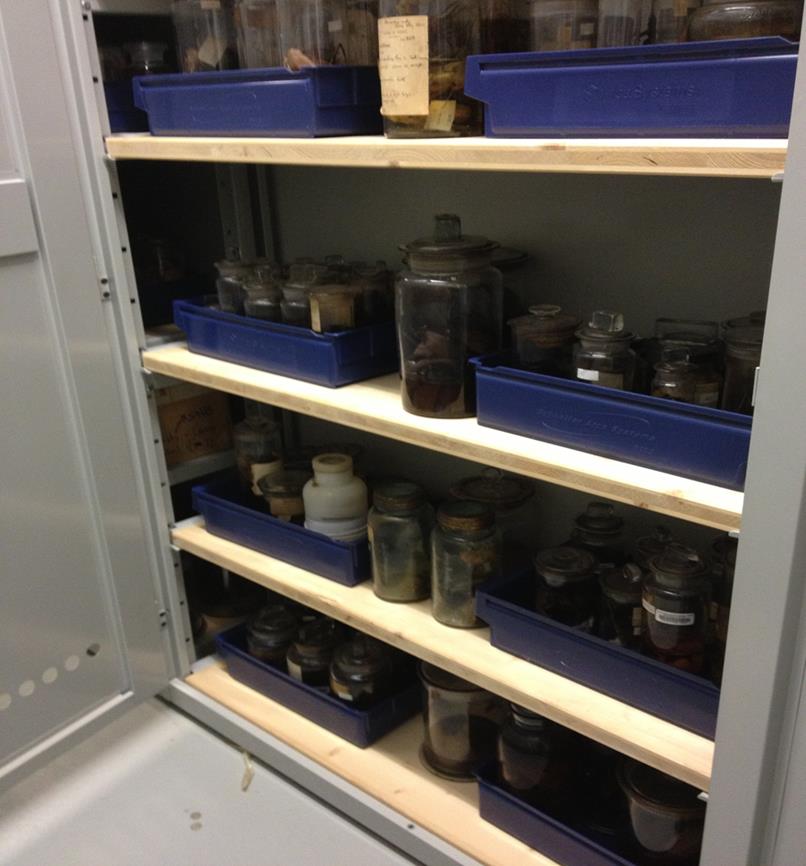
In continuation to this aim, a survey of flowering plants stored in spirit collections across various institutions in Europe was carried out in 2012 so as to assess what preservatives other institutions were using and what would be the best method to store the collections at NHM for posterity. The objective of this survey was to gather information on:
- How big the spirit collection is
- How the collection is used
- Which liquid preservatives the flowering plant collections are stored in




 NatSCA