NatSCA Digital Digest – August

Compiled by Ellie Clark, Collections Move Team Leader at the Natural History Museum

Welcome to the August edition of NatSCA Digital Digest.

A monthly blog series featuring the latest on where to go, what to see and do in the natural history sector including jobs, exhibitions, conferences, and training opportunities. We are keen to hear from you if you have any top tips and recommendations for our next Digest, please drop an email to blog@natsca.org.

Sector News

Registration is now open for the 13th European Bird Curators Meeting, October 2024, in Liverpool.

The European Bird Curators Meetings aim to promote cooperation, dissemination of best practices and new techniques in the curation, management, and use of bird collections. Presenters in the scientific programme often include curators, collection managers, museum historians and ornithological researchers. These are friendly meetings and anyone with an interest is welcome to join us.

The meeting will include plenary and submitted presentations, discussion sessions, collections tour, conference dinner (optional – Tuesday 29th October) and field excursion (optional – Thursday 31st October). 

Please follow the ‘Tickets available here’ link from the event webpage to register. They have single day registration options and have kept costs as low as possible to encourage attendance by local natural history curators. 

If you have any questions, please email vertebratezoology@liverpoolmuseums.org.uk.

Continue reading

Conserving Garden Plant Diversity

Written by Yvette Harvey, Keeper of the Herbarium, Royal Horticultural Society, RHS Garden Wisley.

We live at a period in time where we are very familiar with the concept of mass extinctions that are likely to be caused by human intervention (from burning of the rain-forests, hunting and desertification through to global warming). As the years/decades/centuries progress, our preserved plant and animal [by which I mean anything that moves] collections find themselves being useful tools to provide empirical evidence for the causes of the above, outside of their main purpose of pure taxonomy (Thiers 2020: 219-242).

Following the recent closure of Kew’s Red Listing department, conservation is a subject that readily springs to mind. With c. 390 million specimens contained within the World’s herbaria, information captured in specimen labels has ultimately provided the data for calculating the Area of Occupancy and Extent of Occurrence, both of which play a large part in assessing the IUCN (International Union for Conservation of Nature) Red listing of a plant.

I am lucky to work with a specialist herbarium collection – one that contains ornamental plants based at RHS Garden Wisley. Yes, highly unlikely to play a role in an IUCN assessment, but all the same, a dried ornamental plant collection does play a vital role in conservation. Whilst Plant Heritage aims to conserve living plants, a herbarium that specialises in ornamentals (cultivars) can preserve material of long lost or even recently lost garden plants.

Continue reading

Provenance, Provenance, Provenance

Written by Yvette Harvey, Keeper of the Herbarium, Royal Horticultural Society, RHS Garden Wisley, Surrey.

When all is quiet, the crowds have long-gone home and the lights have been dimmed, the back rooms come alive for the curators who have long finished their official hours. For it is the time for tracking down rogue specimens, delving into the past or anticipating the future. What I am trying to say is that it is the time for research and the inevitable Miss Marple style adventures to be discovered when finding details to add to the current knowledge of a historic specimen. I say current because invariably details will have been lost or not even deemed worthy to have been recorded on labels, or written in a language so obscure as to not be recognised by the modern eye.

Perhaps lost details are just a phenomenon of the botanical world, but I suspect not, and I will explain what I am alluding to above using just a couple of examples of specimens made by a single collector, John Forbes, who undertook a voyage from 1822 until his death in 1823, almost 200 years ago.

John Forbes was one of the Horticultural Society of London’s (now the Royal Horticultural Society) early plant collectors. Head-hunted from the Liverpool Botanical Garden for his horticultural skills, he was employed to travel to Southern Africa to bring back plants to introduce to British gardens. He sailed with Captain Owen on the HMS Leven, a voyage tasked with making a survey of the east coast of Africa, visiting (in the following order): Madeira, Tenerife, Santa Cruz, Cape Verde Islands, Brazil, South Africa, Mozambique (Forbes is noted as the second botanist to collect there (Exell & Hayes: 130)), Madagascar, Comoros, Mozambique, South Africa and finally Mozambique (where Forbes died, 16th August 1823).

Continue reading

Stories from Pressed Plant Books in the Botany Collections

Written by Katherine Slade, Curator: Botany (Lower Plants), Amgueddfa Cymru – National Museum Wales (AC-NMW)

This article was first published as a blog for AC-NMW, 17 May 2019.

Within Amgueddfa Cymru’s botany collections are books of dried plant specimens created by scientists and enthusiasts. Each specimen has been carefully dried and pressed, before being added to the books, sometimes with handwritten or printed notes alongside. The books are of enormous importance both in terms of modern scientific research into climate change and biodiversity, and as a way to see first hand the history of botanical exploration.

You can now look through a catalogue of the 36 books that contain non-flowering plants, fungi, lichens and seaweeds. You can read about a few of the stories surrounding these books below. For more detailed information about each book, please visit the website.

These books show the changes in how we collect, classify and name plants over two centuries from 1800 to present day. An old volume which probably dates from the 19th century entitled “New Zealand Mosses”, contains more than just mosses. Lichens, algae and even some pressed hydrozoans (tiny marine animals) have been included by the unknown collector who chose to group these superficially similar ‘moss-like’ specimens together. This donation entered the Museum’s collections after its Royal Charter was received and before work had begun on the present Cathays Park building.

Continue reading

“My Work Is What Will Survive”

Written by Mandeep Matharu, Yvette Harvey & Matthew Biggs.

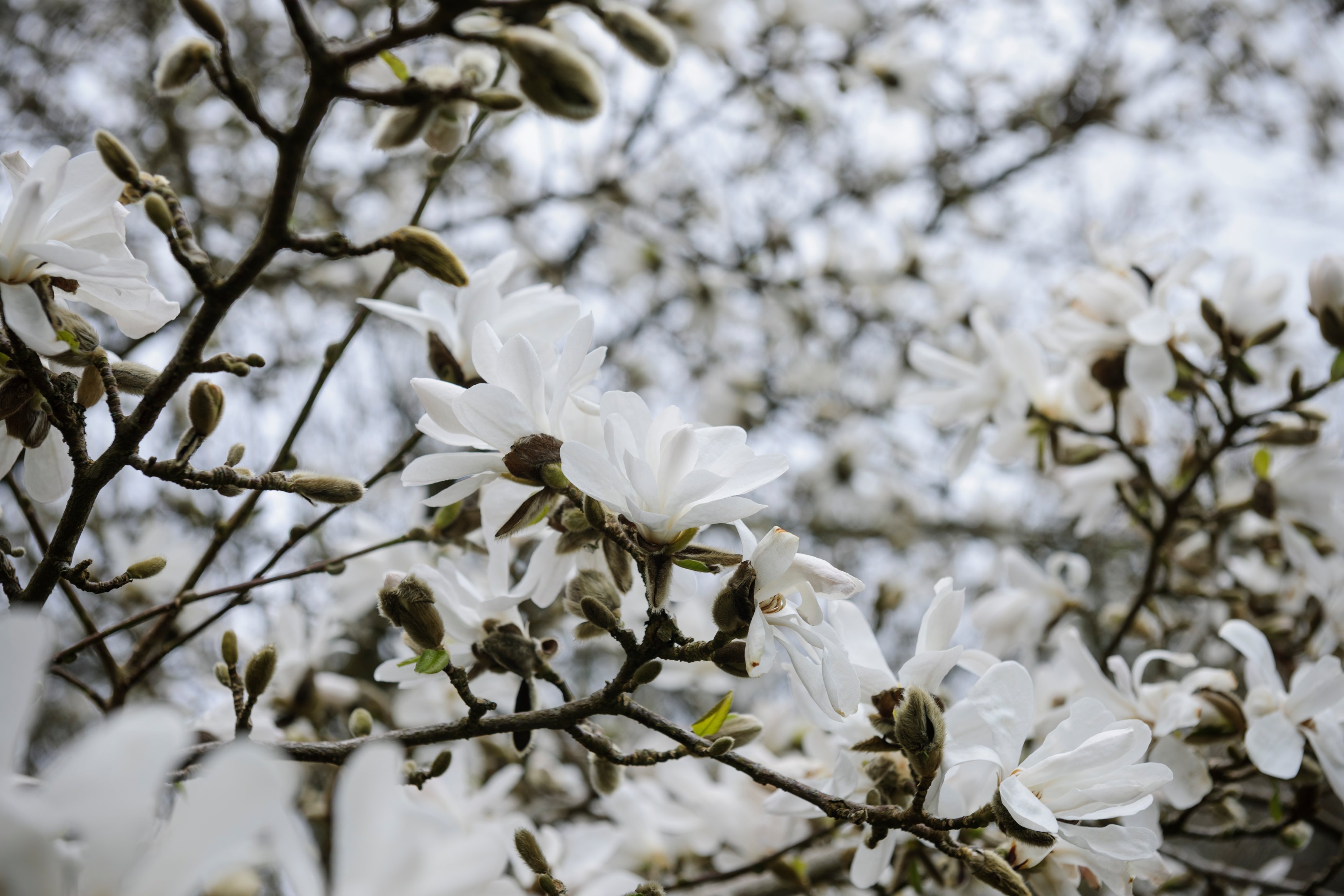
These were the words of one of the pioneering plant cytologists, E. K. Janaki Ammal, who worked at the Royal Horticultural Society (RHS) Garden Wisley from 1946-51, and was their first female scientist. She studied the chromosomes of a wide variety of plants from magnolias to eggplants and sugarcane in addition to medicinal plants, leaving numerous scientific papers, herbarium specimens, and a large number of small, round-headed Magnolia on Wisley’s Battleston hill (Gardiner, 2012), including one bearing the name M. kobus ‘Janaki Ammal’, a vigorous, multi-stemmed tree, over 6m tall and wide, producing masses of white flowers over several weeks of Spring (Biggs, 2018).

Although Janaki’s life is documented within a small number of articles about her and her work, very little has been reported about her years at the RHS and we attempt to rectify that here.

Magnolia kobus at the RHS ©RHS

Continue reading