Wild About Portsmouth – Discovering and Uncovering a Little Known Natural History Collection

Written by Christine Taylor, Curator of Natural History, Portsmouth Museums

Wild about Portsmouth is a two-year Heritage Lottery Funded project to share and raise the profile of the city’s natural history collections.  In addition to enabling visitors to get more hands on with the collections through events and activities, work is being carried out to make them more accessible for museum staff and researchers.

Challenges

The collections are held at three sites across the city and housed in environmentally controlled stores with many specimens held in archival quality boxes. However, the absence of a natural history curator for over 10 years has led to a series of challenges with accessing them:

Little Knowledge of Collections

Apart from the sizeable and substantial HLF Guermonprez Collection transferred from Bognor Regis Museum in the 1970s, very little was known about the collectors associated with the remainder of the natural history collections. In-depth knowledge of the HLF Guermonprez Collection has also been lost over time, although it is occasionally cited in publications by Sussex naturalists.

Continue reading

Neither a Borrower Nor a Lender Be?

An exceptionally fragile Blaschka glass model of a radiolarian in Dublin.

An exceptionally fragile Blaschka glass model of a radiolarian in Dublin – would you lend it?

In museums, collections are key. They are the resource that we rely on to drive our exhibitions, research, outreach, educational activities and even our marketing. We use this resource sustainably, ensuring it will be available for future generations. Our policies and standards protect them, keeping them safe by providing an appropriate environment and managing access – and while this is not always easy, at least we have control. Continue reading

Do you want to train to be Natural Science Curator?

Heritage Lottery Fund ‘Skills for the Future’

Natural History & Social History Training Opportunities

Support from the Heritage Lottery Fund ‘Skills for the Future’ programme and Natural Sciences Collections Association (NatSCA) has created opportunities for four individuals to train in curatorial skills with a partnership of regional museums and heritage sites.

We are looking for people who are passionate and enthusiastic about Natural History/Sciences or Social History. These traineeships are available to anyone who might not have qualifications in the subject area, or are not from museum background, or are wanting a career change.

  • ·         One Natural History traineeship based at The Manchester Museum The University of Manchester
  • ·         One Natural History traineeship based at Leeds Museum Discovery Centre
  • ·         One Natural Science  traineeship based at Thinktank Science Museum, Birmingham Museum Trust
  • ·         One Social History traineeship based at The Herbert Art Gallery & Museum, Coventry

Full information and application forms can be found within the job packs

Please follow link   www.bmag.org.uk/about/vacancies

Closing date is: 20 March 2013 at 10.00 AM   Proposed dates for interviews: W/C 14 April 2014
If you have any enquiries about these traineeship opportunities, please contact Paulette Francis-Green Project Manager by email projmangctrainee@aol.co.uk

Bill Pettit Memorial Project – Conservation of historic Taxidermy

Ann Ainsworth (Colchester and Ipswich Museums)

Hannah Clarke (Freelance Conservator)

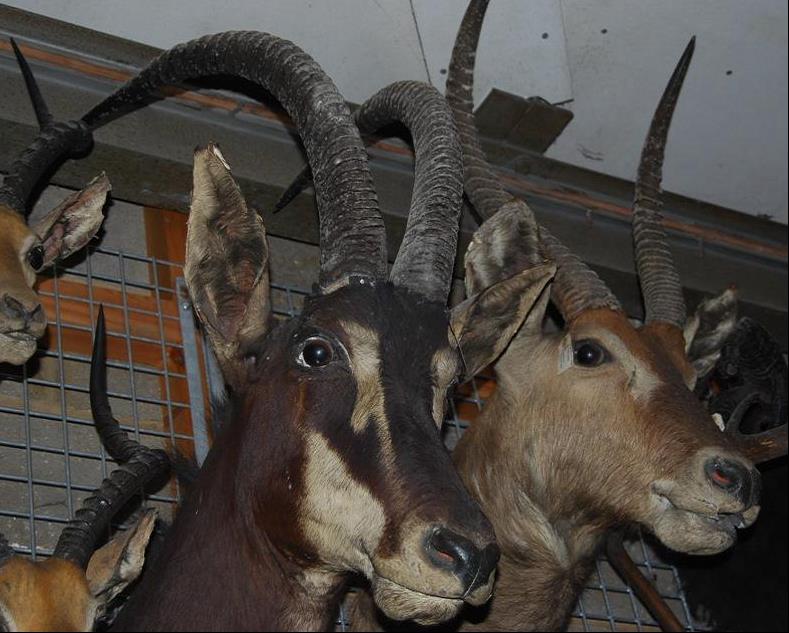
Ipswich Museum has an important historic collection which dates back to its opening in 1847. A recognised strength of the natural history collection is the historically important Victorian and Edwardian taxidermy of animals from across the globe.

The taxidermy collection is stored in an old building which used to be an old coach depot and later a garage. The space had become very dusty and dirty and a significant mould problem had developed.
one

We followed a very simple methodology of light dusting with soft brushes using a vacuum containing a HEPA filter. This was followed by swabbing with an alcohol/water solution to remove the mould and kill the spores. Where possible specimens were covered or wrapped in polythene to act as a protective cover to protect from dust, provide an external surface for mould to grow on, and to prevent pest damage which is also a potential problem within the stores.
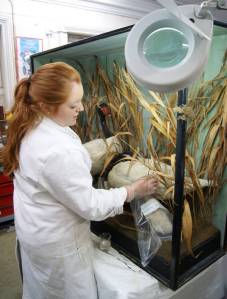
two

The variety of conservation problems, meant that many different treatment processes needed to be used by Hannah. Some of the processes included dry cleaning, wet cleaning, re-adhering, colour matching, re-inserting feathers, removing old varnish with solvents, mitring, sealing with brown gum tape, and applying and buffing wax. New panels of glass and sections of beading had to be sourced and cut to size.

The top panel of the pike case had warped and bowed, as the glass side panels had been broken previously. There were no structural supports on the front inside edges of the case either, meaning that the top of the case was unsupported from the front. The existing beadings on the rear inside edges were not secure, and the metal tacks used to hold the mitred sections of wood in place were very loose. New beading was sourced to match as close to the original as possible and was then colour matched and held in place using new tacks.

Cygnet before conservation

Cygnet before conservation

Cygnet after conservation

Cygnet after conservation

The Bill Pettit Memorial funding went towards payment for the freelance Conservator in terms of time and travel expenses and the purchase of replacement glass and beading for the cases where broken or damaged.

It was agreed that conserved cases would not be returned to store until the planned repair work had been successfully completed. As many of the conserved cases as possible were put on public display in the museum galleries. This has enabled part of the collection not normally seen by visitors to be on display. It has also helped to present a strong message of the Museum Services’ wish to improve the condition of specimens and its storage facilities and helped to raise the profile of the project.

Spicer platypus case after conservation

Spicer platypus case after conservation


Natural history under the hammer

Reblogged from UCL Museums & Collections Blog

Natural history under the hammer

By Mark Carnall, on 4 December 2013

Recently there have been a spate of high profile auctions of natural history specimens raising many issues about ownership, the value we should or shouldn’t put on natural history and the relationship between professional scientists, museums, amateurs and private collectors. My colleague Jack Ashby wrote about the recent dodo bones that were auctioned. Colleagues Dave Hone and Mark Graham give a balanced view of the recent sale of a Diplodocusskeleton over at the Guardian. The ‘duelling dinosaurs’ fossil was estimated to reach $9 million at auction in New York and last year the controversial proposed sale of an allegedly illicitly smuggled Tarbosaurus skeleton caused much debate.

I thought I’d add my thoughts on the subject here, in particular about the relationship between collectors, museums and ethics.

Lost to Science

One of the most common criticisms that comes from the scientific community is that these high profile and expensive auctions, way above the budgets that museums can afford, result in a loss to science when specimens pass into private collections. I don’t want to downplay that this is a real problem, I know of at least two examples of important material that would likely cause a re-evaluation of entire groups of organisms but which are resolutely in the hands of private collectors who won’t allow them to be accessed. However, other museums, particularly art collections, embrace and work with private collectors. The museums get to display important or interesting objects and the collectors receive credit and validation for the collections they have built up. Furthermore, the buying, selling and trading of artworks means that there’s an excellent paper trail in the form of auction and exhibition catalogues which means that the movement of works can be traced much more readily than natural history specimens which don’t have this tradition of a published, publicly accessible paper trail.

Private to Public

When it comes to natural history I think we’re too quick to demonise private collectors with the “loss to science” rhetoric. Many of today’s largest museums were founded as private collections that were donated to the nation including the Natural History Museum London, the Natural History Museum Tring and the British Museum. Of course the Tate galleries still bear the name of the man whose funds and collections seeded what is now considered one of the most important art collections in the world. Recently two George Stubbs paintings, the first Western depictions of Australian animals was ‘saved for the nation‘  by the National Maritime Museum (NMM). The works were finally secured by a significant donation from a shipping magnate and patron of the NMM. It would be interesting to consider if the paintings would have been saved in the same way if it were the Natural History Museum trying to secure the funds instead.  Natural history museums don’t receive anywhere near the same level or have such a long history of patronage supporting them as other kinds of museums. Often it’s assumed that buyers of multimillion pound specimens erect them in their mansions and display them as ‘trophy’ objects. That’s not to say that this doesn’t occur but I think it’s fair to assume that these buyers may have a keen interest and love of natural history. Perhaps talking to private collectors instead of instantly labelling them as a problem would improve the patronage and support of natural history museums and increase the awareness of ethical collecting and trading.

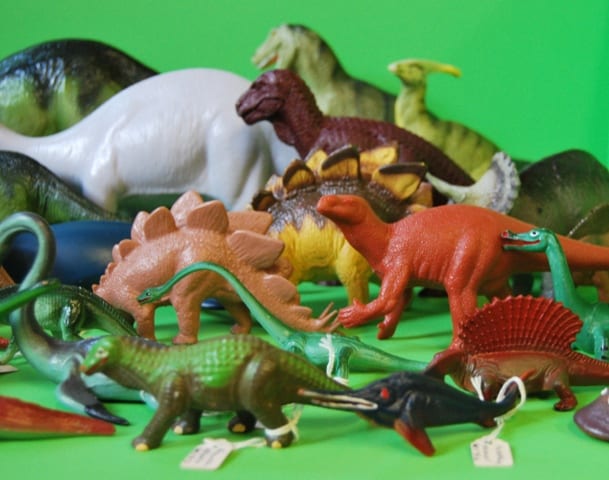
Grant Museum plastic dinosaur specimens

If relationships were improved there’s also the danger that scientific research on specimens could be used to increase the price tag of specimens as commercial assets. Say for example, if research on the recently sold Diplodocus skeleton revealed that it was the largest, rarest or the only example of a new species this increases the rarity and desirability of the object and pushes the price even further away from the reaches of public institutions. Conversely, research may devalue a specimen, yet another reason why private collectors may be wary of caliper bearing scientists examining their collections. It’s already ubiquitous across museums to never give a valuation on objects brought in for opinions or identifications to avoid certifying or authenticating material for sale. I’d recommend looking across the museum sector to seek guidance on how other museums deal with the issues of research affecting commodity prices.

Amateur vs. Professional

Lastly, working with private and amateur collectors can very realistically improve our knowledge about the natural world. Anecdotally, I’d say that there’s a deep mistrust of museums by amateur collectors (either those buying their collections or those collecting fossils and unfortunately extant animals from the wild). There’s the perception that once an object goes into a museum collection it’s essentially lost to the public, only accessible to card carrying scientists. With museums bursting at the seams with objects, only a tiny proportion of collections on display and visits to collections requiring managing it’s easy to see where this perception comes from. Again, looking to other museums provides guidance. The excellent, excellent Portable Antiquities Scheme is a solution to this exact problem in archaeology. There are thousands of amateur archaeologists, metal dectectorists and collectors and the portable antiquities scheme is an easy way to encourage the wider archaeological community to register finds. They are given full credit for the discoveries, there’s a prestige associated with contributing to the scheme and their finds and data are almost instantly available to the wider sector. Quite why a similar scheme for fossil finds doesn’t exist is increasingly perplexing especially as the legislation and policing of the movement of fossil material, as the aforementioned Tarbosaurus auction highlighted,  is nowhere near as robust as it is with artworks and archaeological material.

With museums brokering discussions with private collectors and auction houses we could better support patronage for museums, save important specimens for the public and improve our understanding of  palaeontology and biology.

Mark Carnall is the Curator of the Grant Museum of Zoology