Submitted by Clare Drinkell, Senior Curator Botanist at the Royal Botanic Gardens, Kew.
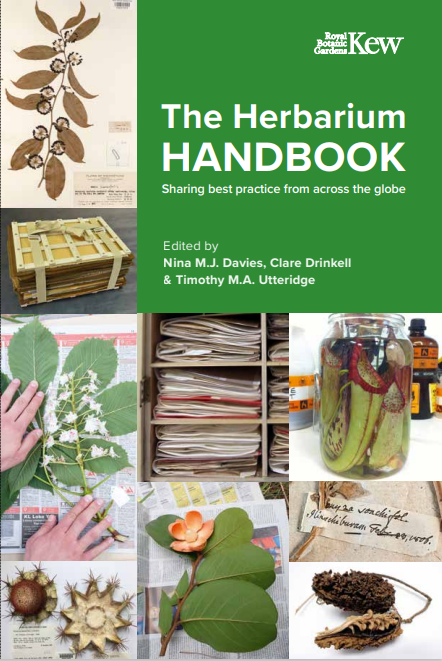
Editors: Nina Davies, Clare Drinkell, Timothy Utteridge. 290 pp, 234 x 156 mm. Over 700 colour photographs. Paperback, ISBN 9781842467695. Kew Publishing, TW9 3AE, UK 2023. £25.00. https://shop.kew.org/kew-herbarium-handbook
Cover page of The Herbarium Handbook
The new Herbarium Handbook is a key new addition to Kew Publishing’s series of handbooks, including The Plant Glossary and The Temperate Plant Families Identification Handbook. Unlike the other books in the series the Herbarium Handbook is a new version of a book first compiled and edited by Kew botanists some thirty-four years ago. The initial Herbarium Handbook came about following an extremely popular International Diploma Course in Herbarium Techniques at Kew. The demand to attend the course was so high that the number of applicants far exceeded places on the course. In view of the interest, the main information imparted during the course was published as a manual, widely recognised as an important reference for fundamental aspects of herbarium care and management.
To celebrate all of your wonderful contributions to the blog in 2023, here is a round up of the top ten most read blogs of the year. I want to take this opportunity to thank everyone who contributed an article. And what a bumper year it has been with articles covering decolonisation work, collections moves, exhibitions, workshops, collections research and management. The NatSCA blog is driven solely by your contributions and it is stands as a testament to the hard work you are all in doing despite challenging times.
I am pleased to say that the 2024 blog calendar is open for business, so drop me a line if you would like to contribute.
9. People and Plants Workshop Three: Sharing Knowledge in the Amazon. Written by Fiona Roberts (Collaborative ESRC PhD student, Cardiff University & Amgueddfa Cymru-National Museum Wales) and Violet Nicholls (Assistant Curator in Herbarium, Portsmouth Museums). The People & Plants workshops were an interesting series of training events focusing on decolonising collections. This article reviews the last of these events which addressed the question of how ethnobotanical collections in museums can best be used to support Indigenous communities.
Every year, 10th December is commemorated as International Human Rights Day, the date when the Universal Declaration of Human Rights was adopted by the members of the United Nations. This year is particularly momentous, as it is the 75th anniversary of the Declaration’s adoption. What has this got to do with museums? The original Declaration includes a number of commitments (set out in 30 Articles) that are obviously related to the work of museums: the right to education, the right to information and freedom of expression, the right to take part in public affairs, among others. Museums often focus on one (article 27) that gets summarized as being ‘the right to participate in cultural life’, but that isn’t it’s full or proper title or scope: more correctly, it is that “Everyone has the right freely to participate in the cultural life of the community, to enjoy the arts and to share in scientific advancement and its benefits.” Note especially the part about sharing in scientific advancement and its benefits: we will come back to this.
Now, the Universal Declaration is not perfect, it is 75 years old after all, and it reflected a world rather different than our world today. Hundreds of millions of people were still under colonial rule. The environment didn’t feature in the Declaration, as human impacts on the environment were not as massive, and not as obvious. Nevertheless, the Declaration has been supplemented by many additional agreements, many of which have a legal standing. However, the necessity of a decent quality environment has been recognized for decades. Indeed, it has been argued that most or possibly all of the 30 rights in the original Universal Declaration rely on a decent quality environment. Sustainable development really got going in the early 1970s, with the Stockholm Conference on the Human Environment, that recognized that people have a right to a decent quality environment. Fast forward 50 years, to 2022, and that right was finally formally recognized by the United Nations. More recently, the inherent rights of nature have been the subject of court cases and in some cases natural features have been granted rights, which helps protect them and to take polluters to court for environmental damage.
Subhadra Das and Miranda Lowe’s paper, Nature Read in Black and White: Decolonial Approaches to Natural History Collections (2018) acted as a wake-up call to our sector, effectively founding a discipline in natural history museums. In the five years since, a lot of work has begun to address the colonial legacies underpinning collections of animals, plants, fungi and rocks.[i] The principal aims of this work include telling more honest stories about the different kinds of injustice involved in the acquisition of collections; and addressing the fact that our museums have long been prioritising narratives elevating white individuals over everyone else. In doing so, it is hoped that a greater diversity of people will feel represented by our museums, thereby enhancing the relevance of the collections.
Natural history collections dwarf those of any other museum discipline, and unlike sectors which have been thinking about this for decades, the practices underpinning their creation have not traditionally prioritised recording associated cultural or social histories. Like others who felt inspired by Subhadra and Miranda’s call to action, faced with contemplating how to begin to unpick the stories hidden behind literally millions of ‘scientific’ specimens, it was fundamental to consider the question, where do you start with decolonial research in natural history museums? Obviously, there is no one answer, but I thought it could be helpful to list a few possible approaches. One underlying element is to recognise how colonialism and its framings have shaped the way that events took place – from major historical moments to minute individual acts – and how the stories about these events have been told.
Below is a list of possible starting points for research, with examples of what that could look like in practice (in reality most of these overlap). For me, each has something to say about the entwined human and environmental costs of the colonial project – questions that natural history museums are uniquely placed to address.
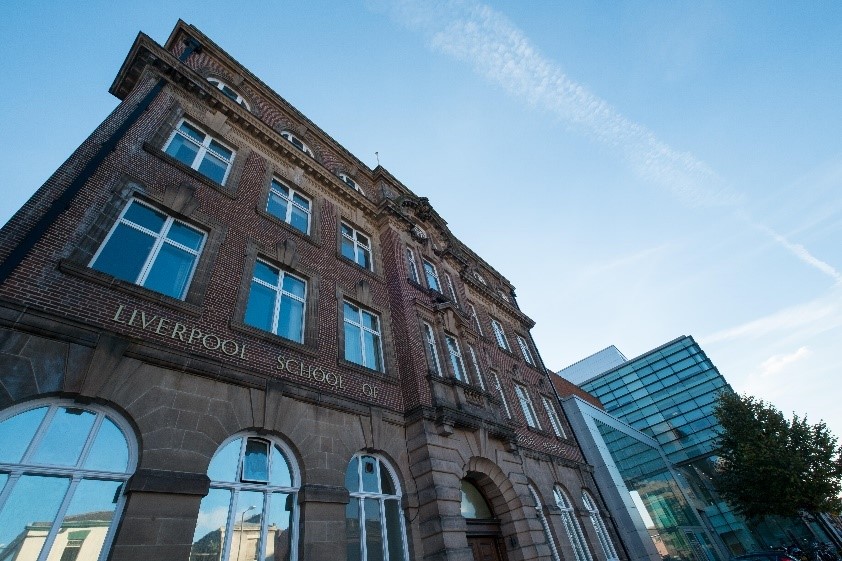
This year marks Liverpool School of Tropical Medicine’s 125th anniversary. The school was the first institute of its kind back in 1898, built to help investigate some of the tropical diseases brought back to the busy port city from shipping expeditions and trade. To celebrate such a major milestone an array of events and activities have been planned by the school, including outreach events and fundraising, whilst also giving us a chance to reflect on our history. One such planned scheme was the distribution of internal funds for exciting projects, proposed by staff members that would make a difference in this very special year.
The Dagnall Laboratory situated in the Mary Kingsley Building is the main teaching laboratory for the school. Within its walls it houses many historical pathological and entomological samples, from mosquito wings and blood films to seven-meter-long tapeworms. Throughout the years a selection of these samples has been used to help educate thousands of medical professionals, postgraduate students and armed forces personnel. However, a large part of the collection became forgotten and neglected as specimen preservation skills and staff were lost over time. With news of potential funding myself and the team saw an opportunity to rediscover these “lost” specimens and decided to put together a bid with the aim to reinvigorate our collection. The project not only aligned with the 125 Anniversary theme of Heritage and History but also looked forward to the future.






 NatSCA