CryoArks – Discover The UK’s First Zoological Biobank

Written by Andrew Kitchener, Principal Curator of Vertebrates, National Museums Scotland.

Many of us have probably been approached by eager PhD students and other researchers who want to snip a bit off those specimens or drill a few holes in others. As curators we start to feel somewhat uncomfortable about seeing our precious collections sliced and diced, and yet we are also keen to discover more about the genetic content of our specimens for their own sake. This is partly because collectively we can contribute to studies that benefit wild populations of species, including the conservation biology of many endangered species and the possibility of rewilding extirpated species. You may also have a chest freezer bursting with grip-seal bags or plastic tubes filled with tissue samples collected from specimens you have acquired, but you’ve no idea what to do with them, but you know they will be useful one day. Or maybe you have a freezer full of specimens you want to get rid of. CryoArks is a new initiative that just might help you to solve all these problems.

Sorting through lemur muscle samples at National Museums Scotland © National Museums Scotland

CryoArks is a BBSRC-funded project led by Professor Mike Bruford at Cardiff University, which has established the UK’s first comprehensive zoological biobank for research and conservation. CryoArks is a consortium of museums, zoos, academic institutions and biobanks, which is working together to establish common standards and working practices to store tissue and DNA samples and make them available on a common web portal, so that researchers and conservation biologists will be able to find out what is available for their research. This will help cut down on the sampling of our permanent collections by giving researchers something else to sink their scalpels into. CryoArks has two main sample storage hubs – at the Natural History Museum in London and at National Museums Scotland in Edinburgh – that currently house more than 65,000 samples, but we have room for almost a quarter of a million. The Royal Zoological Society of Scotland is also a joint CryoArks and European Association of Zoos and Aquaria biobank storage hub, bringing the zoo and non-zoo biobank communities together.

Continue reading

‘Tahemaa Transformed’ The Conservation of the Mummy Coffin at The Bournemouth Natural Science Society.

Written by Bethany Palumbo, ACR, Founder and Owner of Palumbo Conservation Services on behalf of the Bournemouth Natural Science Society.

Tahemaa has been a resident of the Bournemouth Natural Science Society since 1922, when she was donated from the Salisbury museum (fig. 1). New research indicates that she arrived in the UK in 1823 from the ancient city of Thebes, now known as Luxor, on the river Nile. Her coffin is dated from 700 BC making her approximately 2700 years old. We know from the hieroglyphics on the side of her coffin that she was the daughter of a Hor a high priest of Montu, the Flacon-God of War. Other than this we know very little about her and her life in Egypt.

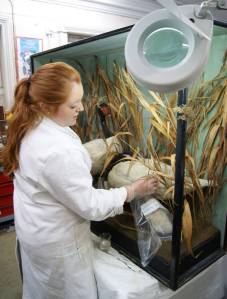
Figure 1. Tahemaa the Mummy at the Bournemouth Natural Science Society.

Tahemaa has been at the Society for nearly 100 years but she has spent most of this time locked away from public view. In 1993, the Society decided to put her on permanent display in the Egyptology exhibition. Since then she has been seen by thousands of admirers, however due to her age and fragile condition, she is in need of urgent conservation treatment. Hundreds of years in an unstable environment have caused significant damage to the coffin. The fluctuations have caused the wood, plaster layers and paint to crack and flake. The layers of the coffin have even separated in some areas, lifting away from the wooden frame (fig 2). Many years without a display case has also resulted in a thick layer of dark, engrained dirt concealing the original colours of her decorative paintwork (fig 3).

Figure 2. Layers of the coffin structure peeling away.

Figure 3. Original colours are darkened with the build-up of surface dirt.

Continue reading

Frequently Asked Questions in Taxidermy

Written by Ella Berry (also available here), amateur taxidermist & MSc Conservation Practice student, Cardiff University. An extended version of this blog was published here on 12 March 2020.

In March of this year I helped out on the Conservation stand at an evening event as part of my role as Volunteer Intern at National Museum Cardiff. It was a fun event, with a turnout of 852 curious visitors. Art conservators and natural history conservators collaborated to show how natural history specimens could inform and create imagery and art.

Photo of me (left) talking to guests at the National Museum Cardiff ‘After Dark’ event alongside Vertebrate Curator Jennifer Gallichan (centre) and local artist Nichola Hope (right) drawing. Photo courtesy of Caitlin Jenkins.

Throughout the event both children and adults came up and asked a lot of questions about the objects, and I noticed some reoccurring queries, especially around the ethics of taxidermy. I have attempted to answer some of these here, so that if anyone else reading this faces the same conundrums, this article will set their mind at ease, or enable them to answer the questions confidently.

Is it ‘ethical’?

‘Ethical’ is a subjective term, therefore what is considered ethical varies between taxidermists. Whether the preservation of animal remains, without the inherently unobtainable consent of the animal, is in itself ethical is up to each individual to decide. ‘Ethical-taxidermy’ has become a more frequently used term generally referring to the animal not being killed specifically for the purpose of becoming a mount. However, this refers to a wide range of sources and can range from accidental deaths such as finding an animal dead or road kill, right through to by-products of culling, pet food supply animals and pest control salvages.

Continue reading

Wild about Portsmouth – Life in Lockdown

Written by Christine Taylor (Curator of Natural History), Bradley Foster (Natural History Collections Assistant), Portsmouth Museums.

Until lockdown, the Wild about Portsmouth project, funded by the National Lottery Heritage Fund, had been a whirlwind of activity, working with volunteers to re-house, reorganise and catalogue the natural history collections, developing school sessions, putting on and attending events as well as setting up displays.

In the four weeks prior to lockdown, the curator, volunteers and the newly appointed (14 February 2020) Natural History Collections Assistant installed an exhibition, ‘D is for Dodo, E is for Extinct’; attended a work placement fair at the University of Portsmouth, a family fun day at Dinosaur Isle, a STEM fair and the HBIC Hampshire Recorders Forum. We also created a Pop-Up Museum one-day event and ran a trial school session on rocks and fossils at Cumberland House Natural History Museum.

One of the online activities created for Cumberland House Natural History Museum website © Portsmouth Museum

Continue reading

What Is That Spiny Thing?

Written by Ranee Om Prakash, Senior Curator – General Herbarium IV, Algae, Fungi and Plants Division, Department of Life Sciences, Natural History Museum

The Natural History Museum (NHM) holds over 80 million specimens and every single specimen tells a story.

Amongst these 80 million objects, one such object is a specimen (Fig. 1) that the museum acquired from Mexico over 2 decades ago. This object excites curiosity amongst novices, students and the general public alike. Whenever anyone looks at this, the first thing they ask is what is that? A pineapple? A furry cat? Is it a sponge? The imaginations are limitless….

Fig. 1. Flower of Melocactus (© The Trustees, Natural History Museum, London)

Continue reading