Borderless Collections – Starting a Collections Community (R)evolution

by Deborah Paul (iDigBio) and Isla Gladstone (Senior Curator of Natural Sciences, Bristol Culture)

The heroes. Our natural sciences collections, collections staff, the planet and all the players worldwide (thanks Shakespeare).

Some of the heroes’ dilemmas. Need for online access to collection specimen data for research, dwindling habitat, damaged planet resources, one-of-a-kind objects, minimal staff, need for financial support and expertise, and an urgent need to reach and engage a broader audience if we are to succeed in addressing these dilemmas. Some actors know their roles, others don’t even know they are part of the story.

With support from the John Ellerman Foundation for the South West Area Natural Sciences collections (SWANS) project, Bristol City Council’s Culture Team (based at Bristol Museum & Art Gallery), the Natural History Museum (UK), and iDigBio, jointly created two workshops. Both of these events serve as part of a coordinated effort to envision and create a robust UK regional digital natural sciences collections program that supports research, engagement and skills, and connects directly to local, national, and international programs now and in the future. The vision includes plans to repeat the second workshop across the UK.

Materials. All materials and talks can be found on the respective workshop wikis: UK Strategy and SWANS Practical Digitisation.

Continue reading

When Museums Get it Wrong – Did We Accidentally Accession Someone’s Holiday Booze?

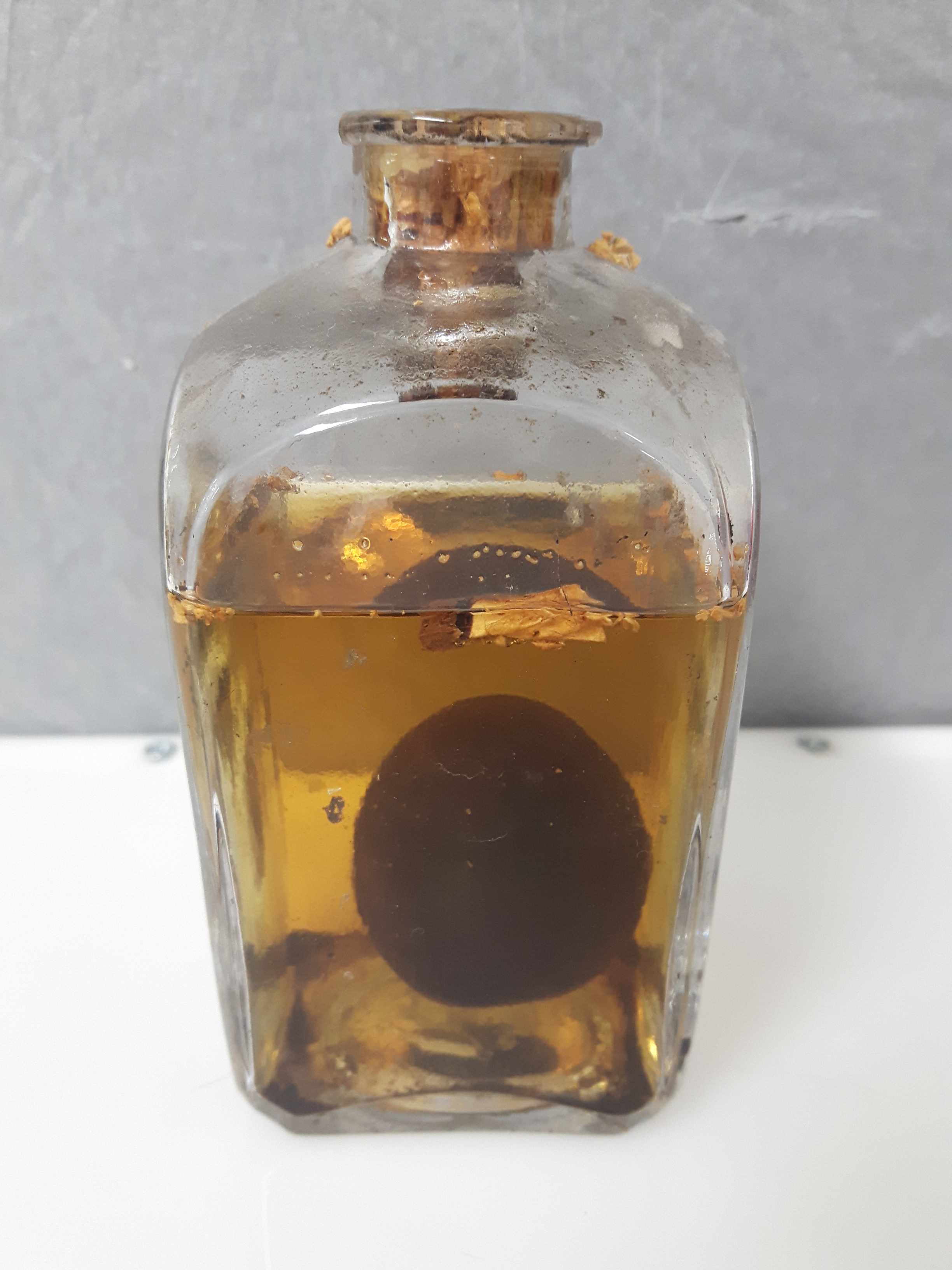
I have a strong suspicion that an object that is now in our collection at the Grant Museum was in fact a souvenir bottle of plum brandy. How could such a thing happen?

The mystery specimen in its original fluid before conservation. Is it in fact a bottle of plum brandy that a researcher bought as a souvenir? (C) UCL Grant Museum of Zoology.

My former colleagues Mark Carnall and Emma-Louise Nicholls first brought this “specimen” to my attention in 2011, when they found it in our wet specimen store: an unmarked bottle of clear brown liquid containing a near-spherical object with a cork stopper in its narrow neck. Mark wrote a blog at the time working through the process of elimination of all the spherical objects that might belong in a zoological collection such as ours. While others had assumed it was a testis, Mark and Emma decided that it was in fact a plum – not zoological at all. Aside from its identity, the other question was: how did a 25mm sphere get in a bottle with a 10mm neck?

Continue reading

Willows in the Wind: Digitisation of the Tullie House Herbarium

Excited (botanical) chatter, the inexorable flashing of camera equipment, intrigued visitors gathering around our new gallery space; this was our Virtual Flora of Tullie Herbarium Project, funded by the Bill Pettit Memorial Award at the start of 2017.

The scope of the project, between 30th of May to 26th of September 2017, was to use a team of volunteers to begin photographing and cataloguing our (“ex”) University of Lancaster herbarium. This significant acquisition of 35,000 vascular plant sheets is a highly data rich and well-provenanced collection with invaluable information on the historical and contemporary distribution of species across the UK and beyond. Almost a third of the specimens were collected from Cumbria, much of it collected during a major 30 year survey of the flora of Cumbria; an exemplar model of field surveying which is aspired to by Botanical Society of Britain and Ireland (BSBI) recorders today. The survey work culminated in the team leader’s (Geoffrey Halliday) highly comprehensive publication of A Flora of Cumbria. No other herbarium has a comparable recent (1968+) collection of Cumbrian material.  But despite the importance of this recent acquisition, none of these specimens were digitised.

Thanks to the Bill Pettit Memorial Award funding this was all about to change.

Continue reading

Meet the Committee – Isla Gladstone

What is your role on the NatSCA Committee?

I help promote information sharing and collaboration between NatSCA and closely allied subject specialist network the Geological Curators’ Group. These groups share core aims and, increasingly with loss of specialist curatorial posts, a membership. It’s exciting to explore how we can capitalise their individual strengths for the benefit of natural sciences collections and the people who work with them. 

Job title and institution

Senior Curator (Natural Sciences), Bristol Museum & Art Gallery, Bristol Culture

Twitter username

@isla_gladstone

Tell us about your day job

I work with a small team (Biology Curator Rhian Rowson and Geology Curator Deborah Hutchinson) to curate over one million natural sciences specimens of all shapes and sizes. As many a curator will recognise, this varies from high level strategic work to lifting, shifting, labelling and cleaning – a medley of activities to enable diverse access to and preserve these astonishing collections.

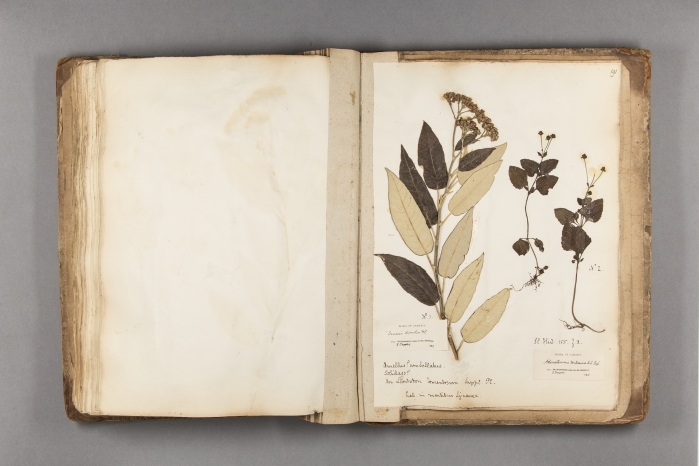
Medicinal plant on a page from Bristol’s earliest natural sciences collection – the Broughton herbarium, Bristol & Jamaica, 1779-90. (C) Bristol Culture.

Continue reading

How a Hundred and Fifty-Year-Old Botany Collection Can Help Modern Science

This article has been re-posted from the Horniman Museum and Gardens blog.

Katie Ott, a museum studies student on placement with the Horniman, tells us about her fascinating work with our botany collection.

I’m Katie, and I’m three weeks into an eight-week work placement at the Horniman, helping the Natural History team to research and document the botany collection.

The botany collection at the Horniman is made up of around 3000 individual specimens either mounted onto herbarium sheets or bound in volumes. The flowering plant collection dates mainly from 1830-1850.

Two herbarium sheets from Flora Britannica no. 4., Katie Ott

Two herbarium sheets from Flora Britannica no. 4., Katie Ott

The main task is to transcribe the (beautiful, but squiggly) Victorian handwriting on the herbarium sheets such as the plant’s scientific name, and where it was found etc onto MimsyXG, our collections management database.

Continue reading