Stepping Into The Genomics Age: A DNA Bank at World Museum, National Museums Liverpool.

By John-James Wilson, Curator of Vertebrate Zoology, World Museum, National Museums Liverpool.

From World Museum’s founding collection of study skins and taxidermy mounts bequeathed by the 13th Earl of Derby to the spirit-preserved amphibians collected by curator Malcolm Largen in the 1980s, World Museum’s Vertebrate Zoology collection has continued to expand and reflect the state-of-the-art in specimen preparation and storage.

As ethics around the sacrifice of animals for science have modernised, ‘traditional’ specimen types are no longer being prepared at the same rates, and growth of the collection has slowed abruptly. At the same time usage of the collection has diversified, including increases in requests for destructive sampling. In particular, the removal of small tissue samples, usually bird toe pad scrapes, is regularly requested for use in DNA extraction which produces a ‘pure’ DNA extract that can be used in a number of genomic investigations.

Continue reading

Extinct – A New Exhibition At The Manx Museum

Written by Laura McCoy, Curator of Natural History for Manx National Heritage.

Wednesday the 8th September saw the opening of the new temporary exhibition ‘Extinct’ at the Manx Museum on the Isle of Man, in partnership with Manx Wildlife Trust, which also coincided with the launch of the Red Data bird list published by Manx BirdLife. There are many species that have become locally extinct on the Isle of Man, particularly birds and plants, and this trend is not slowing down, with the Yellowhammer, once one of our most ubiquitous farmland birds, disappearing from our Island only in 2019. Some may ask how these absences impact our day-to-day lives, why this matters, but as we are becoming increasingly aware, the complexity and variety of our environment is what sustains us; if you knock out enough of the bricks the wall will come tumbling down. These disappearances are symptomatic of a grave state of affairs and islands are particularly sensitive to changes in management and climate. The more protected and supported our environment is, the better it is able to withstand and buffer us from the global shifts that are to come.

When Manx Wildlife Trust came to Manx National Heritage with the idea of this exhibition we were fully on board; learning about these stories of the Isle of Man’s countryside has been a journey, sometimes an upsetting one, but it has also been a call to arms. I had no idea that currently 29% of our current resident bird species, never mind the ones that are already gone, are red listed, and 41% are amber. An estimated forty five species of plant are extinct, seventy seven are red listed. We are still trying to compile what invertebrates and fungi we have, never mind assess what has been lost. 

Continue reading

Databasing Herbarium Specimens and Ease of Use.

Written by Teagan Reinert1* and Karen L. Bacon1

1 Botany & Plant Sciences, School of Natural Sciences, National University of Ireland, Galway; * corresponding author email: t.reinert1@nuigalway.ie

One of the main aims of creating online databases of herbarium images (or any data set) is to increase the ease of access for researchers, educators, and other users who may want to obtain data from the specimens without having to physically travel to an herbarium. Online herbarium databases have become particularly useful during the global COVID-19 pandemic, when many herbaria are not allowing or greatly reducing the amount of in-person visitation.

For many herbaria, online databases are still being constructed and ease of access and use can vary significantly between collections. Additionally, while a database may list a certain number of specimens held by the herbarium, it can often be the case that only a subset of these specimens are actually imaged and available to view online. Some herbarium databases are better than others in actually allowing the user to narrow down their search to get the data they are looking for. The databases range in ease of use from ‘very easy’ to ‘usable but frustrating’. Any databases that are too difficult to use often dissuade researchers from using the digital resources available on that database.

Continue reading

Book Review: Managing Natural Science Collections

Written by Jan Freedman, Curator of Natural History, The Box, Plymouth.

Working with natural science collections is quite a unique role. The specimens we care for, the stories they tell, the research we carry out or help facilitate, and the engagement with the public, are just a few rewarding jobs that we carry out daily. Sometimes there are barriers between those working with natural science collections and those at a higher management level. This is mainly due to a lack of understanding of the importance of these types of collections. “Why are there so many flies?“, “It’s just taxidermy, bring it out for people to stroke“, “It’s just a rock”. Just a few of things many of us have heard being said about natural science collections.

Whilst we can respond to these kinds of comments, some of us may find it more difficult to respond in a strategic way: in a language that makes sense to high level managers or funders. I have in the past, and I’ve found that frustrating, because I know the importance of the collections I look after. I was very pleased to be asked to review a new book about management of collections, focusing on strategy and development, Managing Natural Science Collections: A guide to strategy, planning and resourcing which was released this year and it couldn’t have come at a better time. A time when the country is recovering from an economic slump after the Covid pandemic. A time when cuts to the museum sector are inevitable.

Continue reading

Behind The Heads: Natural History, Empire and The Abel Chapman Collection. Part 2.

Written by Dan Gordon, Keeper of Biology, The Great North Museum: Hancock.

Abel Chapman’s time in southern Africa was only the first of many visits to the continent. His next trip, in 1904, was to a very different place – British East Africa. This was a colonial protectorate roughly equivalent to today’s Republic of Kenya. It had grown out of land leased by the British East Africa Company but was now firmly under British imperial control.

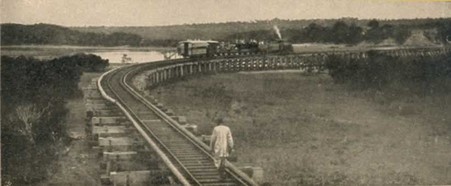
The Uganda railway, a huge feat of engineering, had been completed just three years before Chapman’s visit. This now allowed trains to travel the 800km (500 miles) between Mombasa on the east coast and the African Great Lakes. The British now had the means to extend their influence right across East Africa, disrupting the slave routes and simultaneously opening up the land to the missionaries, settlers, tourists and game hunters that were now pouring in. It was in this rapidly changing environment that Chapman strove to find the longed for wilderness that had eluded him in Transvaal, and test his skills as a sportsman, before that land too vanished under the settler’s plough.

Figure 1. An undated photo of the Uganda Railway near Mombasa (http:/www.jaduland.de, Public domain via Wikimedia Commons)
Continue reading