When Museums Get it Wrong – Did We Accidentally Accession Someone’s Holiday Booze?

I have a strong suspicion that an object that is now in our collection at the Grant Museum was in fact a souvenir bottle of plum brandy. How could such a thing happen?
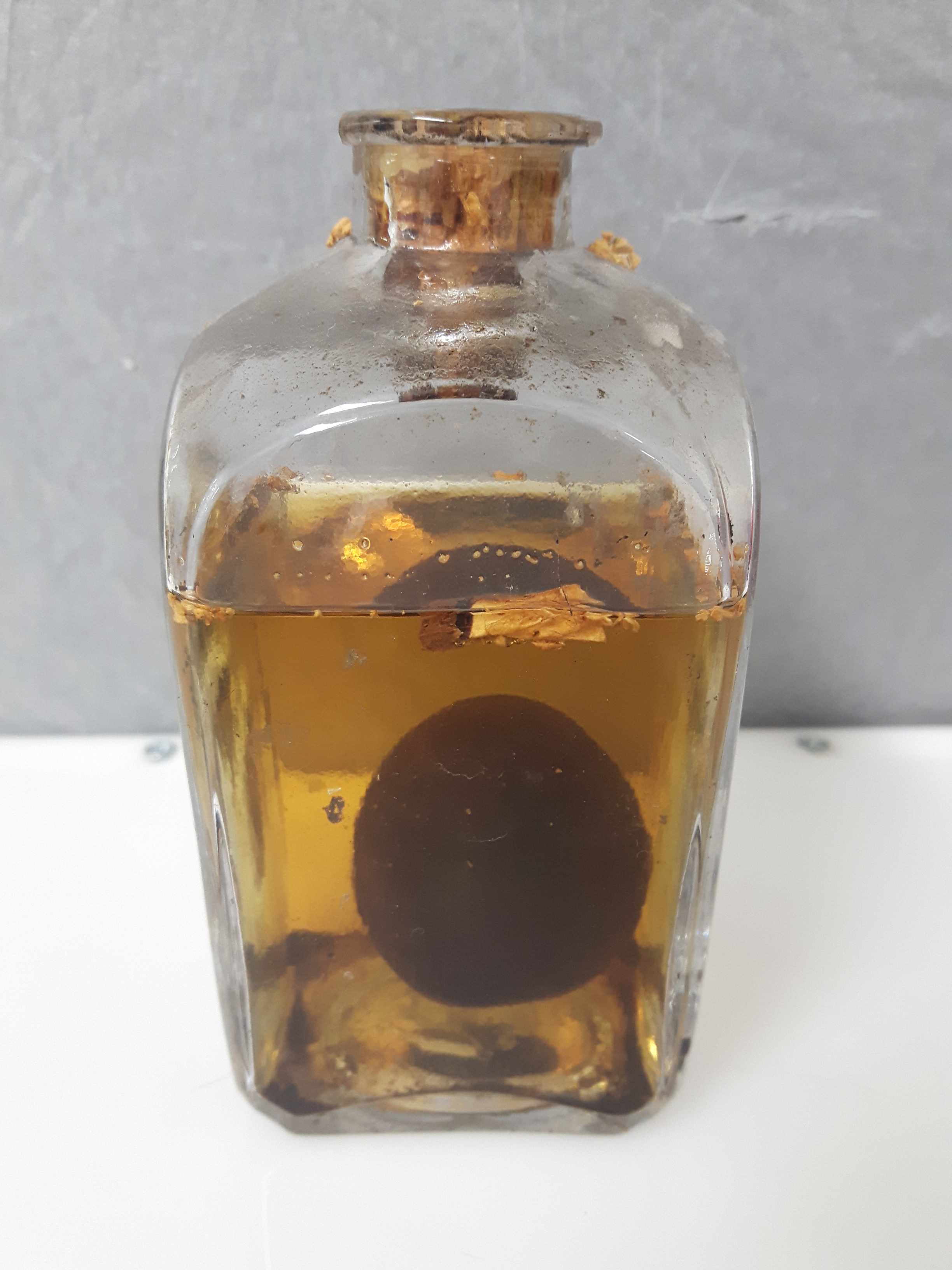
The mystery specimen in its original fluid before conservation. Is it in fact a bottle of plum brandy that a researcher bought as a souvenir? (C) UCL Grant Museum of Zoology.

My former colleagues Mark Carnall and Emma-Louise Nicholls first brought this “specimen” to my attention in 2011, when they found it in our wet specimen store: an unmarked bottle of clear brown liquid containing a near-spherical object with a cork stopper in its narrow neck. Mark wrote a blog at the time working through the process of elimination of all the spherical objects that might belong in a zoological collection such as ours. While others had assumed it was a testis, Mark and Emma decided that it was in fact a plum – not zoological at all. Aside from its identity, the other question was: how did a 25mm sphere get in a bottle with a 10mm neck?

Continue reading

NatSCA Digital Digest – March

What Should I Read?

As part of the International Year of the Reef (that’s this year, in case you hadn’t crossed paths with it yet) the Horniman Museum and Gardens is releasing a series of blogs that showcase and celebrate research taking place around the globe on coral reef conservation. There have been three installments so far, with the latest one here.  FYI- the images in this blog series are STUNNING! The hashtag for Internal Year of the Reef is #IYOR2018.

It’s that wonderful day of the year again when men all over the world realise it’s International Women’s Day and subsequently Google ‘When is International Men’s Day?’. To celebrate the day, the Natural History Museum has published an article- The women watching over London’s natural history collections, to demonstrate the diversity of roles of their wonderful staff, covering 11 fabulous women in conservation, curation, and research.

A new website has been launched in support of museum professionals called Museum Wellness Network; ‘A network for museum professionals to connect over mental health and well being’. As every human on the planet has a state of mental health, anything that aims to improve its quality in others definitely gets my vote. They are also on Twitter should you wish to give them a follow and see what they’re up to.

Continue reading

Taxidermy Koala – The Language of Natural History

This article has been re-posted from the Grant Museum of Zoology blog, with permission of the author Jack Ashby.

With generic terms like mankind and Homo sapiens (“wise man”), people of all genders are well aware that it is the masculine that has dominated the vocabulary of humanity. Not so in the animal kingdom.

Across UCL Culture we are celebrating the centenary of some women first getting the vote in the UK in a number of different ways. In the run up to International Women’s Day, here on the blog our Specimens of the Week will be exploring themes like women in natural history, female specimens, and – in this case – the language of natural history. This week’s Specimen of the Week is…

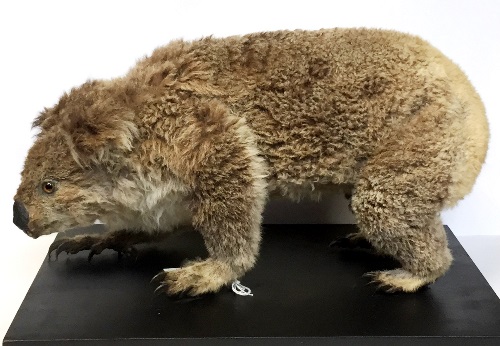
Koalas are one of many Australian mammals that are named after a characteristic that only females have. Their scientific name Phascolarctos means “pouched bear”. LDUCZ-Z65. (C) UCL Grant Museum of Zoology

***The Taxidermy Koala***

I find it interesting to think about animals that are named after features that only one sex has. How would you feel if your species was defined by a characteristic that you yourself didn’t possess?* My own passion is the mammals of Australia. Unlike many other groups (for example there are entire groups of insects that can only be identified by studying male genitalia), for those animals which are named for sex-specific features, Australian mammals are almost** universally named after things that only appear in females.

Continue reading