4th MOBILISE Training School: “Next Step in the Digitisation Process of Natural History collections: Publishing of Biological, Geological, Palaeontological and Mineralogical data”.

Written by Olivia Beavers, Assistant Curator of Vertebrate Zoology at World Museum, National Museums Liverpool.

In December I was selected, along with 17 others, to attend the 4th MOBILISE Action Training School held in Brussels, 6–7th February. This training school gave an opportunity for students and professionals of Natural History Institutions from Europe and Israel to learn more about the publishing of our collections’ data sets. A crucial aim of the training school was to learn how to map data to the Darwin Core Standard, and as a result, create a Darwin Core Archive file to be uploaded to GBIF.

The Training School consisted of two parts: the first was an introduction to the group. This was conducted online and addressed theoretical issues associated with our datasets. Part 2 was the two-day, face to face trip to Brussels to check the cleaning and validation of our data for it to be ready for publishing on GBIF (for Biological Data) or GeoCASe (for Geological, Palaeontological and/or Mineralogical data).
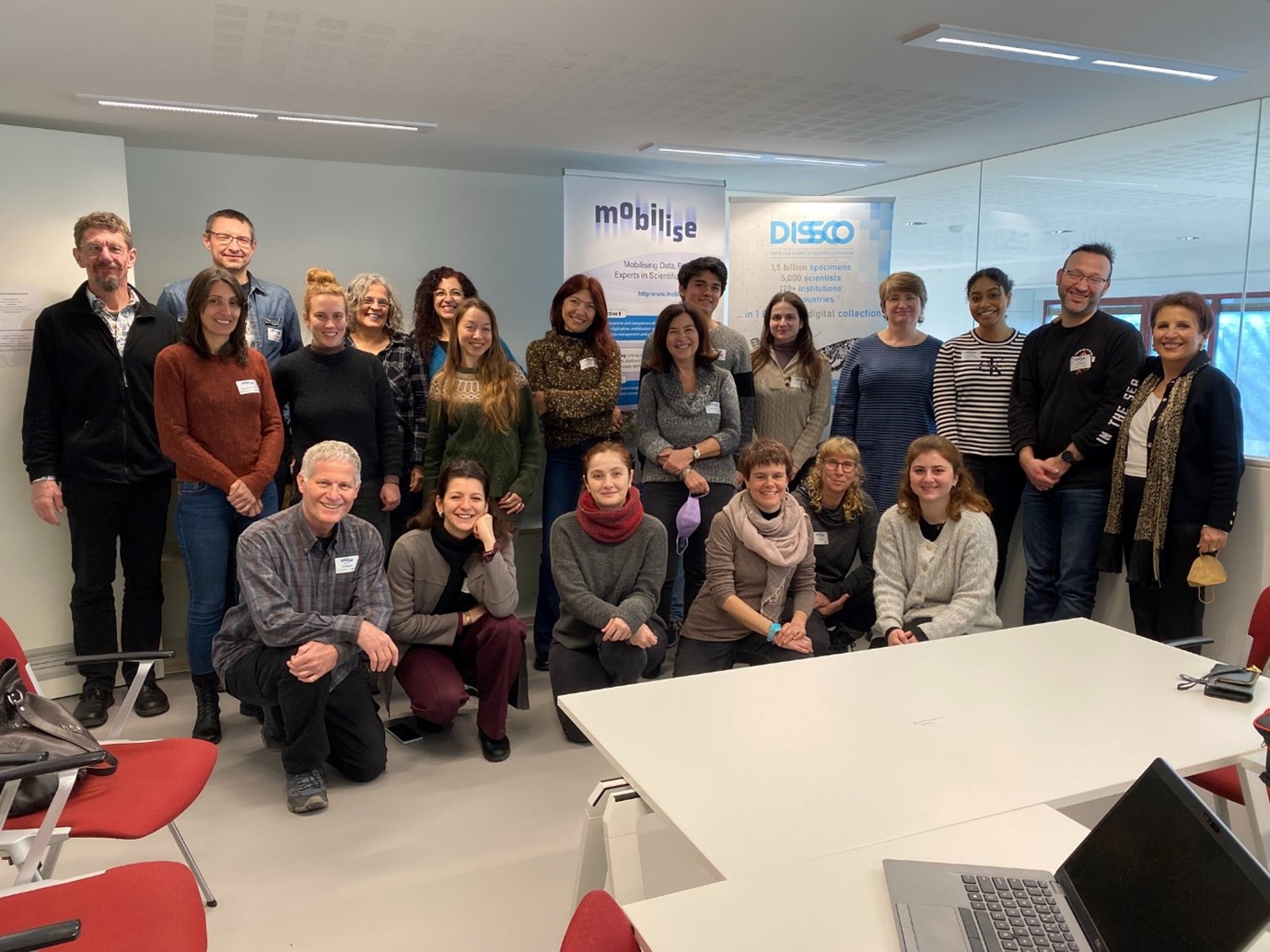
A group photo of the 21 attendees and group leaders at the 4th MOBILISE Action Training School, Brussels
Figure: 1 A group photo of the attendees and group leaders at the 4th MOBILISE Action Training School, Brussels ©Katerina Voreadou
Continue reading →

Listening and learning: Reflections on the Second Workshop of the People and Plants Project

Written by Fiona Roberts. Collaborative ESRC PhD student, Cardiff University and Amgueddfa Cymru-National Museum Wales Decolonising biocultural curation of South Asian medicinal plants.

Monday 7th November, National Museums Collections Centre

In early November, a group of academics, researchers, curators, artists and knowledge holders gathered at Edinburgh’s National Museums Collections Centre. The second workshop of the year-long AHRC-funded ‘People and Plants’ project focused on ‘reactivating ethnobotanical collections as material archives of Indigenous ecological knowledge.’

During the object handling session (Photo by Dr Ali Clark, National Museums Scotland)

The People and Plants Project

Led by National Museums Scotland, Royal Botanic Gardens, Kew and the Powell-Cotton Museum, the project investigates current debates on decolonising museum practices, including the interplay between natural history and ethnography collections, creating a conversation about these among varied experts.

The project’s previous workshop, held at the Powell-Cotton Museum in March 2022, brought together Somali knowledge holders from UK diasporic communities and was run in partnership with the University of Kent’s School of Anthropology and Conservation and the NOMAD project, which engages Somali communities in heritage projects. To read more, see this previous blogpost, and view workshop talks on YouTube [People and Plants – YouTube].

Continue reading →

A Collection of Sri Lankan Bird Skins.

Written by Eimear Ashe, Documentation Officer, National Museum of Ireland – Natural History.

The Temporary Number

During the course of my work in the Natural History Division of the National Museum of Ireland, (NMI) I came across a couple of boxes of bird skins that were in the wrong place. By deciding to move them to their correct place, I opened a metaphorical can of worms. It turned out that these 200 bird skins had been assigned modern numbers during a volunteer project 16 years ago. In the intervening period, the original accession number had been discovered. Never one to leave a wrong number in place, I took on the challenge to renumber this collection before rehousing them.

The Donor

First, I read the acquisition register and found the donor to be a gentleman named Colonel James Grove White, a career British Army officer. Upon retirement, Grove White came to live in Co. Cork in the south of Ireland, and like many British men in Ireland at that time, he came to hold high office during various periods, and was very active in the local community. It was during his time in Ireland, almost 100 years ago, that he donated his collection of “Ceylonese” bird skins. Presumably these were collected by him while on duty in Sri Lanka, although there is no documentation in the NMI to contribute the field collection details, other than the labels on the birds themselves.

Continue reading →

A Sunfish, a Sheriff and a Register

By Eimear Ashe, Documentation Officer, National Museum of Ireland – Natural History.

NatSCA friends, I’d like to tell you a little about our current Inventory Project in the National Museum of Ireland (NMI) – Natural History. But first, back in 2009-2017, we ran a project that allowed us to catalogue 170,000 specimens in our collections management system (Adlib). We proposed another project to continue these efforts. The start date of the project regrettably coincided with the pandemic as well as the untimely loss of a key colleague (Dr Matthew Parkes). We regrouped and decided to postpone the physical inventory of objects and instead to focus on the work that could be done remotely by the team of inventory assistants.

On this project, I manage a team of three contracted inventory assistants. The cataloguers work on Natural History for two or three days per week, and other NMI projects for the rest of their week. I spend one full day each week doing project-related work, that is, supervision, answering queries, checking work and reporting.

Continue reading →

Creating the River Otter Beaver

Written by Jazmine Miles Long, Ethical Taxidermist, Artist, Educator and Natural History Restorer, https://www.jazminemileslong.com, Twitter: @TaxidermyLondon; Instagram: @Jazmine_miles_long

Jazmine with the River Otter Beaver in process

In April 2019 Holly Morgenroth (Collections Officer at The Royal Albert Memorial Museum) gave me a call to say she had acquired a dead beaver that was in good condition for taxidermy. This was significant because this beaver was part of the River Otter Beaver Trial. All deceased beavers should now be sent to the Zoological Society of London for medical autopsies, which means they are usually not in good enough condition for taxidermy after the procedure. This particular beaver, originally from a population of beavers in Scotland, had been introduced to the River Otter in April 2019 to expand the gene pool of the population. Sadly she was found dead – it is possible she drowned in salt water as there were no visible injuries from conflict or a road traffic accident. Devon Wildlife Trust decided she did not need a post mortem and very kindly handed her over to Holly at the museum. Holly jumped at the opportunity and expertly packed her into a large plastic tub and placed her in the museum’s chest freezer and got to work obtaining funding to have her processed into taxidermy and a full skeleton.

Continue reading →