Designated Status for Ipswich Museums’ Post-Cretaceous Geology Collection.

Written by Dr Simon Jackson, Collections and Learning Curator (Natural Sciences), Colchester + Ipswich Museums.

Ipswich Museums’ Post-Cretaceous Geology Collection, which includes our outstanding ice age collection, has been awarded Designated status by Arts Council England. The team here are delighted!

“OK, what exactly is Designation?” some of you may be thinking… Well, the scheme is administered by Arts Council England and identifies the pre-eminent collections of national importance held in England’s non-national museums, libraries and archives, based on their quality and significance. So, this award is a mark of distinction which is useful, for instance, in securing funding. If this has piqued your interest, and, for instance, you may be thinking “perhaps my collection is eligible for the scheme?” you can read more about Designation here: Designation Scheme | Arts Council England or my 2020 paper about the Tullie House bid I led on then, here https://www.natsca.org/article/2578 .

So, what’s been Designated at Ipswich? The Ipswich Post-Cretaceous Geology Collection includes c.30,000 specimens. The greatest strength of the collection includes Suffolk Plio-Pleistocene fossils, the remains of animals which lived during the Pleistocene ice age, and the warmer Pliocene before it. Suffolk has an outstanding Plio-Pleistocene record, with the only exposures of the Coralline Crag (Middle Pliocene) and extensive exposures of the Red Crag (the only exposed British deposit to document the transition into the ice age). The county’s deposits also document the dramatically changing environments of the ice age between warmer, wetter episodes (interglacials) and colder, drier episodes (glacials).  With pre-eminent collections covering this period, the collection now attracts international research, which, for instance, includes searching for the oldest mammoth DNA from Europe in c. 200,000 year old teeth from Suffolk – research led by the Centre for Palaeogenetics, at the Stockholm University and the Swedish Museum of Natural History, and the NHM). You can read more about the project here: https://cimuseums.org.uk/mammothdna/

Continue reading

Meet the NatSCA Committee – Patti Wood Finkle

Written by Patti Wood Finkle, Collections Manager at the Earth and Mineral Sciences Museum & Art Gallery at the Pennsylvania State University, in State College, Pennsylvania, USA.

Name

Patti Wood Finkle

What is your role on the NatSCA committee?

I am an ordinary committee member and have volunteered to lead the conference planning committee next year.

Job title and institution

Collections Manager at the Earth and Mineral Sciences Museum & Art Gallery at the Pennsylvania State University, in State College, Pennsylvania, USA.

Twitter username

I don’t have a twitter account, but I am a co-host on The M Files Podcast, a museum-centric podcast that my colleagues and I started during the pandemic to help museum professionals connect and learn more about other museums. Basically we get to meet new people and chat about how much we enjoy working in museums.

Tell us about your day job

In my current roll, I work with rocks, minerals, fossils, meteorites, man-made composites, industrial paintings and prints, as well as historic scientific instruments and equipment. We have a wide-ranging collection and there are always things to do, whether it is updating the current database with images and information, accessioning an incoming collection, or writing exhibit text (and I’ve done all three this week). A large part of my job is collections based, but with a staff of two, it is important to manage our time wisely and both of us take on tasks such as tours, guest lectureships, exhibit planning and development, supervising our student workers, and working with our parent institution. I also work with students and facilitate partnerships with faculty and student organizations whenever possible.

Natural science collections are very popular with museum visitors. Why do you think this is?

Because natural science is amazing! To see, in person, how large a whale is, how brilliantly a gem may sparkle, how beautiful a beetle can be is exhilarating. Screens and computers can only show you so much, but to see the things for yourself is authentic and tangible. It fuels our curiosity and our wonder. The number of times I have heard both children and adults walk into a natural science gallery and exclaim “WOW!”, sometimes under their breath and sometimes out loud, is affirmation of the power of these collections to continue to awe and educate visitors of all ages.

Continue reading

NatSCA Digital Digest – March 2023

Welcome to the March edition of NatSCA Digital Digest.

Compiled by Olivia Beavers, Assistant Curator of Vertebrate Zoology at World Museum, National Museums Liverpool.

A monthly blog series featuring the latest on where to go, what to see and do in the natural history sector including jobs, exhibitions, conferences, and training opportunities. We are keen to hear from you if you have any top tips and recommendations for our next Digest, please drop an email to blog@natsca.org.

Sector News

NatSCA Conference 2023

Registration is open for the Annual Conference & AGM of the Natural Sciences Collections Association will be held on Thursday 27th and Friday 28th April 2023. Stoke-on-Trent Museums will be hosting the conference at The Potteries Museum & Art Gallery. The conference will include gallery and collection tours, presentations, poster sessions and the annual AGM. The focus this year is:

So how do we actually do all this? Hopeful futures and turning theory into practice for big issues in natural history collections

This is the “How To…” conference for people working with natural history collections. The last few years have seen unprecedented changes in the expectations for what the museum sector can deliver. Global and local social and environmental issues have coincided to reinforce the needs of museums to consider their reinvention and relevance.

Register via Eventbrite through the NatSCA website: https://www.natsca.org/natsca2023. Members can access discounted booking rates by entering a promo code which has been distributed. If you are a NatSCA member and have not received a code via email, please contact membership@natsca.org. We look forward to seeing you in April!

SPNHC Conference

The 38th Annual Meeting of The Society for the Preservation of Natural History Collections is being held in San Francisco, California 28 May – 2 June 2023. Full details here.

Unnatural History Museum session

This session will be held on 22nd March 2023 on the topic of decolonising natural history museums. 

“We are at a crucial historical moment, in which the International Union for Conservation of Nature Red List has announced a catastrophic decline in global biodiversity. Yet nature is, necessarily, interpreted in museums, through taxidermy dioramas and skeletal mounts; virtual tours and digital databases; image, text and film. The Unnatural History Museum brings together museum professionals and academics across disciplines to platform vital conversations about the museum mediation of the natural world during the sixth mass extinction.”

Each session is hosted on Zoom to allow for international participation, and takes the format of short presentations focussed around a specific theme, followed by a synthesised Q&A and roundtable discussion. To register and find out more click here.

Continue reading

Natural History Museums for a World in Harmony with Nature: Now’s the Time!

Written by Henry McGhie, Curating Tomorrow, henrymcghie@curatingtomorrow.co.uk.

Bio: Henry McGhie has a background as an ecologist, museum curator and manager. He set up Curating Tomorrow in 2019 to help empower museums and their partners to contribute to sustainable development agendas, including the Sustainable Developmet Goals (SDGs), climate action, biodiversity conservation, Disaster Risk Reduction and human rights. He is a member of the ICOM Sustainability Working Group, and a Churchill Fellow working on these topics.

This blog post takes in some of the developments over the last couple of years, and sets out some current opportunities for museums with natural history collections to strengthen their contributions to environmental sustainability.

Let’s cast our minds back to 1992, over thirty years ago now, when representatives of all countries agreed to take action in three areas. This was the Rio Earth Summit, which adopted the Convention on Biological Diversity, the Framework Convention on Climate Change (the grandparent of the Paris Agreement) and the Convention to Combat Desertification. It’s entirely possible you may not even have heard of all of these, but don’t worry you’re far from alone. While governments signed onto these agreements, they were broad, framework agreements. It is true that governments were supposed to take the lead in these, and other agreements, but surely sectors – including museums – don’t need to wait to be asked? However, the agreements have just not been turned into action, and that is a fault of governments, but also of the sectors, that could have gained a lot by saying ‘we have something to contribute here’. What I’m proposing isn’t just that museums take up these agreements to look good, sound good, show off, or compete with one another or with other sectors, but to use them as practical tools.

Why? Because connecting with the big picture and international agreements helps museums to:

  • Shape their programmes and activities, to provide people interested in these topics with educational and participatory activities.
  • Put their unique resources to good use in pursuit of positive social and environmental outcomes.
  • Play a significant and distinctive part in an ambitious programme for a better world.
  • Build partnerships and collaborations, with one another and with other sectors, working to shared goals.
  • Create and demonstrate impact, showing that museums and collections are not a nice-to-have, but essential players in securing a future in harmony with nature.
Continue reading

Flora Explorer: Opening the Cabinets at Portsmouth Museums.

Written by Violet Nicholls, Assistant Curator (Herbarium), Portsmouth Museums.

Plants, lichens and fungi have captured the interests of collectors, scientists and artists for centuries, and I have discovered something about them for myself. As time passes from them being found in the field, they don’t get any less complicated, any less fascinating or any less beautiful. I am about 6 months into a two-year project working on the Guermonprez Herbarium called “Flora Explorer”, which is funded by the Headley Trust.

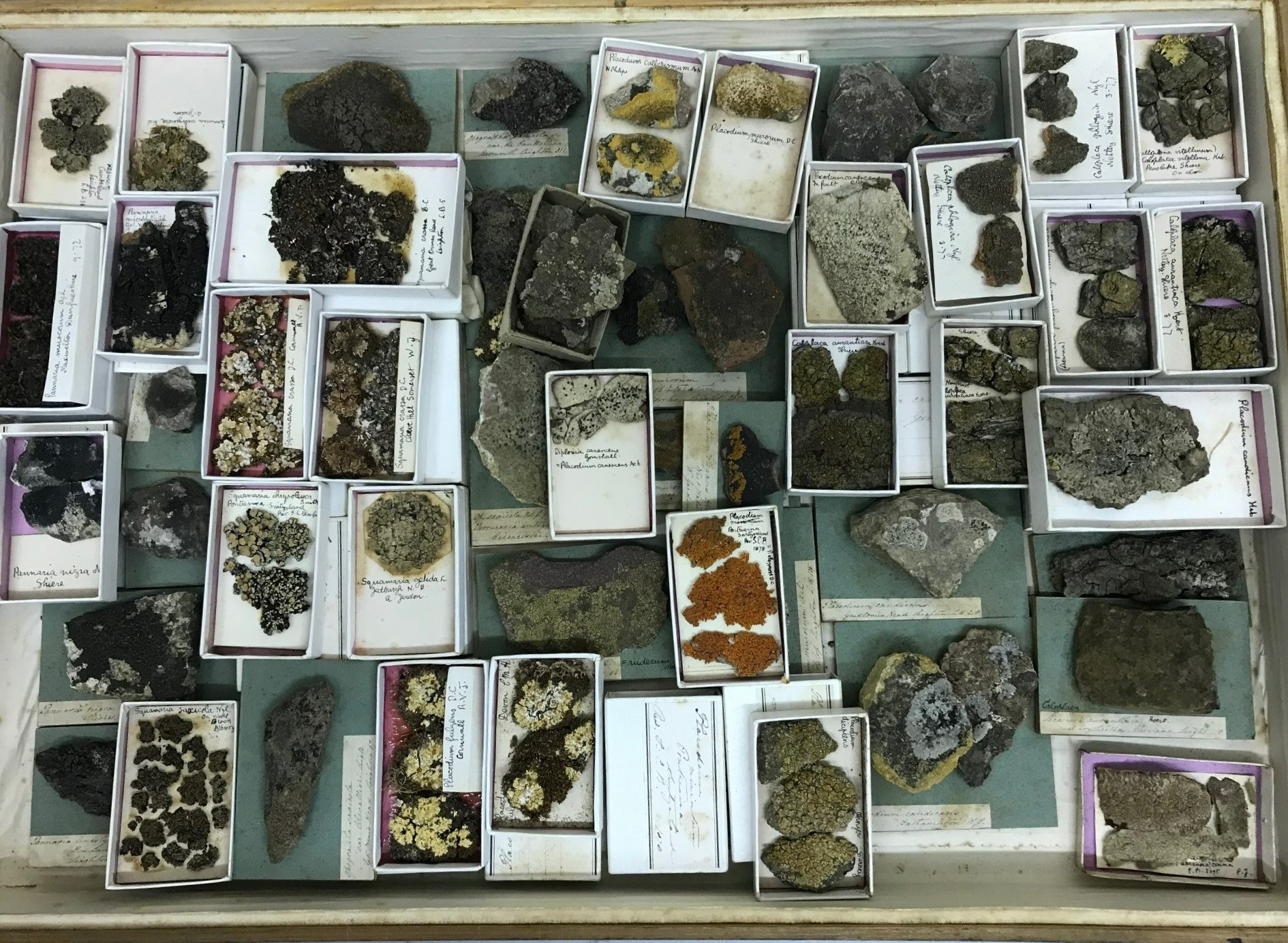
Image of lichen specimens in open trays
Fig. 1. Drawer of colourful specimens from the lichen cabinet.

The Herbarium

I have been cataloguing and studying the plant, fungi and lichen collections at Portsmouth Museums, and am learning a huge amount about past collecting practices, as well as taxonomy and the collectors themselves. There were so many! Sixty-two different names have cropped up whilst cataloguing the herbarium, with nearly 1000 plant specimens recorded on the database so far. There are around 10,000 plants in the Guermonprez Herbarium in total. How many more names will appear?

Henry Leopold Foster Guermonprez (1858-1924) was a taxidermist, ornithologist and “a botanist who should have been better known”.1 The herbarium is made up of plants collected by Guermonprez and members of his family, plants that were sent to him, and others that were purchased. The large collection was transferred from Bognor Regis Museum to Portsmouth Museum in the 1970’s. Many specimens were collected from West Sussex, where I have lived for most of my life.

“Flora Explorer” builds on work carried out during the “Wild about Portsmouth” project, funded by the National Lottery Heritage Fund. The herbarium is organised into taxonomic order, stored in sealed herbarium cabinets, and the specimens are being catalogued using the relational database used by over 650 museums in the UK, Modes Complete. Digitising the collection has many benefits as it increases access for researchers, and for people who may need the data but can only obtain it remotely. Through the process I have also been updating the taxonomy where necessary, which adds further value to the collection.

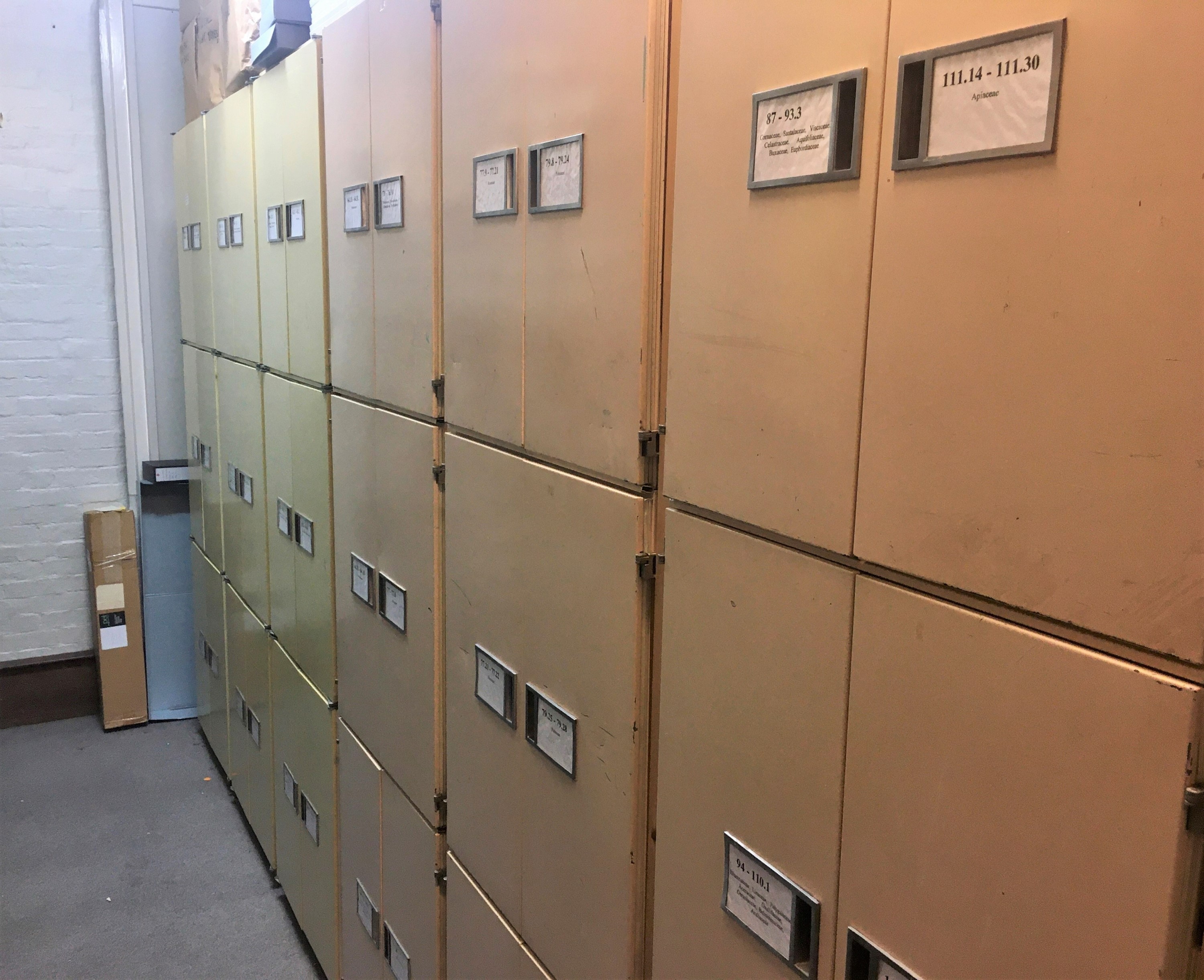
Image of herbarium cabinets at Portsmouth City Museum
Fig. 2. Herbarium cabinets at Portsmouth City Museum, containing plant specimens arranged into taxonomic order.
Continue reading