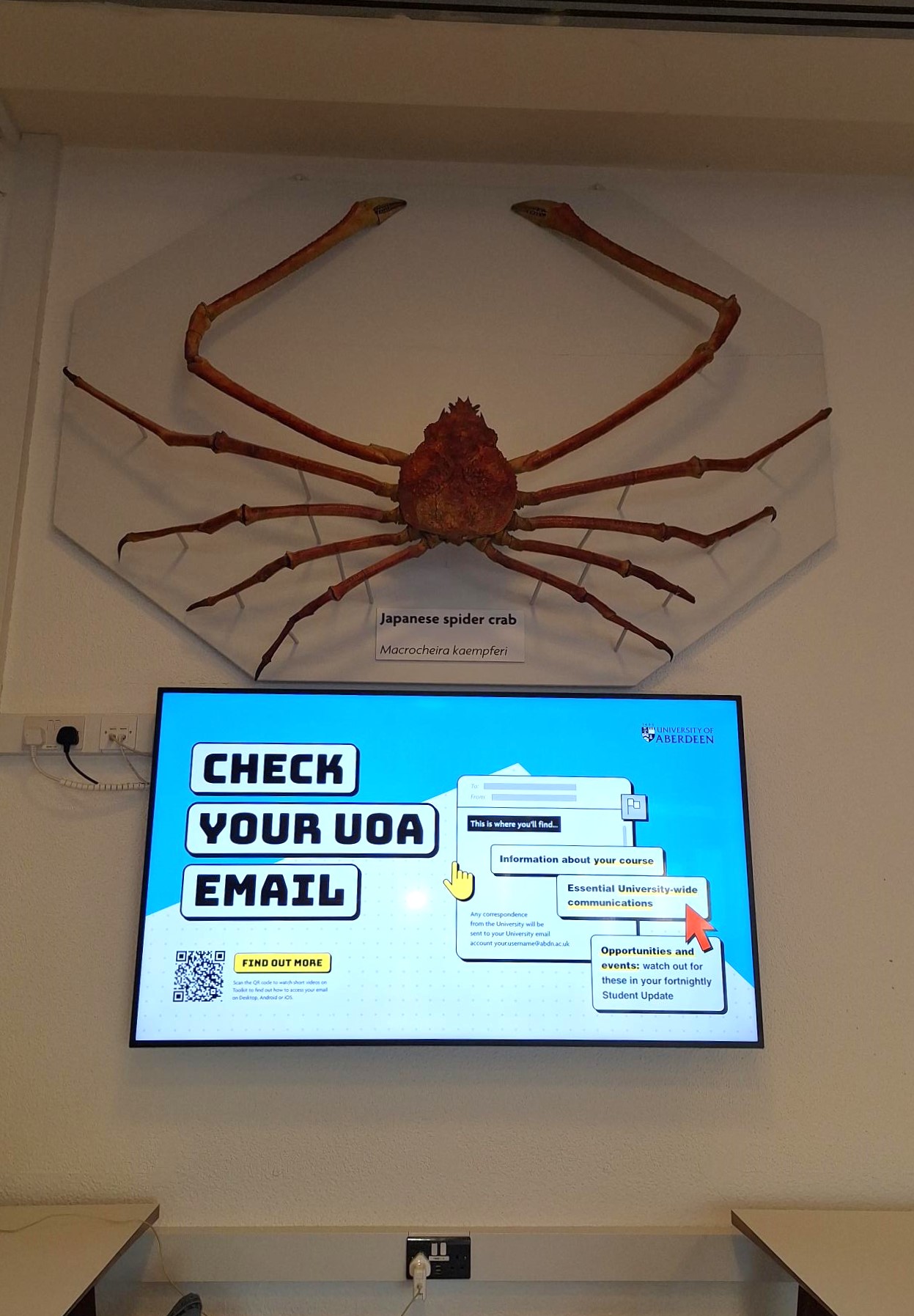
Moving a ‘Monster’ – the Ups and Downs of Exhibiting a Japanese Spider Crab

Written by Hannah Clarke – Assistant Curator (Collections Access), University of Aberdeen.

In May this year, I was given the slightly terrifying task of overseeing the removal and transportation of Aberdeen University’s much-loved Japanese Spider Crab (Macrocheira kaempferi) specimen. The crab, who is usually proudly displayed in the foyer of the University’s Zoology Building, had been requested for loan by Aberdeen Art Gallery & Museums, for their exciting new exhibition ‘Monsters of the Deep.’

The crab had previously been removed during renovation work in 2019, without hiccup, so recalling how ‘straightforward’ this had been last time, I was confident that we could get the crab removed, cleaned, packed, and ready for transport in just under three days.

Continue reading

A Time Capsule of Extinction: Scotland’s Iconic Wildlife

Written by Caitlin Jamison, Museum Collection Technician, Montrose Museum: ANGUSalive.

Montrose Museum in Angus, northeast Scotland, houses an impressive natural history collection. Everything from taxidermy to fossils to rare minerals are housed in a modest, Greek-revival style museum off the high street. Built in 1842, it is one of the first purpose-built museums in Scotland.

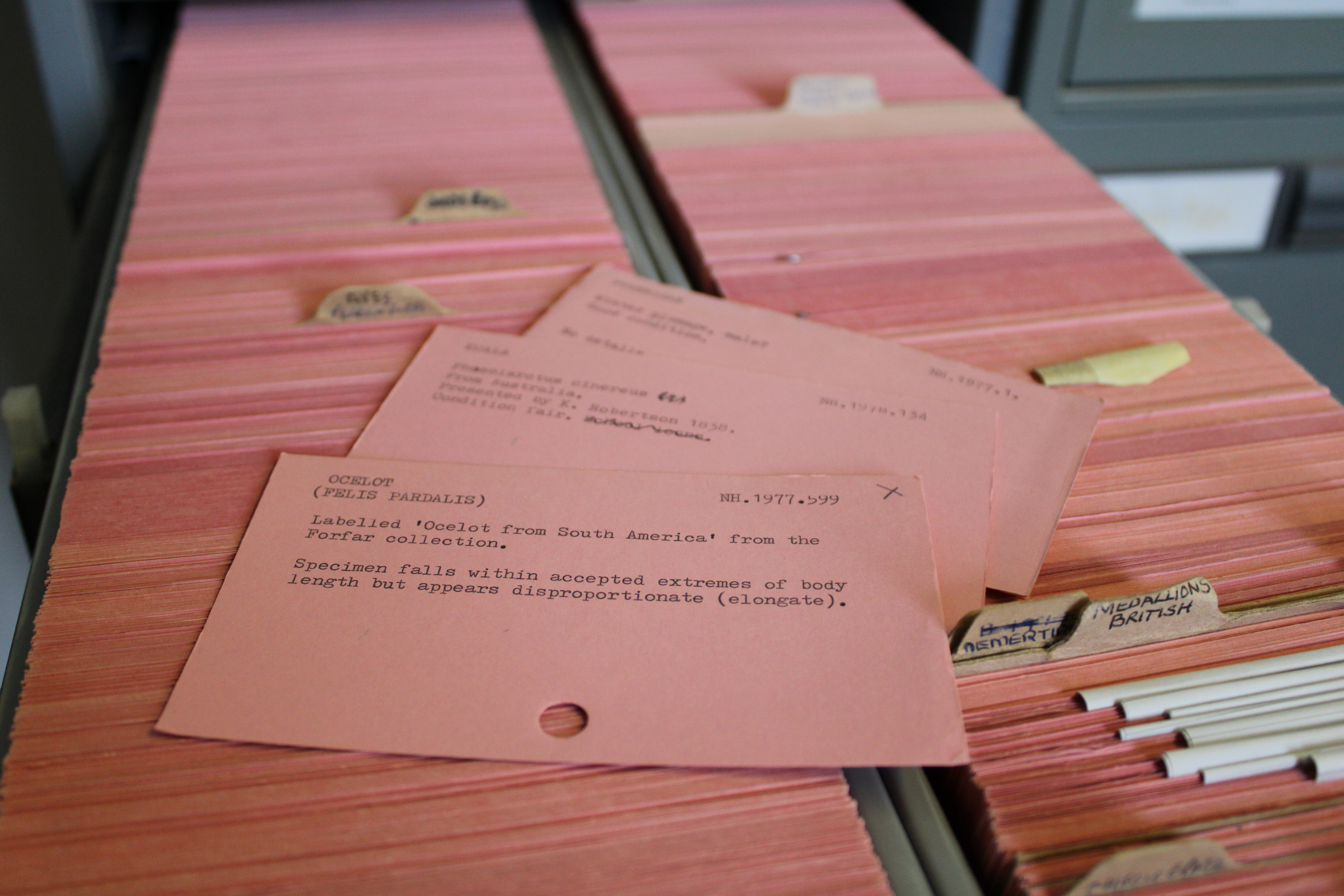
Sadly, due to changing public interest (and the challenging funding situation facing many local authority museums) the collection has been somewhat forgotten since it was catalogued onto neat pink index cards in the late 1970s.

Montrose Museum’s 1970s card catalogue (author’s own photo)
Continue reading

Top NatSCA Blogs of 2024

Compiled by Jen Gallichan, NatSCA Blog Editor.

2024 was a great year for the NatSCA blog and we have seen increases in both the number of readers and number of articles submitted. We are now reaching well over 2000 views per month. I want to take this opportunity to thank everyone who contributed an article. The NatSCA blog is driven solely by your contributions, and it is stands as a testament to all the hard work you are doing. I am pleased to say that the 2025 blog calendar is open for business, so drop me a line if you would like to contribute!

To celebrate all your wonderfulness, I am taking this opportunity to highlight the top 10 most read posts from 2024. This year’s line-up feels more diverse that ever, featuring a coelacanth, live dissections, radiocarbon dating, and fluid collections!

In descending order…

Continue reading

NatSCA Digital Digest – January 2025

Compiled by Milo Phillips, Digitisation Co-ordinator at the Royal Botanic Garden Edinburgh.

Welcome to the January edition of NatSCA Digital Digest.

Happy New Year everyone, and welcome to the first Digital Digest of 2025.

Digital Digest is a monthly blog series featuring the latest on where to go, what to see and do in the natural history sector including jobs, exhibitions, conferences, and training opportunities. We are keen to hear from you if you have any top tips and recommendations for our next Digest, please drop an email to blog@natsca.org.

Sector News

First, we have a few conference deadline reminders for the start of the year:

NatSCA Conference & AGM 2025

The 2025 NatSCA conference Call for Papers is closing soon! The deadline to submit is 5pm GMT Friday 17th January. Get in touch with the committee with any questions (conference@natsca.org). We look forward to reading your submissions!

Making a Difference: Showing the Positive Impact of Natural History Collections

The Annual Conference & AGM of the Natural Sciences Collections Association will be held on Thursday 8th and Friday 9th May 2025 at The University of Manchester, Manchester Museum.

Natural history collections are involved in a huge range of work that has enormous positive impacts on people and the planet – this is a conference to share these stories. The #NatSCA2025 conference invites proposals for presentations looking at impact, how our work is making a difference, how we measure it, how we show success, and how we advocate for collections.

We seek ideas from the natural history collections community, educators, collaborators, and beyond. We are interested in practical lessons, unique solutions, new collaborations, and to show what has and hasn’t worked. We are particularly looking for presentations that share the differences museums are making in:

  • facing global challenges such as the biodiversity and climate crises, and environmental issues
  • improving people’s lives
  • changing laws
  • social justice, restitution, and decolonisation
Continue reading

NatSCA Digital Digest – December 2024

Compiled by Olivia Beavers, Assistant Curator of Vertebrate Zoology at World Museum, National Museums Liverpool.

Welcome to the December edition of NatSCA Digital Digest.

A monthly blog series featuring the latest on where to go, what to see and do in the natural history sector including jobs, exhibitions, conferences, and training opportunities. We are keen to hear from you if you have any top tips and recommendations for our next Digest, please drop an email to blog@natsca.org.

Sector News

NatSCA Conference & AGM 2025

The 2025 NatSCA conference Call for Papers is open! The deadline to submit is 5pm GMT Friday 17th January. In the meantime, don’t hesitate to reach out to the committee with questions. (conference@natsca.org) We look forward to reading your submissions!  

Making a Difference: Showing the Positive Impact of Natural History Collections

The Annual Conference & AGM of the Natural Sciences Collections Association will be held on Thursday 8th and Friday 9th May 2025 at The University of Manchester, Manchester Museum.

Natural history collections are involved in a huge range of work that has enormous positive impacts on people and the planet – this is a conference to share these stories. The #NatSCA2025 conference invites proposals for presentations looking at impact, how our work is making a difference, how we measure it, how we show success, and how we advocate for collections.

We seek ideas from the natural history collections community, educators, collaborators, and beyond. We are interested in practical lessons, unique solutions, new collaborations, and to show what has and hasn’t worked. We are particularly looking for presentations that share the differences museums are making in:

Continue reading